


Gas Prices Just Jumped $0.48 in One Week, and History Says They're Going Higher
Key Points
Gas prices popped in the first week of the Iran conflict and are still moving higher.
Iran's Republican Guard says "not a litre of oil" can travel through the Strait of Hormuz.
Past oil crises in the Persian Gulf imply that prices may not return to normal for years -- unless we get lucky.
- 10 stocks we like better than United States Oil Fund ›
Well, that was certainly unpleasant. From Feb. 28, when bombs started falling on Iran, to March 7 -- the end of the first week of the Iran war -- gasoline prices in the U.S. jumped more than $0.48 to an average of $3.46 per gallon. They're up another $0.42 over the last couple of weeks, hitting $3.88 per gallon on Wednesday evening.
If history is any guide, gas prices aren't coming down anytime soon.
Will AI create the world's first trillionaire? Our team just released a report on the one little-known company, called an "Indispensable Monopoly" providing the critical technology Nvidia and Intel both need. Continue »

Image source: Getty Images.
A historical guide to oil shocks
Oil prices are rising on a supply shock. Iran's Islamic Revolutionary Guard Corps has vowed that "not a litre of oil" will move through the Strait of Hormuz without its say-so. In response, the Trump administration says it's considering providing U.S. Navy escorts for tankers transiting the Strait. Three weeks into the war, however, it seems in no hurry to start.
What does this mean for the price of oil -- and gasoline? History gives us several examples of similar supply shocks, most originating in the same Persian Gulf where today's troubles are unfolding.
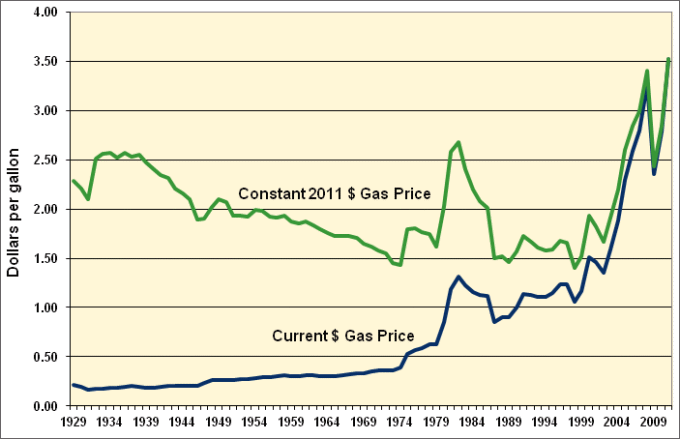
Image source: U.S. Department of Energy.
If you examine a chart of historic gas prices, you'll notice big jumps in gasoline prices around the time of the 1973 OPEC oil embargo, the 1979 Iranian Revolution that ousted the Shah, and also "Gulf War 1," when U.S. and coalition forces ejected Iraq from Kuwait and Saddam Hussein's army set the Kuwaiti oilfields on fire.
1973 OPEC oil embargo
Over a near-50-year history, it's hard to discern precise effects, but I can sketch them out. In 1973, after OPEC embargoed oil shipments to punish the U.S. for supporting Israel, gas prices initially didn't rise much -- only 10% to $0.39 per gallon, according to Department of Energy data. Prices really shot up in 1975, though, to $0.53 (a 47% increase from 1973).
They haven't returned to such low levels since.
1979 Iranian Revolution
Gas prices averaged $0.63 in 1979, when the Shah was ousted. Prices surged 36% to $0.86 per gallon in 1980, then leapt another 38% (89% total) in 1981. It would be another six years -- 1987 -- before prices returned to 1980 levels.
1979's gas price would never be seen again.
1990 Gulf War 1
Gas prices in the U.S. averaged $1 a gallon in 1990 before Saddam Hussein invaded Kuwait. Quick action and multilateral cooperation pushed him back out by 1991, limiting gas price increases to just $1.14 per gallon.
What's more, with Hussein chastened, the Gulf region settled down, and gas prices actually began to fall. They were $1.13 per gallon in 1992, $1.11 in 1993, and still $1.11 in 1994. It was 1995 before inflation returned and oil prices resumed rising.
Future history now
What can investors learn from the above? First, the initial $0.48 jump in gas prices may be only the beginning. The United States Oil Fund (NYSEMKT: USO) ETF is up nearly 50% since the war's start, after all. A year from now, gas prices could be even higher, and prices may not come back down for years -- if ever.
Unless, that is, the current conflict resolves the underlying issue -- namely, a belligerent Iran able to choke off global oil supplies at a whim. If you remove that threat, there's a chance, as in 1991, that gas prices could return to "normal" after the shooting stops.
Keep your fingers crossed.
Should you buy stock in United States Oil Fund right now?
Before you buy stock in United States Oil Fund, consider this:
The Motley Fool Stock Advisor analyst team just identified what they believe are the 10 best stocks for investors to buy now… and United States Oil Fund wasn’t one of them. The 10 stocks that made the cut could produce monster returns in the coming years.
Consider when Netflix made this list on December 17, 2004... if you invested $1,000 at the time of our recommendation, you’d have $494,747!* Or when Nvidia made this list on April 15, 2005... if you invested $1,000 at the time of our recommendation, you’d have $1,094,668!*
Now, it’s worth noting Stock Advisor’s total average return is 911% — a market-crushing outperformance compared to 186% for the S&P 500. Don't miss the latest top 10 list, available with Stock Advisor, and join an investing community built by individual investors for individual investors.
See the 10 stocks »
*Stock Advisor returns as of March 21, 2026.
Rich Smith has no position in any of the stocks mentioned. The Motley Fool has no position in any of the stocks mentioned. The Motley Fool has a disclosure policy.
Recommended Articles


