


How Much Lower Can Opendoor Technologies Stock Go?
Key Points
Opendoor Technologies buys houses and attempts to flip them for a profit, which is typically a very risky business model.
The company lost $1.3 billion during 2025, as tough conditions in the housing market made it difficult to achieve favorable prices.
Opendoor stock is down 53% from its 52-week high, and further downside might be the path of least resistance.
- 10 stocks we like better than Opendoor Technologies ›
Opendoor Technologies (NASDAQ: OPEN) stock hit an all-time low of $0.51 in June last year, before staging an incredible rally that peaked at $10.87 in September. But the rally wasn't driven by the company's fundamentals -- instead, the gains were fueled by retail investors who whipped up a buying frenzy in the stock using social media platforms like X (formerly Twitter) and Reddit.
The stock has since settled at $5.08, and this renewed downtrend looks like it might have legs. Opendoor hired a new chief executive officer (CEO) last year who is trying to revive the company's languishing financial results, but he is aggressively pursuing a strategy that history suggests might not work.
Will AI create the world's first trillionaire? Our team just released a report on the one little-known company, called an "Indispensable Monopoly" providing the critical technology Nvidia and Intel both need. Continue »
Therefore, could Opendoor stock head back to its record low of $0.51? Read on.

Image source: Getty Images.
A concerning track record
Opendoor buys homes and attempts to flip them for a profit. The company entices vendors by giving them a guaranteed price and a quick closing period of around two weeks. This is more convenient than selling through a real estate agent, which is expensive and can sometimes take months with no guarantee of success.
This business model is very fruitful when the real estate market is steadily trending higher, but it can result in substantial losses when housing takes a negative turn, because Opendoor often holds thousands of properties in its inventory.
Competitors like Zillow Group and Redfin learned this the hard way. Both companies shut down their direct buying businesses after the 2021 housing boom ran out of steam. It was a matter of survival in Zillow's case, because its direct buying business was losing so much money that it threatened to take down the entire company.
Opendoor has weathered the peaks and troughs of the real estate market so far, but it has never actually turned a real annual profit (on the basis of generally accepted accounting principles). In fact, it lost a whopping $1.3 billion during 2025, which was a staggering 231% increase from its loss in the previous year.
A not-so-new strategy
Opendoor sold 11,791 homes during 2025 and purchased 8,241 more. Management deliberately acquired fewer homes because of the challenging housing market, with U.S. existing home sales hovering near the lowest level in five years. Plus, according to Redfin, there were 600,314 more sellers than buyers in the real estate market last month, which makes it very hard for companies like Opendoor to move significant volume at favorable prices.
These challenges persist despite the U.S. Federal Reserve cutting interest rates six times since September 2024.
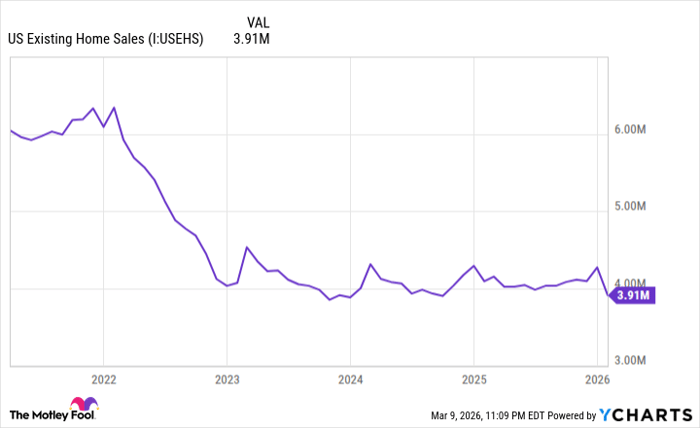
US Existing Home Sales data by YCharts
But the tough conditions haven't deterred Opendoor's new CEO, Kaz Nejatian, who was appointed in September. He previously held leadership roles at PayPal, Shopify, and LinkedIn, so he has a strong background in technology. He thinks Opendoor should be buying more homes right now, not fewer, and he wants to use artificial intelligence to streamline the process and flip each property more quickly.
Nejatian believes boosting volume will give Opendoor more market share, and thus more control over prices. Plus, because it flips homes quickly, their value is less influenced by changes in the broader real estate market. This will reduce the company's exposure to steep losses when house prices fall.
It will take several quarters to determine whether this strategy will work, but I'm not convinced it will turn the company's fortunes around. After all, Zillow was a very high-volume participant in the direct buying industry, and it still couldn't make the numbers work. This business model comes with enormous costs and razor-thin gross profit margins, so there is simply no room for error.
More downside ahead?
Opendoor stock is already down by 53% from last year's peak, and I think the slide will continue. Retail investors have used social media to trigger buying frenzies in many other stocks in the past, with GameStop and AMC being two of the most prominent examples. Most of them have shaky fundamentals, so they never hold their gains, and they typically go on to lose most of their value.
If Opendoor's strategy shift doesn't bear fruit over the next few quarters, I think its stock will continue trending toward its all-time low of $0.51, representing a further potential downside of 90% from here.
Should you buy stock in Opendoor Technologies right now?
Before you buy stock in Opendoor Technologies, consider this:
The Motley Fool Stock Advisor analyst team just identified what they believe are the 10 best stocks for investors to buy now… and Opendoor Technologies wasn’t one of them. The 10 stocks that made the cut could produce monster returns in the coming years.
Consider when Netflix made this list on December 17, 2004... if you invested $1,000 at the time of our recommendation, you’d have $508,607!* Or when Nvidia made this list on April 15, 2005... if you invested $1,000 at the time of our recommendation, you’d have $1,122,746!*
Now, it’s worth noting Stock Advisor’s total average return is 933% — a market-crushing outperformance compared to 188% for the S&P 500. Don't miss the latest top 10 list, available with Stock Advisor, and join an investing community built by individual investors for individual investors.
See the 10 stocks »
*Stock Advisor returns as of March 14, 2026.
Anthony Di Pizio has no position in any of the stocks mentioned. The Motley Fool has positions in and recommends PayPal, Shopify, and Zillow Group. The Motley Fool recommends Reddit and recommends the following options: long January 2027 $42.50 calls on PayPal and short March 2026 $65 calls on PayPal. The Motley Fool has a disclosure policy.
Recommended Articles


