


Oil Stocks Are Surging. Here Are 2 to Buy and Hold for Decades.
Key Points
Buying oil stocks will help protect a portfolio from oil price shocks or a protracted period of high prices.
Both Devon Energy and Diamondback Energy have structured themselves to thrive in a lower oil price environment.
Recent increases in oil prices create significant upside potential.
- 10 stocks we like better than Devon Energy ›
The attacks on Iran have driven oil prices higher and reminded investors that oil stocks are part of a diversified portfolio. The good news is the sector has definitely fallen out of favor in recent years, and despite the recent rise in oil stocks like Devon Energy (NYSE: DVN) and Diamondback Energy (NASDAQ: FANG), they remain excellent value stocks that investors can buy to gain exposure to North American oil production. Here's why.
Good value stocks, whether oil is $80 or $50
Having started the year around $57 a barrel, oil prices have spiked to closer to $88 at the time of this writing. That said, it's incredibly difficult to predict the outcome of the Iran conflict, the implications for oil production and transportation, and, ultimately, where oil prices are headed next.
Will AI create the world's first trillionaire? Our team just released a report on the one little-known company, called an "Indispensable Monopoly" providing the critical technology Nvidia and Intel both need. Continue »

Image source: Getty Images.
But protecting against the possibility of an extended period of high prices makes sense, and it makes even more sense if the stocks are attractive even if oil prices drop back to a $50 handle. The key point is that both companies have adjusted their strategies in light of the downtrend in oil prices that began in fall 2023 and are structured to do well at $50 oil, so anything above that can be seen as a bonus.
Both oil companies are focused on producing at relatively low cost in the U.S., so investors are assured they are not investing in oil-producing regions directly exposed to the Middle East conflict. That said, the issue with domestic producers often comes down to ensuring the corporate break-even price (the oil price required to generate cash flow to fund oil production) is low.
1. Diamondback Energy
For Diamondback, that means focusing on the Permian Basin, being disciplined with capital allocation, and generating operational improvements, such as increasing the productivity of its drilling rigs and developing assets in secondary zones rather than pursuing acquisitions.
That disciplined approach means Diamondback can generate the cash flows to support its base dividend of $4.20 a share (currently yielding 2.2%). Diamondback also uses opportunistic hedging to protect downside exposure to the price of oil and, in doing so, ensure it can continue production. Consequently, management believes its current hedges give it upside exposure to oil prices above $50 a barrel.
2. Devon Energy
Just as Diamondback previously used acquisitions to build scale and generate cost synergies by focusing on developing assets in the Permian, Devon's impending merger with Coterra Energy (announced in early February) will also create significant synergy opportunities in the Delaware Basin (Permian).
Adding Coterra will nearly double Devon's acreage in the Delaware Basin by adding 346,000 acres to its 400,000 acres, resulting in the combined company having the largest share of Delaware Basin inventory with a break-even price of less than $40 a barrel. In addition, the new Devon Energy will have the overwhelming majority of its inventory with a break-even price of less than $50 a barrel.
Stocks to buy
Both stocks trade on extremely low price-to-free cash flow multiples.
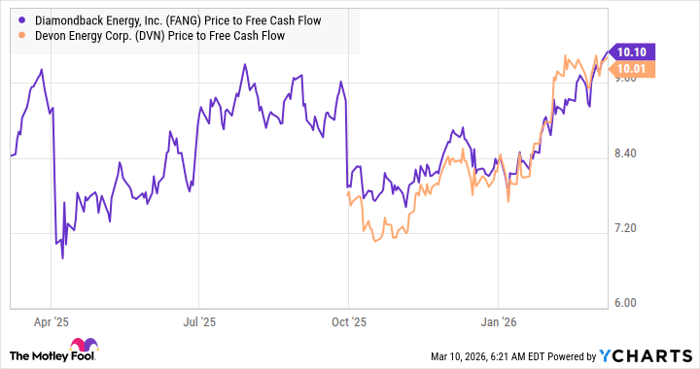
FANG Price to Free Cash Flow data by YCharts
As such, the combination of good valuations, low break-even prices, and upside potential from a protracted period of relatively high prices makes these two stocks compelling buys for investors looking for energy exposure.
Should you buy stock in Devon Energy right now?
Before you buy stock in Devon Energy, consider this:
The Motley Fool Stock Advisor analyst team just identified what they believe are the 10 best stocks for investors to buy now… and Devon Energy wasn’t one of them. The 10 stocks that made the cut could produce monster returns in the coming years.
Consider when Netflix made this list on December 17, 2004... if you invested $1,000 at the time of our recommendation, you’d have $514,000!* Or when Nvidia made this list on April 15, 2005... if you invested $1,000 at the time of our recommendation, you’d have $1,105,029!*
Now, it’s worth noting Stock Advisor’s total average return is 930% — a market-crushing outperformance compared to 187% for the S&P 500. Don't miss the latest top 10 list, available with Stock Advisor, and join an investing community built by individual investors for individual investors.
See the 10 stocks »
*Stock Advisor returns as of March 14, 2026.
Lee Samaha has no position in any of the stocks mentioned. The Motley Fool has no position in any of the stocks mentioned. The Motley Fool has a disclosure policy.
Recommended Articles


