


This Artificial Intelligence (AI) Stock Just Projected $10 Billion in Revenue for 2026. Here's Why It's Just Getting Started.
Key Points
Equinix owns 280 data centers globally, which connect to all the major cloud networks.
It already collects rent from 60% of the Fortune 500, and its revenue is primed for growth driven by AI capex.
Despite a high share price, Equinix pays a solid 2% yield.
- 10 stocks we like better than Equinix ›
Real estate investment trusts (REITs) are a fantastic way to profit from real estate without needing to go through any of the headaches of being a landlord. By law, they must pay out 90% of their taxable income to shareholders as a dividend.
Most REITs own things like apartment buildings or malls. But artificial intelligence (AI), or rather the expenses associated with it, has created a new kind of REIT, one that holds the physical real estate for the digital world.
Will AI create the world's first trillionaire? Our team just released a report on the one little-known company, called an "Indispensable Monopoly" providing the critical technology Nvidia and Intel both need. Continue »
AI needs data centers to run. Unfortunately, data centers are very expensive. EziBlank's estimate puts the price tag of building one at $7 million to $12 million per megawatt of IT load.
That adds up quickly if you want to build a big data center, and it doesn't include the power bill or maintenance costs. Both those things will vary based on location, but neither will be cheap.
Enter Equinix (NASDAQ: EQIX), a data center REIT with an interesting secondary revenue stream.
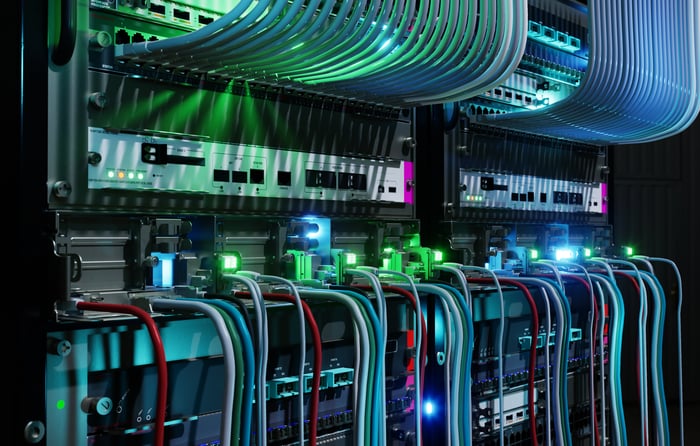
Image source: Getty Images.
Electronic landlord and tollbooth
As a REIT, Equinix generates the bulk of its revenue (roughly 70%) from renting space in its 280 data centers around the world to over 10,500 companies, including 60% of the Fortune 500.
It operates data centers across every single continent except Antarctica, and its services are available in over 65 global metros.
Thanks to its Equinix Fabric Network, all its data centers globally are connected. It also doesn't require any additional hardware on the part of a customer to connect to that network.
The revenue from those data centers is growing both quickly and steadily. It was up 5% over 2024 to $9.2 billion for 2025, and the company is projecting upwards of $10 billion in revenue for 2026.
In the second half of 2025, Equinix saw a dramatic spike in bookings. Third-quarter 2025's bookings grew 14% over the second quarter. Then, in the fourth quarter, bookings grew 20% over Q3.
So, the core of Equinix's business is doing quite well. But the company can leverage its position to generate even more revenue as a tollbooth to the cloud.
Equinix has partnerships with every major cloud provider, including Alphabet's Google Cloud, Amazon Web Services, and Microsoft Azure, among others. It can provide its customers with a direct link to any of those cloud networks.
Customers who pay for the privilege of that direct link (either physical or virtual) to the cloud of their choice enjoy a faster low-latency private internet connection.
Data traveling over that link doesn't touch the public internet at all, which reduces the security risk of using public networks and makes the data harder for hackers to try to intercept.
It's also worth noting that Equinix's adjusted funds from operations (AFFO) grew considerably in 2025 and were up 12% over 2024 to $3.7 billion. That brings me to the main reason any investor would hold a REIT -- the dividend.
Despite the fact that Equinix is trading at $937 as I write this, it still pays a solid quarterly dividend of $5.16 per share that yields 2% at current prices. Equinix has also raised its dividend each year for the past 11 years.
Those are serious increases. The dividend has grown 10% year over year since 2024. That's why, despite the company's almost 9% share price growth over the past 12 months, its dividend yield grew from 1.81% for 2024 to 2.45% for 2025.
Now, on to why Equinix is projecting its revenue growth to accelerate to over $10 billion next year.
Go big or go home
Amazon, Google, and others made waves earlier this year when they projected incredible boosts to their AI spending for 2026. Amazon alone projected $200 billion in capital expenditure (capex) for this year.
Tech giants have data center construction fever. In all, there are already 4,000 data centers in operation across the United States alone, with another 3,000 of them under construction or planned.
But, given the expenses associated with data centers mentioned above, not every company has Amazon-level money to throw at their AI integration. So it will likely make much more economic sense to rent space in an Equinix data center, where they can connect to all the big cloud networks easily without having to spend millions or billions on data centers of their own.
Over 10,000 companies have already done just that, and I don't see that number shrinking given the amount of money being poured into AI hardware. Give Equinix a look to collect a slice of the rent from cyberspace's own landlord.
Should you buy stock in Equinix right now?
Before you buy stock in Equinix, consider this:
The Motley Fool Stock Advisor analyst team just identified what they believe are the 10 best stocks for investors to buy now… and Equinix wasn’t one of them. The 10 stocks that made the cut could produce monster returns in the coming years.
Consider when Netflix made this list on December 17, 2004... if you invested $1,000 at the time of our recommendation, you’d have $530,233!* Or when Nvidia made this list on April 15, 2005... if you invested $1,000 at the time of our recommendation, you’d have $1,119,682!*
Now, it’s worth noting Stock Advisor’s total average return is 955% — a market-crushing outperformance compared to 191% for the S&P 500. Don't miss the latest top 10 list, available with Stock Advisor, and join an investing community built by individual investors for individual investors.
See the 10 stocks »
*Stock Advisor returns as of March 11, 2026.
James Hires has positions in Alphabet. The Motley Fool has positions in and recommends Alphabet, Amazon, Equinix, and Microsoft. The Motley Fool has a disclosure policy.
Recommended Articles


