


Warren Buffett's $187 Billion Warning Shows the Time to Be Fearful When Others Are Greedy Has Arrived
Key Points
Although Warren Buffett retired as Berkshire Hathaway's CEO on Dec. 31, his legacy is still being felt.
Buffett was a net seller of stocks for 13 consecutive quarters -- and stock market valuations explain why.
While Buffett's net selling may be disappointing to some investors, his patience and desire to pounce on price dislocations proved highly profitable for Berkshire Hathaway and its shareholders.
- 10 stocks we like better than Berkshire Hathaway ›
A little over two months ago, on Dec. 31, Berkshire Hathaway's (NYSE: BRKA)(NYSE: BRKB) longtime billionaire boss, Warren Buffett, retired as CEO and handed the reins over to successor Greg Abel. During the Oracle of Omaha's time at the helm, he oversaw a greater than 6,000,000% cumulative return in his company's Class A shares (BRK.A) and ran circles around the Dow Jones Industrial Average (DJINDICES: ^DJI), S&P 500 (SNPINDEX: ^GSPC), and Nasdaq Composite (NASDAQINDEX: ^IXIC).
But even though Warren Buffett is no longer overseeing his company's daily operations or signing off on investments in Berkshire's $319 billion investment portfolio, his legacy is still being tangibly felt.
Will AI create the world's first trillionaire? Our team just released a report on the one little-known company, called an "Indispensable Monopoly" providing the critical technology Nvidia and Intel both need. Continue »
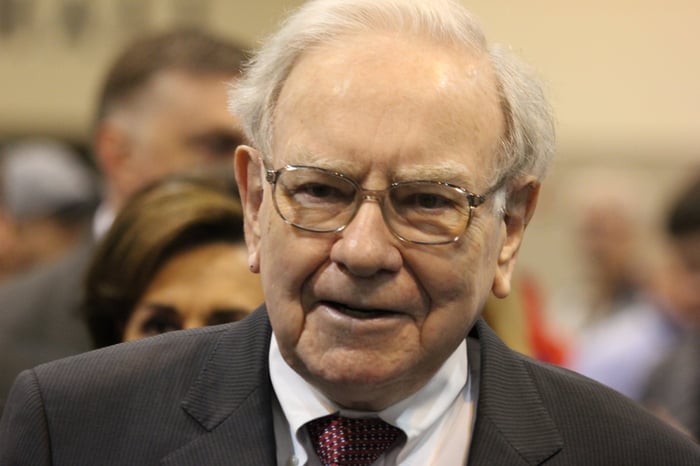
Warren Buffett retired as Berkshire Hathaway's CEO on Dec. 31, 2025. Image source: The Motley Fool.
Last weekend, on Feb. 28, Berkshire Hathaway unveiled its fourth-quarter operating results, covering Buffett's last full quarter as CEO. This report highlighted a historic $187 billion warning to Wall Street and strongly suggests that the time to be fearful when others are greedy is here.
The Oracle of Omaha goes out with a $187 billion warning to Wall Street
Berkshire Hathaway is a conglomerate with a lot of moving parts. The trillion-dollar company that Buffett and now-late right-hand man Charlie Munger helped build owns around five dozen businesses, including insurer GEICO and railroad operator BNSF, and has a $319 billion investment portfolio. Although Berkshire owns assets that generate billions of dollars in profits, it's the investment portfolio that oftentimes receives the most attention.
Many of the Oracle of Omaha's unwritten investing rules set him and his shareholders up for success. He focused on the long term, sought out businesses with strong management teams and sustainable moats, and typically gravitated to companies with hearty capital-return programs.
But in the years leading up to his retirement, Warren Buffett was a net seller of stocks every quarter:
- Q4 2022: $14.64 billion in net-equity sales
- Q1 2023: $10.41 billion
- Q2 2023: $7.981 billion
- Q3 2023: $5.253 billion
- Q4 2023: $0.525 billion
- Q1 2024: $17.281 billion
- Q2 2024: $75.536 billion
- Q3 2024: $34.592 billion
- Q4 2024: $6.713 billion
- Q1 2025: $1.494 billion
- Q2 2025: $3.006 billion
- Q3 2025: $6.099 billion
- Q4 2025: $3.164 billion
For 13 consecutive quarters, beginning Oct. 1, 2022, Buffett sold more stocks than he purchased, to the cumulative tune of $186.7 billion. If Wall Street's most-renowned long-term value investor is a persistent seller of stocks, something is amiss on Wall Street.
The time to be fearful when others are greedy has arrived
The Oracle of Omaha's net selling spanning more than three years leading up to his retirement can be explained in one word: value.
Value is one thing Warren Buffett refused to compromise on or waver from. He occasionally made a short-term trade or bought a heavily indebted business, but he never purchased a stake in a company he didn't perceive to be a good deal. The problem with the stock market is that good deals are increasingly hard to come by.
Although value is subjective (i.e., what one investor finds pricey might be viewed as a bargain by another), several historical valuation tools point to this being an incredibly pricey stock market.
Warren Buffett Indicator hits an all-time high of 224%, the most expensive stock market valuation in history 🚨🚨 pic.twitter.com/BgIiOkFlfl
-- Barchart (@Barchart) January 11, 2026
For example, the market cap-to-GDP ratio, which you might know better as the Buffett indicator, recently hit an all-time high. This valuation metric, favored by Berkshire's now-former boss, adds up the market value of all publicly traded U.S. stocks and divides the total by U.S. gross domestic product (GDP).
When back-tested to December 1970, the Buffett indicator has averaged 87% -- i.e., the value of all stocks has equaled 87% of U.S. GDP. In January 2026, the Buffett indicator topped 221%, signaling just how pricey stocks are, relative to history.
The S&P 500's Shiller Price-to-Earnings (P/E) Ratio tells a similar story. This Shiller P/E, also known as the Cyclically Adjusted P/E Ratio (CAPE Ratio), has averaged 17.3 when back-tested over 155 years. It's spent the last four months bouncing between 39 and 41, making this the second-priciest stock market in history behind only the dot-com bubble.
Buffett's 13 consecutive quarters of net selling were his way of signaling Wall Street and investors that stock valuations no longer made sense. In short, the time to be fearful when others were being greedy had arrived.
Image source: Getty Images.
Patience and price dislocations are a recipe for success
On some level, it's disappointing to see one of Wall Street's greatest investors sitting on his proverbial hands and building up Berkshire Hathaway's cash pile to a near-record level of $373.3 billion. Buffett's $187 billion warning intimates that the Dow Jones Industrial Average, S&P 500, and Nasdaq Composite will undergo significant corrections.
But you might be surprised to learn that being patient and waiting for price dislocations to materialize was an effective moneymaking strategy for Berkshire's now-retired boss over more than half a century.
For instance, Bank of America (NYSE: BAC) has been one of Buffett's most profitable ventures on a nominal-dollar basis. He initially purchased $5 billion in preferred BofA stock in August 2011, with Bank of America receiving $5 billion to shore up its balance sheet in the wake of the financial crisis. This initial purchase took place with BofA's common stock valued at a 62% discount to book value.
In mid-2017, Berkshire exercised 700 million Bank of America warrants at $7.14 per share, netting an instant $12 billion windfall that has since grown. Buffett's company made a jaw-dropping profit (some of which has been realized) thanks to his willingness to pounce on price dislocations.
With $373 billion in available capital and a new CEO (Greg Abel) whose investment philosophy is modeled very closely to that of Warren Buffett, patience and price dislocations are likely to remain Berkshire Hathaway's recipe for success.
Should you buy stock in Berkshire Hathaway right now?
Before you buy stock in Berkshire Hathaway, consider this:
The Motley Fool Stock Advisor analyst team just identified what they believe are the 10 best stocks for investors to buy now… and Berkshire Hathaway wasn’t one of them. The 10 stocks that made the cut could produce monster returns in the coming years.
Consider when Netflix made this list on December 17, 2004... if you invested $1,000 at the time of our recommendation, you’d have $532,066!* Or when Nvidia made this list on April 15, 2005... if you invested $1,000 at the time of our recommendation, you’d have $1,122,072!*
Now, it’s worth noting Stock Advisor’s total average return is 959% — a market-crushing outperformance compared to 193% for the S&P 500. Don't miss the latest top 10 list, available with Stock Advisor, and join an investing community built by individual investors for individual investors.
See the 10 stocks »
*Stock Advisor returns as of March 6, 2026.
Bank of America is an advertising partner of Motley Fool Money. Sean Williams has positions in Bank of America. The Motley Fool has positions in and recommends Berkshire Hathaway. The Motley Fool has a disclosure policy.
Recommended Articles


