


Is Vertiv Stock a Buy Right Now?
Key Points
Vertiv is likely to outperform as long as AI data center momentum continues to grow.
A discounted cash flow analysis suggests the stock is, at the least, priced to perfection.
- 10 stocks we like better than Vertiv ›
The artificial intelligence (AI) data center investing theme has been on fire over the last year. That said, valuations still matter, and investors need to consider what they are buying when they invest in data center infrastructure companies like Vertiv (NYSE: VRT).
Vertiv's growth keeps exceeding expectations
I last discussed the data center power and thermal management technology stock in mid-January, and it is up 52% since then, up 62% in 2026, and up 185% over the last year. Its remarkable performance consistently exceeds expectations for revenue and, importantly, order growth.
Will AI create the world's first trillionaire? Our team just released a report on the one little-known company, called an "Indispensable Monopoly" providing the critical technology Nvidia and Intel both need. Continue »

Image source: Getty Images.
The order growth continues to generate a massive increase in backlog (as shown below), and given the recent capital spending commitments made by hyperscalers like Amazon, Alphabet, and Microsoft, it's understandable if investors start penciling in more growth over the medium term.
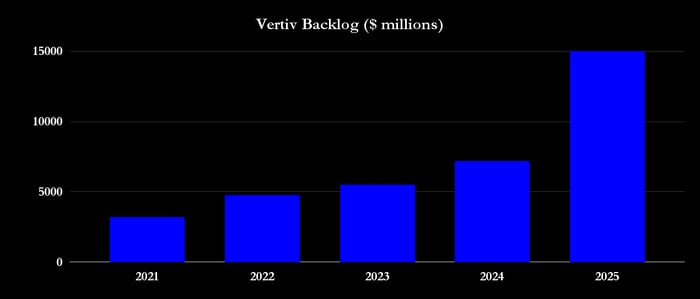
Data source: Vertiv presentations. Chart by author.
Wall Street expectations for Vertiv
Wall Street has already started upgrading estimates, with the consensus (shown below) for 2026 matching Vertiv management's recent estimate of $2.1 billion to $2.3 billion in free cash flow (FCF).
Here is a truncated discounted cash flow analysis reverse-engineered to determine the terminal growth rate required to justify the current enterprise value of $100 billion. I've used Wall Street consensus FCF to 2028, and assumed 14% and 15% growth (g) in line with market expectations for data center spending, rising from $1 trillion in 2026 to $1.7 trillion in 2020. I've used a weighted average cost of capital (WACC) of 9%, which is in line with an industrial technology company.
|
Metric |
2026 Est. |
2027 Est. |
2028 Est. |
2029 Est. |
2030 Est. |
|---|---|---|---|---|---|
|
Free cash flow |
$2.287 billion |
$2.669 billion |
$3.543 billion |
$4.048 billion |
$4.648 billion |
|
Discount factor |
0.92 |
0.84 |
0.77 |
0.71 |
0.65 |
|
Present value |
$2.098 billion |
$2.246 billion |
$2.736 billion |
$2.868 billion |
$3.021 billion |
|
Sum of present value for the next 5 years |
$12.97 million |
N/A | N/A | N/A | N/A |
Data sources: Author's analysis, marketscreener.com
Taking the current $100 billion valuation and subtracting the present value of the next five years' FCF of $12.97 billion yields a required present value of $87 billion. This gives a terminal value (TV) of $87 billion × (1.09)^5 = $134 billion.
Using Terminal Value = FCF in 2030*(1+g)/(WACC-g), we can solve for g given a TV of $134 billion, a 2030 FCF of $4.648 billion, and a WACC of 9%.
Ultimately, g = 5.3%.
In plain English, this means that to justify Vertiv's current valuation, the company's FCF will have to grow by 5.3% from 2030 into perpetuity.
What it means to investors
If you assume the overall economy grows at 3%, a perpetual growth rate of 5.3% implies decades of above-GDP growth, which seems optimistic. Moreover, there are signs of slowing investment commitments with OpenAI reportedly aiming to spend $600 billion by 2030, down from an earlier figure of $1.4 trillion, possibly in response to difficulties obtaining funding.
All told, while AI stocks will trade on near-term momentum and newsflow, and could go higher, a stock like Vertiv looks richly priced and will look even more so if the current growth assumptions aren't achieved. Now is not the time to be piling into the AI center trade.
Should you buy stock in Vertiv right now?
Before you buy stock in Vertiv, consider this:
The Motley Fool Stock Advisor analyst team just identified what they believe are the 10 best stocks for investors to buy now… and Vertiv wasn’t one of them. The 10 stocks that made the cut could produce monster returns in the coming years.
Consider when Netflix made this list on December 17, 2004... if you invested $1,000 at the time of our recommendation, you’d have $519,015!* Or when Nvidia made this list on April 15, 2005... if you invested $1,000 at the time of our recommendation, you’d have $1,086,211!*
Now, it’s worth noting Stock Advisor’s total average return is 941% — a market-crushing outperformance compared to 194% for the S&P 500. Don't miss the latest top 10 list, available with Stock Advisor, and join an investing community built by individual investors for individual investors.
See the 10 stocks »
*Stock Advisor returns as of March 3, 2026.
Lee Samaha has no position in any of the stocks mentioned. The Motley Fool has positions in and recommends Alphabet, Amazon, Microsoft, and Vertiv. The Motley Fool has a disclosure policy.
Recommended Articles


