


Why Amazon Stock Lost 12% in February
Key Points
Tech stocks fell broadly in February on fears of AI disruption.
Amazon said it would spend in $200 billion in capex this year.
The company delivered a solid fourth-quarter earnings report.
- 10 stocks we like better than Amazon ›
Shares of Amazon (NASDAQ: AMZN) were heading lower last month as tech investors fretted over AI disruption and balked at Amazon's forecast for $200 billion in capital expenditures this year.
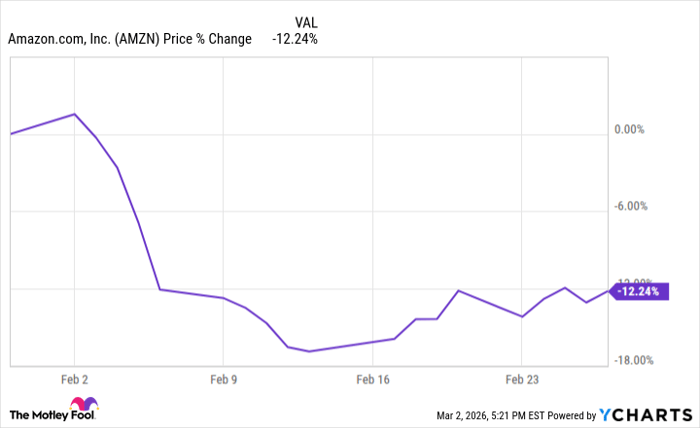
Though the tech giant reported a solid fourth-quarter earnings report, the capex number was enough to send the stock lower following the report, and it stayed down for the duration of the month. According to data from S&P Global Market Intelligence, the stock finished February down 12%.
Will AI create the world's first trillionaire? Our team just released a report on the one little-known company, called an "Indispensable Monopoly" providing the critical technology Nvidia and Intel both need. Continue »
As you can see from the chart below, the stock fell early in the month on the earnings report and stayed down from there.
AMZN data by YCharts
What happened with Amazon
As the chart above shows, the stock was already falling before it tumbled on its earnings report, losing 6%.
Prior to that, shares had been spooked by a broader sell-off in tech stocks that hit software stocks particularly hard, as investors fear that new AI tools from Anthropic and other AI start-ups could disrupt incumbents.
While Amazon doesn't seem directly exposed, as an incumbent and an industry leader, some of its businesses could be at risk.
The big news out last month was the earnings report.
Amazon delivered solid results with revenue up 14% to $213.4 billion and operating income increasing from $21.2 billion to $25 billion. The company reported double-digit growth in all three of its business segments, including 24% growth in Amazon Web Services (AWS), its cloud infrastructure division.
However, Amazon said it planned to spend $200 billion in capital expenditures this year, more than any of its "Magnificent Seven" peers, and enough to lead investors to sell the stock. By contrast, Amazon spent $83 billion in capex in 2025, and spending $200 billion this year will almost certainly drive its free cash flow into the red.

Image source: Amazon.
What it means for Amazon
Amazon has undergone previous cycles of capex spending on e-commerce fulfillment centers and on AWS data centers in the past, and always comes out on the other side.
The risk here is that there's an AI bubble, and that the $200 billion in capex never delivers the profit that Amazon expects it to, but its hyperscaler peers are doing the same thing.
Amazon needs to compete in AI, and spending aggressively is table stakes right now. Whether it pays off remains to be seen, but the company's overall growth remains solid, and the stock is reasonably priced at a price-to-earnings ratio of 29.3, which is only modestly more expensive than the S&P 500. There's no reason to panic here.
Should you buy stock in Amazon right now?
Before you buy stock in Amazon, consider this:
The Motley Fool Stock Advisor analyst team just identified what they believe are the 10 best stocks for investors to buy now… and Amazon wasn’t one of them. The 10 stocks that made the cut could produce monster returns in the coming years.
Consider when Netflix made this list on December 17, 2004... if you invested $1,000 at the time of our recommendation, you’d have $519,015!* Or when Nvidia made this list on April 15, 2005... if you invested $1,000 at the time of our recommendation, you’d have $1,086,211!*
Now, it’s worth noting Stock Advisor’s total average return is 941% — a market-crushing outperformance compared to 194% for the S&P 500. Don't miss the latest top 10 list, available with Stock Advisor, and join an investing community built by individual investors for individual investors.
See the 10 stocks »
*Stock Advisor returns as of March 2, 2026.
Jeremy Bowman has positions in Amazon. The Motley Fool has positions in and recommends Amazon. The Motley Fool has a disclosure policy.
Recommended Articles


