


Fed Chair Nominee Kevin Warsh's Biggest Challenge Won't Be Balance Sheet Deleveraging or Interest Rates -- It'll Be Something Far More Important
Key Points
Jerome Powell's term as Fed chair ends on May 15, and President Trump has nominated former Fed Governor Kevin Warsh to succeed him.
Warsh's prior voting record and public critiques of the Fed may put him at odds with Wall Street and President Trump.
However, building Fed credibility amid historic division within the Federal Open Market Committee (FOMC) will be Warsh's greatest hurdle.
- 10 stocks we like better than S&P 500 Index ›
For the better part of the last seven years, Wall Street's benchmark indexes have delivered outsize returns. The benchmark S&P 500 (SNPINDEX: ^GSPC) has only three stretches spanning nearly a century where it's delivered at least a 16% return in three straight years. Two of those three periods have occurred over the last seven years (2019-2021 and 2023-2025).
We've also witnessed the Dow Jones Industrial Average (DJINDICES: ^DJI) eclipse 50,000 and the Nasdaq Composite (NASDAQINDEX: ^IXIC) briefly top 24,000.
Will AI create the world's first trillionaire? Our team just released a report on the one little-known company, called an "Indispensable Monopoly" providing the critical technology Nvidia and Intel both need. Continue »
Despite these exceptionally strong returns, headwinds are piling up for Wall Street. Everything from a historically pricey stock market to the potential for an artificial intelligence bubble-bursting event threatens to weigh on equities.
But these catalysts arguably take a back seat to a historic upcoming shift at America's foremost financial institution, the Federal Reserve.
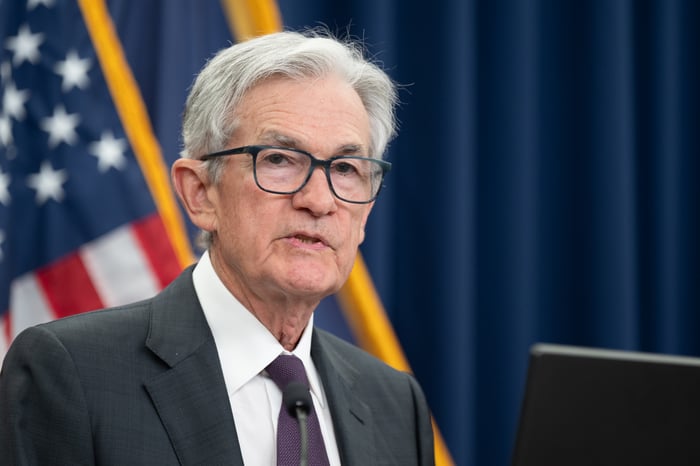
Jerome Powell's term as Fed chair ends on May 15. Image source: Official Federal Reserve Photo.
May 15 marks the final day of Jerome Powell's term as Fed chair. With President Donald Trump and Jerome Powell not seeing eye to eye on interest rates, the writing was on the wall that Powell wouldn't be serving a third term. On Jan. 30, Trump nominated former Fed Governor Kevin Warsh to succeed him.
While Warsh's voting track record and previous commentary have raised several concerns on Wall Street, the prospective future head of the central bank has a much bigger task at hand than just adjusting interest rates and reducing the Fed's balance sheet. He's going to need to establish the Fed's credibility under his watch, which is easier said than done.
Kevin Warsh's balance sheet critiques may put him at odds with Wall Street (and President Trump)
Warsh previously served on the Federal Reserve Board of Governors from Feb. 24, 2006, to March 31, 2011, and was also a voting member of the Federal Open Market Committee (FOMC). The FOMC is the 12-person body, including the Fed chair, responsible for setting the nation's monetary policy.
You'll note by the timeline of Warsh's tenure that he was an FOMC member before, during, and immediately after the financial crisis. His voting track record during this period has primarily painted him as a "hawk" -- i.e., someone who advocates for tighter monetary policy (and potentially higher interest rates) to keep inflation down.
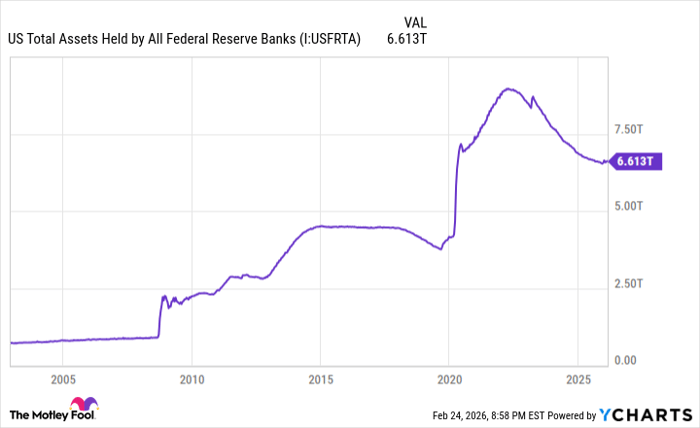
US Total Assets Held by All Federal Reserve Banks data by YCharts.
Following the Great Recession, Warsh became a vocal critic of the Federal Reserve's rapidly growing balance sheet, comprised of U.S. Treasury bonds and mortgage-backed securities (MBS). During periods of outsize uncertainty, the central bank would buy long-term Treasury bonds to keep borrowing costs low or would purchase MBSs to support a potentially weak housing market.
Trump's Fed chair nominee strongly believes the central bank should be a passive observer rather than an active market participant. In other words, he'd prefer to meaningfully pare down the $6.6 trillion in assets the Fed currently holds on its balance sheet.
Unfortunately, deleveraging the Fed's balance sheet can open a can of worms for Wall Street and provoke vocal criticism from President Trump.
Since bond prices and yields have an inverse relationship, selling Treasury bonds could weigh on prices and lift yields. Shrinking the Fed's balance sheet runs the risk of increasing borrowing costs, including mortgage rates, during a period when a historically pricey stock market is fully focused on the Fed's rate-easing cycle continuing.

Image source: Getty Images.
Warsh's biggest challenge will be establishing Fed credibility under his watch
However, Kevin Warsh's desire to deleverage the central bank's balance sheet may not be his biggest challenge as incoming Fed chair (assuming he receives the necessary votes in the Senate Banking Committee and then U.S. Senate). Rather, it'll be successfully building credibility for America's foremost financial institution.
Typically, the Fed serves as Wall Street's foundation. It's an unwavering financial force that calms markets and investors. Moreover, it's an entity whose members are perceived to share a common goal of maximizing employment and stabilizing prices.
History teaches us that the FOMC is often behind the curve when adjusting monetary policy. Using backward-looking economic data to formulate decisions will do that. But investors have shown they're incredibly tolerant of an FOMC that's playing catch-up as long as all members are on the same page.
Throughout most of Jerome Powell's nearly eight-year tenure as Fed chair, he's enjoyed a remarkably low dissent rate. Through the end of 2025, just 21 dissents were recorded, equating to an average of 0.33 dissents per FOMC meeting. To put this into perspective, this is, by far, the lowest dissent rate among the last six Fed chairs, dating back to 1978, with the next-closest being an average of 0.54 dissents per meeting during Alan Greenspan's tenure (1987-2006).
Jerome Powell has the lowest average dissent rate per FOMC meeting among recent Fed chairs. That's a reasonable metric to argue he has done a competent job leading the Federal Reserve. While there may have been policy missteps, it is always easier to be critical in hindsight. pic.twitter.com/i44rVTdniP
-- Bluekurtic Market Insights (@Bluekurtic) January 12, 2026
For much of Powell's time as Fed chair, he's built up the Federal Reserve's credibility. But over the last eight months, dissents have begun testing his track record. Each of the previous five FOMC meetings has featured at least one dissent, with the October and December meetings highlighted by dissents in opposite directions (i.e., at least one voting member favoring no cut, while another preferred a 50-basis-point reduction in the federal funds target rate).
Opposite dissents are exceptionally rare. Over the last 36 years, there have only been three FOMC meetings with dissents in opposite policy directions -- two of these three events have occurred since late October.
This historic division may not be resolved before Warsh (presumably) becomes the Federal Reserve's next chair in mid-May. His greatest challenge will be unifying the FOMC's monetary policy approach and restoring credibility for America's leading financial institution. It won't be an easy task -- and the continuation of the bull market rally for the Dow Jones Industrial Average, S&P 500, and Nasdaq Composite may depend on his success.
Should you buy stock in S&P 500 Index right now?
Before you buy stock in S&P 500 Index, consider this:
The Motley Fool Stock Advisor analyst team just identified what they believe are the 10 best stocks for investors to buy now… and S&P 500 Index wasn’t one of them. The 10 stocks that made the cut could produce monster returns in the coming years.
Consider when Netflix made this list on December 17, 2004... if you invested $1,000 at the time of our recommendation, you’d have $519,015!* Or when Nvidia made this list on April 15, 2005... if you invested $1,000 at the time of our recommendation, you’d have $1,086,211!*
Now, it’s worth noting Stock Advisor’s total average return is 941% — a market-crushing outperformance compared to 194% for the S&P 500. Don't miss the latest top 10 list, available with Stock Advisor, and join an investing community built by individual investors for individual investors.
See the 10 stocks »
*Stock Advisor returns as of March 1, 2026.
Sean Williams has no position in any of the stocks mentioned. The Motley Fool has no position in any of the stocks mentioned. The Motley Fool has a disclosure policy.
Recommended Articles


