


Looking to Buy the Dip on Tech Stocks? Consider This Low-Cost Vanguard ETF.
Key Points
Semiconductor stocks are showing no signs of slowing down.
In contrast, the software industry is in a deep bear market.
Buying the entire tech sector instead of a single sliver helps mitigate risk.
- 10 stocks we like better than Vanguard Information Technology ETF ›
Aside from a brief sell-off in spring 2025, the tech sector went on a virtually uninterrupted run in the three-year period from 2023 to the end of 2025 -- gaining 131%.
Here's why the tech sector is under pressure in 2026, why pockets of the sector are doing very well while others are doing poorly, and a low-cost exchange-traded fund (ETF) that could be worth a closer look.
Will AI create the world's first trillionaire? Our team just released a report on the one little-known company, called an "Indispensable Monopoly" providing the critical technology Nvidia and Intel both need. Continue »

Image source: Getty Images.
Volatilty is heating up in the tech sector
The Vanguard Information Technology ETF (NYSEMKT: VGT) has a staggering $130.3 billion in net assets, making it by far the largest U.S. sector ETF. With a mere 0.09% expense ratio, the fund offers a low-cost way for investors to get exposure to tech stocks.
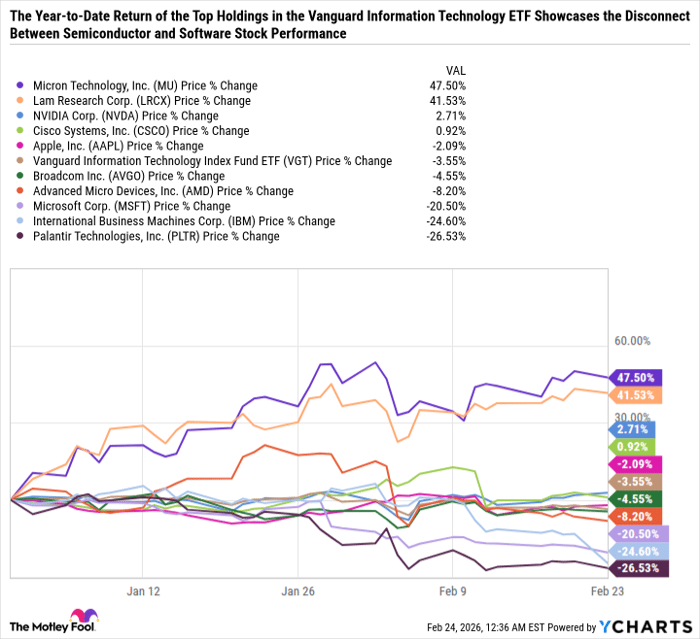
At first glance, tech stocks are holding up fairly well, with the Vanguard Information Technology ETF down just 3.6% year to date compared to a roughly flat S&P 500. But dig deeper, and there's a divide that has become impossible to ignore.
BlackRock's iShares Semiconductor ETF (NASDAQ: SOXX), which closely tracks the semiconductor industry, is up a staggering 18.6% year to date. Notable holdings include chip designers like Micron Technology, Nvidia, Advanced Micro Devices, and Broadcom -- and semiconductor equipment companies like Applied Materials, Lam Research, and ASML Holding.
Meanwhile, another BlackRock ETF, the iShares Expanded Tech Software ETF (NYSEMKT: IGV) -- which tracks the software industry -- is down 27.2% year to date. Its top holdings include Microsoft, Palantir Technologies, Oracle, Salesforce, and other enterprise software companies that are undergoing huge sell-offs due to artificial intelligence (AI) disruption fears.
Here's a look at the performance of the top 10 holdings in the ETF.
MU data by YCharts
Because the Vanguard Information Technology ETF has exposure to the whole tech sector, the large gains from semiconductor stocks have essentially offset the sell-off in software stocks.
It's also worth noting that Nvidia, Apple, and Microsoft make up a combined 43.3% of the ETF. So for the sector to undergo a steep sell-off, there would have to be major declines from all three of those top holdings, as well as cracks in key industries like semiconductors.
A balanced way to buy tech stocks
The advantages of buying a sector ETF are on full display in 2026. It wasn't long ago that software was instrumental in powering the tech sector to new heights. But AI models challenge the value proposition of established enterprise software tools. However, there are plenty of quality software stocks that are arguably oversold and worth buying and holding.
Meanwhile, chip stocks are benefiting from increased demand for compute, networking, and storage. But the semiconductor industry is cyclical. So owning only chip stocks and leaving out the rest of the sector would be a mistake.
The best reason not to buy a sectorwide ETF would be if you already own your maximum desired allocation of a key holding, like Nvidia, Apple, or Microsoft. In that case, buying the ETF would double down on already large positions instead of providing true diversification. If that's not the case, then the Vanguard Information Technology ETF is well worth considering.
Should you buy stock in Vanguard Information Technology ETF right now?
Before you buy stock in Vanguard Information Technology ETF, consider this:
The Motley Fool Stock Advisor analyst team just identified what they believe are the 10 best stocks for investors to buy now… and Vanguard Information Technology ETF wasn’t one of them. The 10 stocks that made the cut could produce monster returns in the coming years.
Consider when Netflix made this list on December 17, 2004... if you invested $1,000 at the time of our recommendation, you’d have $456,188!* Or when Nvidia made this list on April 15, 2005... if you invested $1,000 at the time of our recommendation, you’d have $1,133,413!*
Now, it’s worth noting Stock Advisor’s total average return is 916% — a market-crushing outperformance compared to 194% for the S&P 500. Don't miss the latest top 10 list, available with Stock Advisor, and join an investing community built by individual investors for individual investors.
See the 10 stocks »
*Stock Advisor returns as of February 27, 2026.
Daniel Foelber has positions in ASML, Nvidia, and Oracle and has the following options: short March 2026 $240 calls on Oracle and short November 2026 $1,440 calls on ASML. The Motley Fool has positions in and recommends ASML, Advanced Micro Devices, Apple, Applied Materials, Lam Research, Micron Technology, Microsoft, Nvidia, Oracle, Palantir Technologies, Salesforce, and iShares Trust-iShares Semiconductor ETF. The Motley Fool recommends BlackRock and Broadcom. The Motley Fool has a disclosure policy.
Recommended Articles


