


Jensen Huang Says the "ChatGPT Moment" for Physical AI Has Arrived. Here Are 2 Stocks to Buy for 2026.
Key Points
Tesla is banking its future on unsupervised full self-driving technology and Optimus robots.
Intuitive Surgical's da Vinci systems have been used in more than 20 million procedures.
- These 10 stocks could mint the next wave of millionaires ›
One reason Nvidia (NASDAQ: NVDA) has been so successful is the ability of its management -- particularly CEO Jensen Huang -- to read the tea leaves and accurately position the company for success. Remember, Nvidia used to be best known for making products that help make graphics in personal computers look amazing. Now, it's the largest publicly traded company in the world by market capitalization, and its semiconductors play a huge role in the buildout of artificial intelligence (AI) applications.
So when Huang talks about the future, he gets a lot of attention. And his statements about the future of robotics should be a clarion call for investors who are looking to capitalize on the next generation of AI products.
Will AI create the world's first trillionaire? Our team just released a report on the one little-known company, called an "Indispensable Monopoly" providing the critical technology Nvidia and Intel both need. Continue »
In fact, Huang compares the advances in robotics to the revolutionary change that OpenAI's ChatGPT brought to generative AI, changing the way many people research, analyze information, and create content.
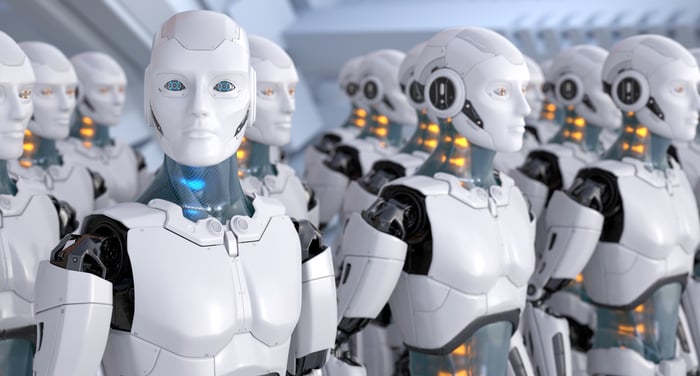
Image source: Getty Images.
"The ChatGPT moment for robotics is here," Huang said in January at the CES 2026 conference. "Breakthroughs in physical AI -- models that understand the real world, reason, and plan actions -- are unlocking entirely new applications. Nvidia's full stack of Jetson robotics processors, CUDA, Omniverse and open physical AI models empowers our global ecosystem of partners to transform industries with AI-driven robotics."
While I think that Nvidia continues to be a no-brainer investment opportunity, I'm going to look at two other companies that specialize in robotics. They appear to be at the forefront of capitalizing on Huang's vision of AI-enhanced machinery.
Tesla
Tesla (NASDAQ: TSLA) has a lot riding on the success of its transformation from an electric-vehicle (EV) maker to a robotics company. While Elon Musk's company will still continue to churn out Model 3, Model Y, and Cybertrucks, Tesla is shuttering the production line handling Model S and X vehicles at its Fremont, California, factory so it can instead mass-produce its Optimus robots.
The general-purpose robots, which are expected to cost between $20,000 and $30,000 each, are expected to be on sale by the end of 2027, said Musk, who envisions them as commonplace and as indispensable as smartphones.
That's a bold statement, but consider that the Optimus robots are already performing basic tasks in Tesla's manufacturing facilities. Musk believes they'll be able to handle more complex tasks by the end of the year.
Robotics are also a huge part of Tesla's automotive future, as the company continues to work on its full-self-driving (FSD) technology. While FSD is currently for sale and in use in Tesla vehicles (a human driver must monitor and take over, if needed), Musk says Tesla is advancing the software in hopes that unsupervised FSD will be approved for widespread use in the U.S.
Intuitive Surgical
Intuitive Surgical (NASDAQ: ISRG) is a California company that makes robotic surgical systems, as well as related instruments and accessories. Surgeons use the company's da Vinci surgical robot for numerous procedures, including specialties such as urology and gynecology.
The company has made five versions of the da Vinci line, and the newest iteration was recently approved by U.S. regulators for specialized cardiac procedures, such as mitral valve repair and replacement. The robot has more than 10,000x the computing power of the fourth-generation robot.
Intuitive's robots have been used in surgeries on more than 20 million patients, with 3.1 million procedures in 2025 alone. It has more than 12,000 da Vinci systems deployed in hospitals around the world, including more than 1,900 that were placed in 2025.
The company is already incorporating AI into its robotic lines, such as its Ion robotic-assisted bronchoscopy platform. Last year, U.S. regulators approved a series of software advancements that introduced AI across Ion's workflow.
In addition, Intuitive generates revenue from instruments, accessories, and service contracts that have already been signed to support the products that it has placed in hospitals. Unlike speculative robotics ventures -- such as Tesla -- Intuitive robots are already widely used and accepted in the medical community.
Don’t miss this second chance at a potentially lucrative opportunity
Ever feel like you missed the boat in buying the most successful stocks? Then you’ll want to hear this.
On rare occasions, our expert team of analysts issues a “Double Down” stock recommendation for companies that they think are about to pop. If you’re worried you’ve already missed your chance to invest, now is the best time to buy before it’s too late. And the numbers speak for themselves:
- Nvidia: if you invested $1,000 when we doubled down in 2009, you’d have $500,200!*
- Apple: if you invested $1,000 when we doubled down in 2008, you’d have $51,820!*
- Netflix: if you invested $1,000 when we doubled down in 2004, you’d have $420,864!*
Right now, we’re issuing “Double Down” alerts for three incredible companies, available when you join Stock Advisor, and there may not be another chance like this anytime soon.
See the 3 stocks »
*Stock Advisor returns as of February 25, 2026.
Patrick Sanders has positions in Nvidia. The Motley Fool has positions in and recommends Intuitive Surgical, Nvidia, and Tesla. The Motley Fool recommends the following options: long January 2028 $520 calls on Intuitive Surgical and short January 2028 $530 calls on Intuitive Surgical. The Motley Fool has a disclosure policy.
Recommended Articles


