


1 Glorious Growth Stock to Buy Before It Soars by 45%, According to Wall Street
Key Points
Workiva helps businesses aggregate their data so they can rapidly draft executive reports and even regulatory filings.
Workiva stock got swept up in the recent sell-off in the software space, and its price is already down 25% in 2026.
Wall Street expects a recovery, and I agree, considering Workiva delivered accelerating revenue growth and a big jump in adjusted profit last year.
- 10 stocks we like better than Workiva ›
Most enterprise software companies experienced a sharp decline in value during the early stages of 2026, as investors worry that artificial intelligence (AI) will eat their lunch. There is a concern that tools like Anthropic's Claude Code will enable businesses to rapidly build their own software tools, reducing their reliance on external vendors. Plus, as AI makes every business more productive, they will have fewer employees and will therefore purchase fewer software licenses.
Workiva (NYSE: WK) stock is down 25% this year already, but I'm not so sure the decline is warranted. Its flagship platform helps organizations aggregate their data to create one trusted source, which managers use to draft executive reports and even regulatory filings. I think it will be a long time before managers trust AI with such a critical workflow -- after all, sending an error-riddled report to the U.S. Securities and Exchange Commission, for example, could have dire consequences.
Where to invest $1,000 right now? Our analyst team just revealed what they believe are the 10 best stocks to buy right now, when you join Stock Advisor. See the stocks »
Wall Street appears to agree with that sentiment, because the majority of the analysts tracked by The Wall Street Journal gave Workiva stock a buy rating, and not a single analyst recommends selling. Their consensus price target implies a potential upside of 45% over the next 12 months or so, and here's why I agree.

Image source: Getty Images.
AI adds a new dimension to Workiva's platform
Large organizations use dozens, and in some cases even hundreds, of digital applications in their day-to-day operations. Manually collecting data from all of them is time-consuming, and it also opens the door to mistakes. Workiva solves this problem by plugging into every major productivity app, system of record, and storage platform, and aggregating all of their data onto its dashboard, which then becomes a trusted source of truth.
Workiva offers several ready-made templates to help managers rapidly turn that data into reports, and it launched a new AI-powered assistant last year called Workiva AI to make this process even easier. With a few simple prompts, managers can have this tool instantly draft generic disclosures in regulatory filings or even turn tabulated data into actionable insights for their executive team.
Workiva has also put together an entire library of pre-prepared prompts, which is useful for organizations adopting AI in these workflows for the very first time. Plus, since it familiarizes itself with every document an organization has uploaded onto the Workiva platform, it fully understands the context behind every request.
At the end of 2025, around 30% of Workiva's customers had activated AI features, and CEO Julie Iskow said their usage tends to increase once they have done so. In other words, tools like Workiva AI appear to be driving real value.
Revenue growth accelerated in 2025
Workiva generated a record $885 million in total revenue during 2025, which was up 20% from the year-ago period. That growth rate marked an acceleration from 2024, when revenue increased by 17%, so the company came into 2026 with some real momentum.
A record 6,624 customers were using Workiva at the end of 2025, which was up by a modest 5% year over year. However, there was significantly faster growth among the highest spending cohorts. The number of customers with annual contract values of over $300,000 soared by an eye-popping 42%, while those with annual contract values of over $500,000 jumped by 37%.
Workiva also made progress at the bottom line last year. It still lost $26.2 million on a generally accepted accounting principles (GAAP) basis, but that was a 52% reduction from its loss in 2024. Plus, after excluding one-off and non-cash expenses, the company actually delivered an adjusted profit of $103.7 million, which represented an impressive 94% increase.
Wall Street is decisively bullish on Workiva stock
The Wall Street Journal tracks 14 analysts who cover Workiva stock, and 10 have assigned it a buy rating. Three others are in the overweight (bullish) camp, while the remaining analyst recommends holding. None of the analysts recommends selling.
Their consensus price target is $89.45, implying the stock could climb by 45% over the next 12 months or so. However, the Street-high target of $102 suggests the stock could soar by 66% instead.
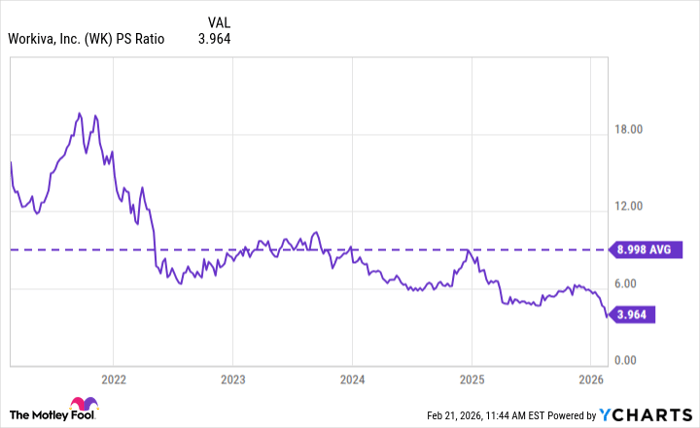
I think both of those targets are realistic, not only because of the momentum in Workiva's business, but also because of its attractive valuation. Its stock is trading at a price-to-sales (P/S) ratio of 3.9 right now, which is less than half of its five-year average of 8.9:
Data by YCharts.
Ultimately, I think the broad sell-off in the software space this year has given investors an opportunity to buy Workiva stock at a bargain price. Looking beyond the next year, investors with a long-term mindset could reap the greatest rewards as the company works on capturing its sizable addressable market, which it values at $35 billion.
Should you buy stock in Workiva right now?
Before you buy stock in Workiva, consider this:
The Motley Fool Stock Advisor analyst team just identified what they believe are the 10 best stocks for investors to buy now… and Workiva wasn’t one of them. The 10 stocks that made the cut could produce monster returns in the coming years.
Consider when Netflix made this list on December 17, 2004... if you invested $1,000 at the time of our recommendation, you’d have $409,970!* Or when Nvidia made this list on April 15, 2005... if you invested $1,000 at the time of our recommendation, you’d have $1,174,241!*
Now, it’s worth noting Stock Advisor’s total average return is 889% — a market-crushing outperformance compared to 192% for the S&P 500. Don't miss the latest top 10 list, available with Stock Advisor, and join an investing community built by individual investors for individual investors.
See the 10 stocks »
*Stock Advisor returns as of February 24, 2026.
Anthony Di Pizio has no position in any of the stocks mentioned. The Motley Fool has positions in and recommends Workiva. The Motley Fool has a disclosure policy.
Recommended Articles


