


Should You Buy Vistra Stock While It's Below $200 -- Or Wait for a Better Yield?
Key Points
Vistra has a large generative capacity across its assets with growing EBITDA and solid margins.
It has a low dividend yield even after a dip in price through late 2025.
That dividend is growing at a rapid pace, which makes a case for Vistra even with its low yield.
- 10 stocks we like better than Vistra ›
Artificial intelligence (AI) has energy trading at a premium. The data centers that AI programs run on are gluttonously gobbling up every spare electron on the grid.
Will AI create the world's first trillionaire? Our team just released a report on the one little-known company, called an "Indispensable Monopoly" providing the critical technology Nvidia and Intel both need. Continue »
The energy demand from data centers caused Virginia, which has more data centers in operation and under construction than any other state, to become the largest energy importing state in 2023.
What's particularly impressive about that is the fact that Virginia has a population of about 9 million, and the state it replaced as the largest energy importer was California, which has a population of about 40 million. So, the increase is primarily due to the data centers.
And that has been the result in just one state. Data centers are driving huge demand for electricity, and companies like Vistra Corp (NYSE: VST) have been making money hand over fist meeting that need. Vistra alone is up 652% over the past three years.
However, Vistra dipped through the end of 2025 and is now back below $200, which makes its dividend yield look much better. So, should you pick up shares of Vistra now? Or should you wait and see?
Let's find out.
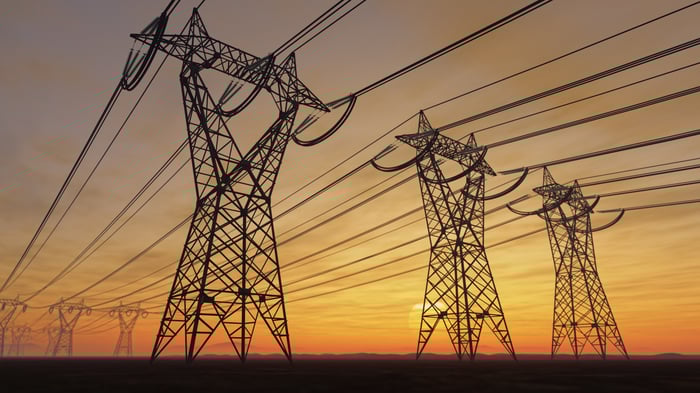
Image source: Getty Images
The best little power plant in Texas
Vistra is based in Irving, Texas, but it provides electricity across the country. Its assets, which collectively generate about 44,000 megawatts, include both fossil fuel plants and green energy like nuclear and solar. The company operates 50 renewable plants nationwide.
And the company is focused on the AI market. In January of this year, it spent $4 billion on 10 natural gas power plants across the Northeast U.S. and Texas expressly for the purpose of powering data centers. That follows the $6.8 billion acquisition of its current nuclear fleet in 2024 and a $1.9 billion purchase of seven gas plants in May 2024.
The buying spree during Vistra's most recently reported quarter (Q3 2025) appears to be paying off. Adjusted earnings before interest, taxes, depreciation, and amortization (EBITDA) for the first nine months of 2025 totaled $4.17 billion, up 13.9% over the first nine months of 2024.
That same quarter, the company managed an EBITDA margin of 29.9% and a net profit margin of 6.99%. Vistra channels those profits into a dividend which it has paid and raised every year since 2019.
Now, prior to 2024 and the bulk of Vistra's bull run, that dividend yielded a solid 2% to 3%, but the company's considerable share-price growth has lowered the company's dividend yield to 0.52%.
Despite the low current yield, there's a case to be made for Vistra. The company's shares are up about 6% year to date, and it is beginning to wipe out its decline at the end of 2025. If that continues, the yield will get lower.
However, Vistra is growing its dividend at a nice clip. The five-year compound annual growth rate (CAGR) for its dividend is 10.7% at present. And with a current payout ratio of 32.2%, Vistra has plenty of runway to continue growing its dividend.
With a yield unlikely to get much better than it is now, barring a catastrophic crash in Vistra's share price, this is one stock to consider for your energy-dividend portfolio -- and one you will likely want to watch for further dips in share price to see if you can increase your yield.
Should you buy stock in Vistra right now?
Before you buy stock in Vistra, consider this:
The Motley Fool Stock Advisor analyst team just identified what they believe are the 10 best stocks for investors to buy now… and Vistra wasn’t one of them. The 10 stocks that made the cut could produce monster returns in the coming years.
Consider when Netflix made this list on December 17, 2004... if you invested $1,000 at the time of our recommendation, you’d have $424,262!* Or when Nvidia made this list on April 15, 2005... if you invested $1,000 at the time of our recommendation, you’d have $1,163,635!*
Now, it’s worth noting Stock Advisor’s total average return is 904% — a market-crushing outperformance compared to 194% for the S&P 500. Don't miss the latest top 10 list, available with Stock Advisor, and join an investing community built by individual investors for individual investors.
See the 10 stocks »
*Stock Advisor returns as of February 24, 2026.
James Hires has no position in any of the stocks mentioned. The Motley Fool has no position in any of the stocks mentioned. The Motley Fool has a disclosure policy.
Recommended Articles


