


Consumer Staples Are Leading With the S&P 500 Near Record Highs. History Says That Rarely Ends Well.
Key Points
The S&P 500 is still trading near all-time highs, but the consumer staples sector is outperforming by 13 percentage points year to date.
History shows that this is an anomaly that's likely to correct itself with a sharp pullback in the S&P 500.
Over the past 25 years, consumer staples outperformance like this correlates with 10% to 20% pullbacks in the S&P 500.
- 10 stocks we like better than Select Sector SPDR Trust - State Street Consumer Staples Select Sector SPDR ETF ›
In most cases, the S&P 500 (SNPINDEX: ^GSPC) hitting new all-time highs is a good thing. It signals confidence that the current economic conditions are good and are likely to continue being so into the future.
But sometimes, there's a hidden warning in there. From 2023-2025, the bull market was led by tech and growth stocks. That's what you'd expect to see during a big market expansion.
Will AI create the world's first trillionaire? Our team just released a report on the one little-known company, called an "Indispensable Monopoly" providing the critical technology Nvidia and Intel both need. Continue »
However, 2026 has been different. The S&P 500 is still sitting near all-time highs, but tech is one of the worst-performing sectors year to date. Instead, we're seeing energy, consumer staples, industrials, materials, and utilities stocks leading the way.
Image source: Getty Images.
When consumer staples and utilities stocks are beating the S&P 500, investors should take caution. These are the sectors that investors pivot into when they're generally feeling more cautious or nervous. But the S&P 500 is still near all-time highs. Which narrative is the correct one?
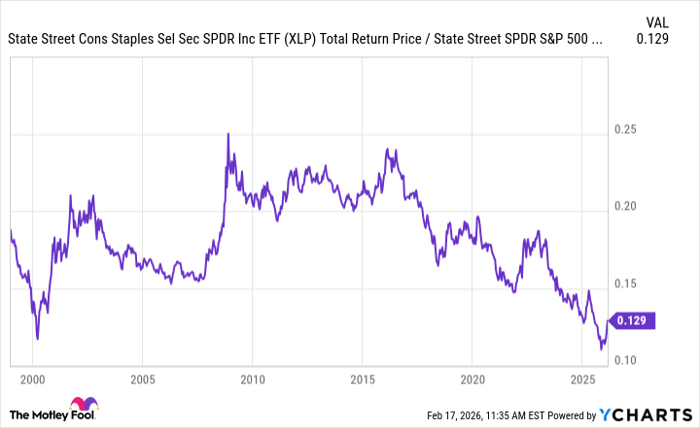
Let's take a look at the consumer staples sector, represented by the State Street Consumer Staples Select Sector SPDR ETF (NYSEMKT: XLP) specifically relative to the S&P 500, represented by the State Street SPDR S&P 500 ETF (NYSEMKT: SPY) over the past quarter-century.
Fundamental Chart data by YCharts.
When the line is trending higher, consumer staples are outperforming the market. We see this happening during fairly obvious periods in history -- the tech bubble, the financial crisis, the 2022 bear market.
Then there's 2026, when this ratio moved sharply higher. It's still a modest blip on a longer-term chart, but it's there.
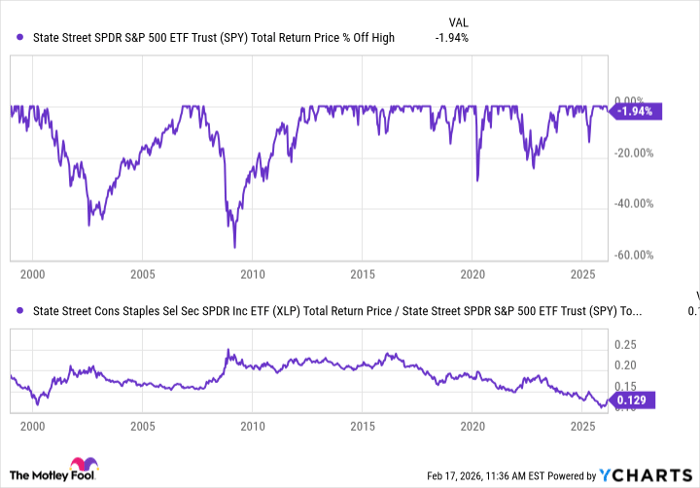
Now, let's overlay a chart of S&P 500 drawdowns over the same timeframe.
SPY Total Return Price data by YCharts.
The two lines, as expected, are nearly perfectly inversely correlated. When consumer staples outperform, it's almost always during a downturn in the S&P 500. Conversely, when the sector lags, the S&P 500 is either at or moving toward new highs.
Virtually every spike in the consumer staples-to-S&P 500 ratio has also resulted in a 10%+ correction for the index. Just recently, we saw it happen during the first-quarter 2025 "Liberation Day" scare. It happened during the 2022 bear market. It happened during the COVID-19 recession (albeit briefly). 2016, 2008, and 2001 all saw corrections and/or bear markets when consumer staples led the market.
What happens next?
Today, consumer staples is sharply beating the S&P 500, but without the correction. In order to bring this relationship back in line with the historical norm, one of two things would need to happen.
Either the consumer staples sector needs to reverse course sharply, or the S&P 500 needs to correct.
Given current market trends and questions around tech capex spending, valuations, and the health of the labor market, it would suggest that the latter is more likely. Given that the 10-year Treasury yield has fallen by roughly 20 basis points since the beginning of February, I believe broader risk-off sentiment is deepening.
A correction in the S&P 500 isn't a guarantee even with this signal. But the S&P 500 is looking especially vulnerable to one.
Should you buy stock in Select Sector SPDR Trust - State Street Consumer Staples Select Sector SPDR ETF right now?
Before you buy stock in Select Sector SPDR Trust - State Street Consumer Staples Select Sector SPDR ETF, consider this:
The Motley Fool Stock Advisor analyst team just identified what they believe are the 10 best stocks for investors to buy now… and Select Sector SPDR Trust - State Street Consumer Staples Select Sector SPDR ETF wasn’t one of them. The 10 stocks that made the cut could produce monster returns in the coming years.
Consider when Netflix made this list on December 17, 2004... if you invested $1,000 at the time of our recommendation, you’d have $424,262!* Or when Nvidia made this list on April 15, 2005... if you invested $1,000 at the time of our recommendation, you’d have $1,163,635!*
Now, it’s worth noting Stock Advisor’s total average return is 904% — a market-crushing outperformance compared to 194% for the S&P 500. Don't miss the latest top 10 list, available with Stock Advisor, and join an investing community built by individual investors for individual investors.
See the 10 stocks »
*Stock Advisor returns as of February 22, 2026.
David Dierking has no position in any of the stocks mentioned. The Motley Fool has no position in any of the stocks mentioned. The Motley Fool has a disclosure policy.
Recommended Articles


