


Social Security Has a Worsening Income Inequality Problem -- and Retirees May End Up Paying the Price
Key Points
The Old-Age and Survivors Insurance trust fund (OASI) is estimated to be seven years away from exhausting its asset reserves, which may lead to sweeping benefit cuts for retired workers.
One of the many demographic shifts responsible for Social Security's deteriorating financial foundation is rising income inequality.
While taxing the rich can be one solution, it's not the only solution needed to strengthen Social Security for future generations.
- The $23,760 Social Security bonus most retirees completely overlook ›
Social Security wrapped up a history-making year in 2025.
For the first time in Social Security's 90-year history, we witnessed the average monthly retired-worker benefit surpass $2,000. Additionally, the 2.7% cost-of-living adjustment (COLA) passed along to the program's more than 70 million traditional beneficiaries in 2026 marked the fifth consecutive year in which benefits rose by at least 2.5%. That hasn't happened in nearly three decades.
Where to invest $1,000 right now? Our analyst team just revealed what they believe are the 10 best stocks to buy right now, when you join Stock Advisor. See the stocks »
Despite this history, the financial bedrock of America's foremost retirement program is crumbling before our eyes. Although several factors are responsible for Social Security's worsening financial outlook, the program's income inequality problem can no longer be ignored.

Image source: Getty Images.
Sweeping Social Security benefit cuts may be just seven years away
Every year since the first retired-worker benefit check was mailed in January 1940, the Social Security Board of Trustees has released a report examining the financial state of the program. This lengthy report details how it brings in income and tracks where those dollars end up.
The annual Trustees Report also makes forward-looking projections. The 2025 Social Security Trustees Report estimates that the program faces a $25.1 trillion long-term unfunded obligation. In simpler terms, the projected income collected in the 75 years following the release of a report is expected to fall short of forecasted outlays, including annual COLAs, by $25.1 trillion.
However, this isn't the most immediate concern for Social Security or its retired beneficiaries.
According to the 2025 Trustees Report, the Old-Age and Survivors Insurance trust fund (OASI) is projected to exhaust its asset reserves -- the excess income collected since inception that's invested in special-issue, interest-bearing government bonds, as required by law -- by 2033. The OASI is the fund that doles out monthly benefits to retired workers and survivors of deceased workers.
The silver lining is that the OASI doesn't need any money in its reserve to continue paying eligible beneficiaries. In other words, Social Security isn't in danger of bankruptcy or of halting benefits. But the projected depletion of the OASI's asset reserves would signal that the existing payout schedule, including COLAs, isn't sustainable.
If estimates from the Trustees Report prove accurate, retired workers and survivors of deceased workers could see their payouts slashed by up to 23% in 2033 to avoid any further reductions through 2099.
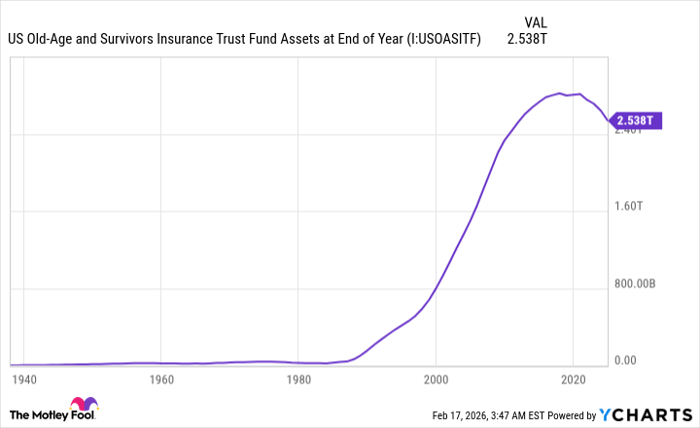
The OASI's asset reserves could be gone in seven years. US Old-Age and Survivors Insurance Trust Fund Assets at End of Year data by YCharts.
Rising income inequality is a tangible problem for America's top retirement program
The above provides a broad overview of the magnitude of the problem(s) Social Security is facing. Let's dive into one of its more pervasive issues: income inequality.
In 2024, Social Security's combined OASI and Disability Insurance trust fund (DI) collected nearly $1.42 trillion in income. Most of it (over 91%) came from the 12.4% payroll tax on earned income (wages and salaries, but not investment income). In 2026, this payroll tax applies to earned income ranging from $0.01 to $184,500, with all earnings above $184,500 (known as the "earnings tax cap") exempted.
The earnings tax cap increases almost every year in lockstep with the National Average Wage Index. The only time it doesn't rise is when deflation occurs, which results in no COLA being passed along to beneficiaries.
Approximately 94% of working Americans earn less than the earnings tax cap in a given year. This means they're paying into Social Security with every dollar they earn. In comparison, roughly 6% of workers will surpass the earnings tax cap and see at least some portion of their earned income escape the payroll tax.
Here's the issue: wages and salaries for higher-earning individuals have grown at a faster pace than the earnings tax cap over the last four decades.
In 1983, when the last sweeping overhaul of Social Security was signed into law (Social Security Amendments of 1983), approximately 90% of earnings were subject to the payroll tax. But the 2025 Fast Facts & Figures report from the Social Security Administration (SSA) found that "about 83% of earnings in covered employment were taxable in 2024."
Over time, more earned income is side-stepping the 12.4% payroll tax -- and it's the retirees who rely most on Social Security income to make ends meet who could end up paying the price.

Image source: Getty Images.
Think taxing the rich is a fix-all? Not so fast...
As noted, income inequality isn't Social Security's only issue. A historically low U.S. birth rate, a significant decline in legal migration into the country, and the steady retirement of baby boomers have all contributed to weakening the program's financial foundation. However, income inequality is perceived as one of the easier demographic shifts to tackle.
If you were to randomly survey working Americans, there's a high probability they'd favor taxing the rich. If the earnings tax cap were increased or removed entirely, it wouldn't affect the 94% of workers who already pay into Social Security with every dollar they earn. Instead, adjusting the tax cap would immediately generate additional income from the 6% of workers who currently see some portion of their earnings escape the payroll tax.
Sounds like an easy fix, right? Unfortunately, it's not that simple.
Several years ago, the SSA's Office of the Chief Actuary (OACT) published an analysis of what would happen to America's leading retirement program if the earnings tax cap were completely removed and all wages and salaries were subject to the payroll tax. The OACT estimated it would extend the solvency of the combined trust funds (OASI and DI) by "about 35 years."
While generating immediate income by taxing the well-to-do would certainly push back any possible sweeping benefit cuts for the OASI, the OACT's analysis makes clear that taxing all earned income, by itself, isn't sufficient to eliminate the program's long-term unfunded obligation. In fact, it doesn't even come close. While taxing high earners can be a solution, it's not the only solution needed to strengthen Social Security for future generations.
Additionally, a strong argument can be made that high earners are already paying their fair share into Social Security. Regardless of how much a worker earned annually during their time in the labor force, the maximum Social Security benefit at full retirement age in 2026 is $4,152 per month. Just as a cap exists on the maximum monthly benefit, there's a cap on how much earned income workers are taxed on.
To make things even more challenging, amending the Social Security Act in Congress requires 60 votes in the Senate. Since neither Democrats nor Republicans has held a supermajority of seats in the upper house of Congress since the late 1970s, bipartisan cooperation would be needed to adjust payroll taxation on high earners. There's virtually no chance of this happening.
Although taxing the rich is a popular proposal, there's no surefire solution to resolving Social Security's worsening income inequality problem -- and that's bad news for retirees.
The $23,760 Social Security bonus most retirees completely overlook
If you're like most Americans, you're a few years (or more) behind on your retirement savings. But a handful of little-known "Social Security secrets" could help ensure a boost in your retirement income.
One easy trick could pay you as much as $23,760 more... each year! Once you learn how to maximize your Social Security benefits, we think you could retire confidently with the peace of mind we're all after. Join Stock Advisor to learn more about these strategies.
View the "Social Security secrets" »
The Motley Fool has a disclosure policy.
Recommended Articles


