


CEO Elon Musk Just Gave a Mouth-Watering Update on Tesla's Robotaxi Fleet. Should You Buy In or Be a Skeptic?
Key Points
On Tesla's fourth-quarter earnings call, CEO Elon Musk guided for the company's robotaxi fleet to double each month and cover a quarter to half of the U.S. by year-end.
Musk has made plenty of big promises during his tenure at Tesla.
Tesla trades at a monster valuation.
- These 10 stocks could mint the next wave of millionaires ›
If you've been following Tesla (NASDAQ: TSLA), you know that the most important thing at the company no longer has to do with electric vehicles. It's now all about artificial intelligence (AI).
Currently, the most prominent is Tesla's self-driving robotaxi fleet, which has launched in Austin, Texas, and San Francisco. While investors can monitor the fleet, there's still a lot to play out, which is why investors are always anxious for updates from CEO Elon Musk.
Where to invest $1,000 right now? Our analyst team just revealed what they believe are the 10 best stocks to buy right now, when you join Stock Advisor. See the stocks »
On Tesla's 2025 fourth-quarter earnings call, Musk issued a mouthwatering update on the robotaxi business. Should investors buy into the hype or be skeptical, given that Musk is known for making big promises?
Musk guiding for a surge in robotaxi vehicles
Tesla launched robotaxis in a few select markets last year, including Austin and San Francisco. However, it wasn't exactly a full self-driving launch. The vehicles were geofenced to certain areas within the perspective cities, and human monitoring was involved, either remotely or via human monitors in the passenger seat of the robotaxis.
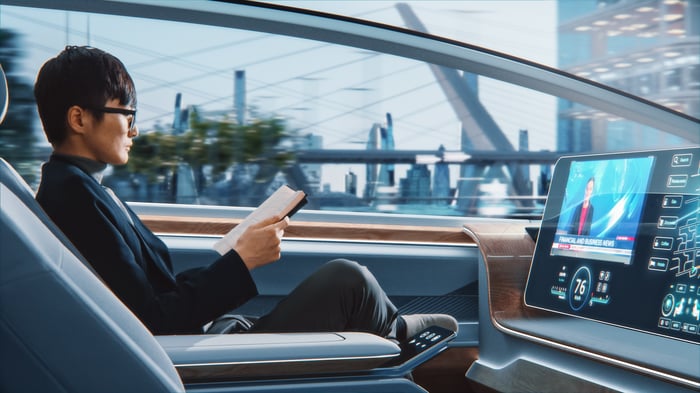
Image source: Getty Images.
Musk has long given big promises on robotaxis and did so again during Tesla's fourth-quarter earnings call. The billionaire serial entrepreneur said that between Austin and the Bay area, he thinks there are well over 500 robotaxis carrying paid customers, a number that he expects to likely double each month. He expects there will be robotaxis "in probably somewhere between a quarter and half of the United States by the end of the year, pending regulatory approval."
Furthermore, Musk also said that there are robotaxis in Austin operating with no physical or remote monitor and 100% unsupervised. However, he added that the company is being very cautious with the rollout, and there can be some very difficult intersections for robotaxis to navigate.
The claims about fully unsupervised robotaxis have also been challenged by sites like Electrek. An independent project tracking Tesla's robotaxis, called Robotaxi Tracker, recently reported that only about four of Tesla's 58 robotaxis in Austin are unsupervised.
Challenges facing Tesla's robotaxi fleet
Musk is clearly a visionary, but that doesn't mean he doesn't make lofty promises that don't always pan out. After all, in 2019, he said the company would have 1 million robotaxis operating in the U.S. in 2020.
This is the challenge for investors -- figuring out what's real and what's hype.
For one, on X, the platform Musk owns, he tweeted just a few weeks ago that production for the robotaxi and Optimus humanoid robot would be "agonizingly slow." Other various media reports suggest that Tesla's crash rate among its robotaxi fleet could be an issue, as well.
While Musk seems to have a generally favorable standing within the Trump administration right now, I don't think any regulatory agency is going to approve more robotaxis if there are genuine safety concerns. Some level of accidents is to be expected -- much like with humans on the road -- but anything alarming could create regulatory risk or adoption risk if people are nervous to get into robotaxis.
Tesla also doesn't expect to start production of its cybercabs -- specialized two-seat vehicles with no steering wheels that will help scale the company's robotaxi fleet -- until April. In fact, Tesla plans to wind down production of its Model S and X vehicles to make room for Optimus production.
Understand the risk-reward scenario
Tesla is going all in on AI, primarily through robotaxis and, eventually, the Optimus humanoid robots. The company is more than doubling capital expenditures from last year to ramp up production on these and other product lines, and some Wall Street analysts don't expect the company to generate any free cash flow in 2026 or 2027.
With Tesla trading at over 200 times forward earnings, I assume the market is pricing in a certain amount of success from robotaxis and humanoid robots. But as mentioned above, Tesla faces several challenges, and based on the company's past, it seems more likely than not that the company won't be able to hit Musk's timeline.
Investors must ask themselves if the risk-reward proposition is worth it here. In my mind, the market is already pricing a lot of success from Tesla's robotaxi business into the stock price, meaning if the business struggles or turns out not to be as large an opportunity as many expect, the stock price could get hit hard. That's why I am cautious on the name and think investors should be as well.
Don’t miss this second chance at a potentially lucrative opportunity
Ever feel like you missed the boat in buying the most successful stocks? Then you’ll want to hear this.
On rare occasions, our expert team of analysts issues a “Double Down” stock recommendation for companies that they think are about to pop. If you’re worried you’ve already missed your chance to invest, now is the best time to buy before it’s too late. And the numbers speak for themselves:
- Nvidia: if you invested $1,000 when we doubled down in 2009, you’d have $480,903!*
- Apple: if you invested $1,000 when we doubled down in 2008, you’d have $52,909!*
- Netflix: if you invested $1,000 when we doubled down in 2004, you’d have $443,299!*
Right now, we’re issuing “Double Down” alerts for three incredible companies, available when you join Stock Advisor, and there may not be another chance like this anytime soon.
See the 3 stocks »
*Stock Advisor returns as of February 10, 2026.
Bram Berkowitz has no position in any of the stocks mentioned. The Motley Fool has positions in and recommends Tesla. The Motley Fool has a disclosure policy.
Recommended Articles


