


Better Crypto Buy: XRP (Ripple) vs. Ethereum
Key Points
Stablecoins have exploded in popularity and could become a multitrillion-dollar market, according to Citi Group.
Ripple's stablecoin push could actually undermine XRP's value.
In contrast, Ethereum stands to gain from stablecoin adoption.
- 10 stocks we like better than XRP ›
XRP (CRYPTO: XRP) has a lot of momentum behind it, gaining more than 340% from the Nov. 2024 elections to Nov. 25, 2025. That's more than 15 times the growth Ethereum (CRYPTO: ETH) investors saw.
But past performance doesn't tell us much about the future. The real question is which coin is likely to perform better now. To answer that, we need to understand the economics of both and, critically, which creates more value from network adoption.
Where to invest $1,000 right now? Our analyst team just revealed what they believe are the 10 best stocks to buy right now. Continue »
XRP's value proposition
Traditional banking settlements are secure, but they are slow and expensive. Transactions can take days or even weeks to finalize, and international transfers can involve multiple intermediaries, each collecting a fee.
Ripple, the company behind XRP, created the coin to solve these problems. Its technology enables secure transactions that are faster and much cheaper. Ripple's technology has gained a significant foothold in the industry and is used by major banks around the world.
This real-world usage is the core of XRP's investment thesis: as more financial institutions want to use the Ripple network to make transfers, demand for XRP for network fees will grow. More banks mean more demand.
But there's a critical flaw in this thesis. Banks can use RippleNet -- Ripple's primary product -- without touching the XRP token. Most major banks that use Ripple's technology do exactly that. They can capture most of the efficiency gains while avoiding exposure to a volatile cryptocurrency.
Ripple's On-Demand Liquidity (ODL), on the other hand, involves at least some direct exposure to XRP. ODL uses XRP as a bridge asset for cross-border payments, eliminating the need for institutions to maintain prefunded foreign currency accounts. That frees up capital and solves real liquidity problems for those who need it.
But most major banks don't have meaningful liquidity constraints that would justify exposing themselves, even temporarily, to an asset as volatile as XRP.
And even XRP's place in ODL transactions isn't certain. Ripple recently purchased Rail, a stablecoin payment platform, and is attempting to position itself as a major player in the stablecoin market -- a market that could be worth trillions of dollars. Ripple's stablecoin, RLUSD, could supplant XRP as the primary bridge asset in ODL transactions.
Ethereum benefits from stablecoins
Ethereum presents the opposite case. It will likely benefit if stablecoins take off. The coin is the backbone of much of the crypto industry, including most of the leading stablecoins -- the lion's share of USDC, USDT, and DAI transactions happen on its blockchain.
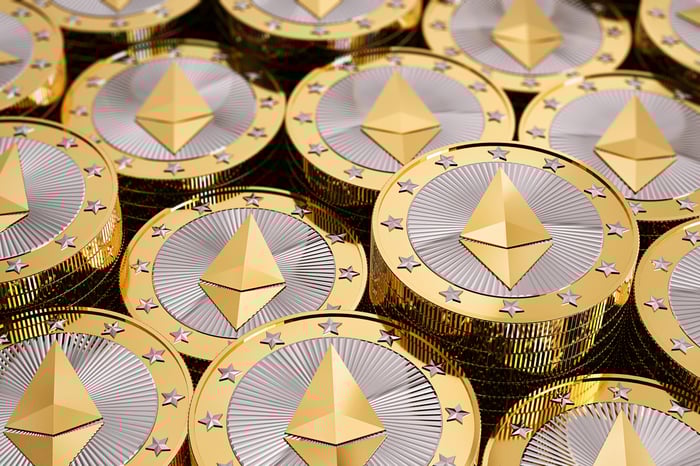
Image source: Getty Images.
Stablecoin transactions, indeed all transactions, that happen on Ethereum's blockchain require "gas" fees to be paid in Ether, the native coin of the network. Ether has to be acquired -- demand pressure -- to pay gas fees, and each time, a portion is burned and removed from circulation forever -- supply pressure.
Admittedly, this is complicated by what are known as Layer-2 solutions. These helper chains process transactions in bulk off the main network, reducing Ethereum's gas fees. But the core of the idea still holds.
XRP has a burn mechanism, too, however. Why am I saying it matters for Ethereum but not XRP? Scale. XRP burns a tiny fraction of a token per transaction, far too little to affect supply in any meaningful way. Ethereum burns enough Ether per transaction to actually move the needle.
The verdict
The economics of the tokens are substantially different, and I believe Ethereum's are superior.
That's not to say Ethereum doesn't have problems. Aside from Layer-2 networks reducing gas fees, new Ethereum is introduced to the market to reward the validators that secure the network -- analogous to Bitcoin's miners -- and this counteracts the reduced supply from token burning. While a relative balance has been struck -- total supply has been relatively stable since 2022 -- that could change if usage changes dramatically.
Although XRP has captured a lot of attention with its 230% run during the past year, in my view, Ethereum is the better crypto bet for long-term investors.
Should you invest $1,000 in XRP right now?
Before you buy stock in XRP, consider this:
The Motley Fool Stock Advisor analyst team just identified what they believe are the 10 best stocks for investors to buy now… and XRP wasn’t one of them. The 10 stocks that made the cut could produce monster returns in the coming years.
Consider when Netflix made this list on December 17, 2004... if you invested $1,000 at the time of our recommendation, you’d have $576,882!* Or when Nvidia made this list on April 15, 2005... if you invested $1,000 at the time of our recommendation, you’d have $1,119,006!*
Now, it’s worth noting Stock Advisor’s total average return is 1,002% — a market-crushing outperformance compared to 190% for the S&P 500. Don’t miss out on the latest top 10 list, available when you join Stock Advisor.
See the 10 stocks »
*Stock Advisor returns as of November 24, 2025
Johnny Rice has no position in any of the stocks mentioned. The Motley Fool has positions in and recommends Bitcoin, Ethereum, and XRP. The Motley Fool has a disclosure policy.
Recommended Articles


