


EU’s 20th Sanctions Package Targets Entire Russian Crypto Sector Starting May 2026
The EU Council has adopted its 20th sanctions package against Russia. It includes serious restrictions for the cryptocurrency sector.
For the first time, the European Union did not target individual platforms but instead imposed a sectoral ban on all crypto services registered in Russia.
The Garantex Lesson: Why Targeted Sanctions Don’t Work
The EU regulation explains why it has shifted to a sectoral approach. In February 2025, the Garantex crypto exchange was added to the sanctions list for facilitating access to the global financial system for sanctioned individuals.
However, the measure proved ineffective. Investigations showed that Garantex’s operations simply migrated to other Russian legal entities.
The regulation acknowledges that targeted inclusion of individual exchanges and platforms in sanctions lists only leads to the emergence of new structures for circumventing restrictions. Hence, the decision was made to ban the entire sector at once.
Follow us on X to get the latest news as it happens
What Exactly Has Been Banned
The BeInCrypto editorial team has reviewed the materials and compiled all the prohibitions mentioned in the new package into a single overview.
Sectoral Ban on Russian Crypto Platforms
The main measure is a ban on any direct or indirect transactions with crypto providers and cryptocurrency exchange platforms from Russia. The rule is enshrined in Article 5bb of Regulation (EU) No 833/2014 and Article 1bb of Decision (CFSP) 2026/508.
The ban will take effect on May 24, 2026. Before that date, market participants can complete their current contracts.
Exceptions are provided for EU diplomatic missions and partner countries in Russia, for EU citizens who lived in Russia before February 24, 2022, and for companies winding down business in Russia, but the latter require authorization from the competent authorities of an EU member state.
Ban on Specific Crypto Assets and the Digital Ruble
The list of crypto assets with which transactions are prohibited has been expanded. The RUBx cryptocurrency has been added. Also prohibited are operations with central bank digital currencies from the sanctions list and any support for their development from the EU. This measure is primarily aimed at the digital ruble.
A Kyrgyz organization that operates a crypto exchange with notable trading volumes of the ruble stablecoin A7A5 has been placed under personal sanctions. The name of the organization is not disclosed in the press release.
It will appear after the publication of the annexes to the regulation in the Official Journal of the EU. Earlier, in the 19th sanctions package, the EU had already introduced a ban on A7A5 and the affiliated Kyrgyz companies Old Vector and Grinex.
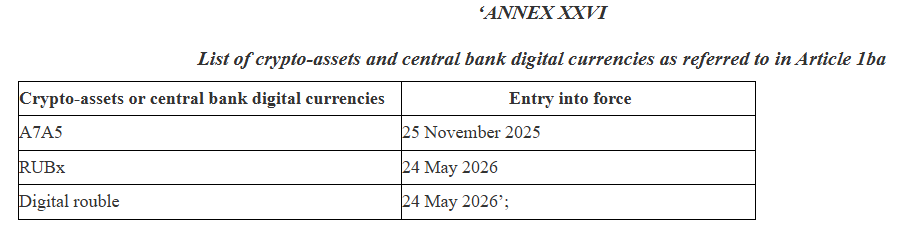 Screenshot of Part of the EU’s 20th Sanctions Package Against Russia, Showing a Table of Prohibited Digital Assets
The EU Council notes: against the backdrop of large-scale financial sanctions, Russia is increasingly using cryptocurrencies for international settlements. In early 2026, transfers via the ruble stablecoin A7A5 exceeded $100 billion.
A Blow to Workaround Settlement Schemes
Another new measure is a ban on services that are formally neither banks nor crypto providers but help Russian clients conduct cross-border settlements. This refers to mutual offset (netting) schemes, reconciliation, and other mechanisms that allow circumventing sanctions.
“Mirror” and “successor” structures of blocked crypto providers and payment services also fall under the ban.
Transaction Ban for Banks
A ban has been introduced against 20 Russian banks. Four more financial institutions in third countries have been placed under restrictions for helping to circumvent sanctions or for links to SPFS, Russia’s analog of SWIFT.
Mirror Measures for Belarus
Similar cryptocurrency restrictions have been extended to Belarus. The sanctions regime against Minsk has been extended until February 28, 2027.
Not the Best Time for Sanctions
The EU sanctions have coincided with Russian authorities’ attempts to push crypto community participants onto domestic licensed platforms. The draft law “On Digital Currency and Digital Rights” envisages mandatory storage of cryptocurrencies in depositories under the control of the Central Bank, a ban on personal wallets, and a limit of 300,000 rubles per year for unqualified investors. It may come into force on July 1, 2026.
The result is a vicious circle. Russia is centralizing the crypto market and creating a single point of control, while the EU is imposing a sectoral ban on all Russian crypto services. Market participants, who the law will oblige to move to domestic platforms, will automatically be cut off from European counterparties.
Crypto that comes into contact with the Russian circuit may be flagged as “dirty.” This is how coins associated with Iran and North Korea are labeled, for example. In this case, moving it outside of Russia will be extremely problematic. Transactions will be associated with blocking risks.
Subscribe to our YouTube channel to watch leaders and journalists provide expert insights
Recommended Articles


