

Are shrinking DeFi yields driving users away from on-chain markets?

Source Cryptopolitan

DeFi yield has fallen to a much lower range in 2026, and was considered a sign of a maturing industry. However, the recent Drift Protocol hack raised the issue of technical risk and whether current yields offset the value of putting assets on-chain. 

DeFi yield has been sliding on most protocols, and the early days of high-return yield farming seem to be over. DeFi has become a more mature sector, where protocols rely on stablecoins and the predictable yield of tokenized bonds or money funds. 

Peak farming days often relied on new token issuance to offset risk, and traders would recoup their initial deposit within a short period. 

Santiago R., founder of Inversion, considers that on-chain yield should be much higher to offset the current technical risks. 

I get asked constantly what is enough yield to come onchain. I think it’s at least 18% today. Anything below that is not worth the hassle or the risk,” explained Santiago R. in an X post

He does not give details on generating that yield, but points to smart contract risk, general exposure of holdings, and overall protocol risk. 

DeFi yield should be higher to offset technical risk

DeFi is still not anonymous and has often exposed whale wallets. Confidential usage is not as widespread yet. 

Overall, DeFi calculates risk and yield in financial terms, mostly linked to the volatile nature of crypto assets. Protocols do not account for general vulnerabilities, which have often led to dramatic losses. 

On-chain rates are also low due to the limited demand for assets. Low yield on deposited tokens does not mean the investment is low-risk, but that risk may not be priced correctly, noted Santiago R. He proposes higher yields, alongside selling insurance products against losses. 

DeFi yield slides in the past months

DeFi yields have fallen even below the levels of US T-bills, at 3.8% annualized. For some lending protocols, annualized yields start at virtually zero.

There are still high individual liquidity pair yields on DEX, which offset the risk of impermanent loss or a token rug pull. However, most of the Aave V3 and other lending vaults have much lower yields.

While individual vaults can still offer high hypothetical returns, overall yields have fallen to the lowest level since 2022.
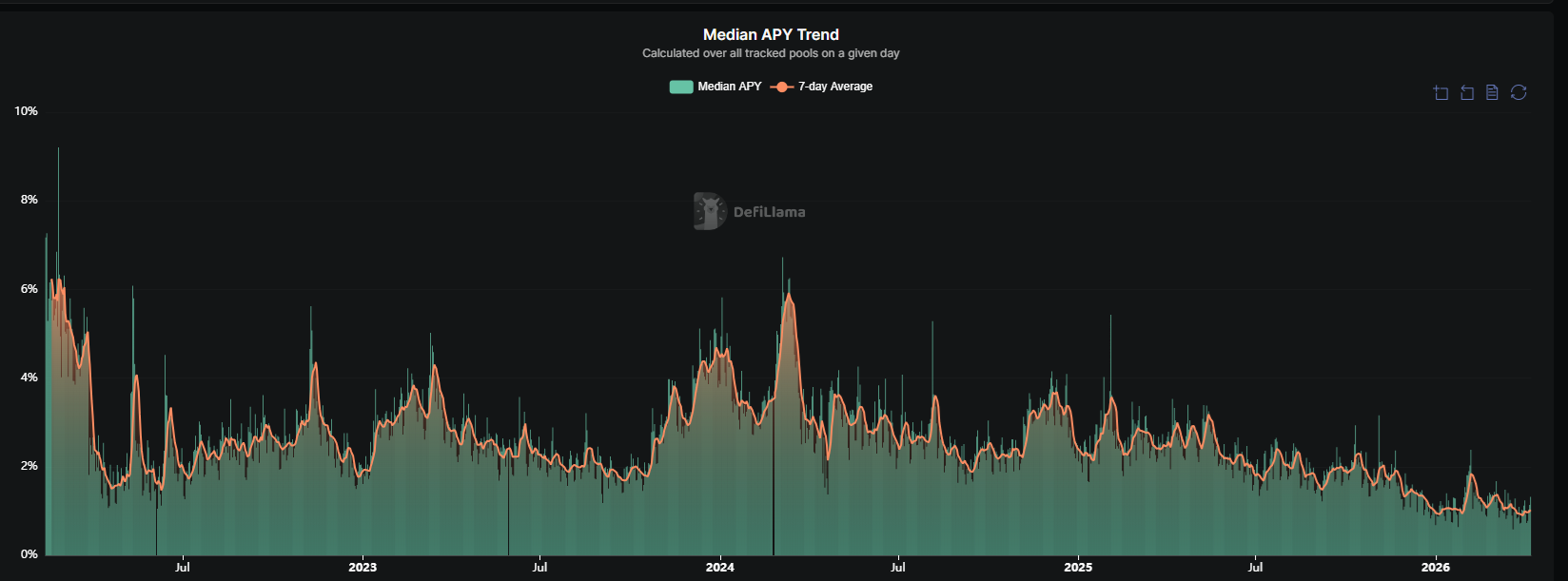
Is DeFi yield now too low to attract on-chain users?
Median DeFi yields have been sliding in the past year, and in some cases may be too low to offset locking assets on-chain. | Source: DeFiLlama.

There are also no more general periods of outsized yields, partially due to the more bearish outlook for the crypto market. High yields happen only during periods of hype, but the general enthusiasm ended with the first DeFi summer.

Especially for stablecoin liquidity pairs, yields are often under 0.5%. For Morpho, vault yield ranges from virtually zero to as much as 352% for the riskiest vaults. 

The recently exploited Drift Protocol offered relatively high yields of up to 16%, reflecting crypto risk partially. The protocol’s vaults were considered low-risk and mature, at least up to the $280M hack on April 1. 

If you're reading this, you’re already ahead. Stay there with our newsletter.

Disclaimer: For information purposes only. Past performance is not indicative of future results.
placeholder
Bitcoin CME gaps at $35,000, $27,000 and $21,000, which one gets filled first?Prioritize filling the $27,000 gap and even try higher.
Author  FXStreet
Aug 22, 2023
Prioritize filling the $27,000 gap and even try higher.
placeholder
Natural Gas sinks to pivotal level as China’s demand slumpsNatural Gas price (XNG/USD) edges lower and sinks to $2.56 on Monday, extending its losing streak for the fifth day in a row. The move comes on the back of China cutting its Liquified Natural Gas (LNG) imports after prices rose above $3.0 in June. It
Author  FXStreet
Jul 01, 2024
Natural Gas price (XNG/USD) edges lower and sinks to $2.56 on Monday, extending its losing streak for the fifth day in a row. The move comes on the back of China cutting its Liquified Natural Gas (LNG) imports after prices rose above $3.0 in June. It
placeholder
Bitcoin briefly loses 2025 gains as crypto plunges over the weekend.Bitcoin experienced a sharp decline this weekend, briefly erasing its 2025 gains and dipping below its year-opening value of $93,507. The cryptocurrency fell to a low of $93,029 on Sunday, representing a 25% drop from its all-time high in October. Although it has rebounded slightly to around $94,209, the pressures on the market remain significant. The downturn occurred despite the reopening of the U.S. government on Thursday, which many had hoped would provide essential support for crypto markets. This year initially appeared promising for cryptocurrencies, particularly after the inauguration of President Donald Trump, who has established the most pro-crypto administration thus far. However, ongoing political tensions—including Trump's tariff strategies and the recent government shutdown, lasting a historic 43 days—have contributed to several rapid price pullbacks for Bitcoin throughout the year. Market dynamics are also being influenced by Bitcoin whales—investors holding large amounts of Bitcoin—who have been offloading portions of their assets, consequently stalling price rallies even as positive regulatory developments emerge. Despite these sell-offs, analysts from Glassnode argue that this behavior aligns with typical patterns seen among long-term investors during the concluding stages of bull markets, suggesting it is not indicative of a mass exodus. Notably, Bitcoin is not alone in its struggles, as Ethereum and Solana have also recorded declines of 7.95% and 28.3%, respectively, since the start of the year, while numerous altcoins have faced even steeper losses. Looking ahead, questions linger regarding the viability of the four-year cycle thesis, particularly given the increasing institutional support and regulatory frameworks now in place in the crypto landscape. Matt Hougan, chief investment officer at Bitwise, remains optimistic, suggesting a potential Bitcoin resurgence in 2026 driven by the “debasement trade” thesis and a broader trend toward increased adoption of stablecoins, tokenization, and decentralized finance. Hougan emphasized the soundness of the underlying fundamentals, pointing to a positive outlook for the sector in the longer term.
Author  Mitrade
Nov 17, 2025
Bitcoin experienced a sharp decline this weekend, briefly erasing its 2025 gains and dipping below its year-opening value of $93,507. The cryptocurrency fell to a low of $93,029 on Sunday, representing a 25% drop from its all-time high in October. Although it has rebounded slightly to around $94,209, the pressures on the market remain significant. The downturn occurred despite the reopening of the U.S. government on Thursday, which many had hoped would provide essential support for crypto markets. This year initially appeared promising for cryptocurrencies, particularly after the inauguration of President Donald Trump, who has established the most pro-crypto administration thus far. However, ongoing political tensions—including Trump's tariff strategies and the recent government shutdown, lasting a historic 43 days—have contributed to several rapid price pullbacks for Bitcoin throughout the year. Market dynamics are also being influenced by Bitcoin whales—investors holding large amounts of Bitcoin—who have been offloading portions of their assets, consequently stalling price rallies even as positive regulatory developments emerge. Despite these sell-offs, analysts from Glassnode argue that this behavior aligns with typical patterns seen among long-term investors during the concluding stages of bull markets, suggesting it is not indicative of a mass exodus. Notably, Bitcoin is not alone in its struggles, as Ethereum and Solana have also recorded declines of 7.95% and 28.3%, respectively, since the start of the year, while numerous altcoins have faced even steeper losses. Looking ahead, questions linger regarding the viability of the four-year cycle thesis, particularly given the increasing institutional support and regulatory frameworks now in place in the crypto landscape. Matt Hougan, chief investment officer at Bitwise, remains optimistic, suggesting a potential Bitcoin resurgence in 2026 driven by the “debasement trade” thesis and a broader trend toward increased adoption of stablecoins, tokenization, and decentralized finance. Hougan emphasized the soundness of the underlying fundamentals, pointing to a positive outlook for the sector in the longer term.
placeholder
WTI Price Forecast: Seems vulnerable near $90.50 as technical breakdown comes into playWest Texas Intermediate (WTI) – the benchmark US Crude Oil price – plummets to a nearly two-week trough during the Asian session on Wednesday in reaction to news that the US and Iran have agreed to a two-week ceasefire.
Author  FXStreet
Yesterday 01: 48
West Texas Intermediate (WTI) – the benchmark US Crude Oil price – plummets to a nearly two-week trough during the Asian session on Wednesday in reaction to news that the US and Iran have agreed to a two-week ceasefire.
placeholder
Gold remains depressed as skepticism over US-Iran truce supports USDGold (XAU/USD) once again shows some resilience below the $4,700 mark during the Asian session on Thursday, and for now, seems to have stalled the previous day's retracement slide from a three-week high.
Author  FXStreet
6 hours ago
Gold (XAU/USD) once again shows some resilience below the $4,700 mark during the Asian session on Thursday, and for now, seems to have stalled the previous day's retracement slide from a three-week high.
goTop
quote