


Next Major Bitcoin Catalyst May Be A New ‘Big Print’: Expert
John Haar, managing director at Swan Private, says the policy response to COVID remains one of the clearest catalysts for Bitcoin adoption in recent years and argued that another large-scale round of money creation is likely a matter of when, not if. In an interview with Milk Road, Haar said the next “big print” may emerge within the next three to 24 months, driven by anything from war and banking stress to pension insolvency or AI-related labor disruption.
The Next Big Print Favors Bitcoin
Haar framed the argument less as a prediction of an imminent event and more as a recurring feature of the monetary system. He pointed to COVID-era stimulus and balance sheet expansion as a lived experience that changed how many investors thought about fiat risk and scarcity.
“Like you said, two big prints kind of in most people’s adult lifetime, and the most recent one being COVID,” Haar said. “And I can just say, I saw firsthand how many people that affected people to say, whoa, that, you know, as all those things I said, they can just print money, stimulus checks, et cetera, et cetera. But I also, this is not just a theory, because I’ve seen it firsthand, hundreds of clients at SWAN who I’ve talked to.”
That direct client experience appeared central to his point. Haar said one of the first questions he asks new clients is about their “Bitcoin story,” and he described a recurring pattern among those who entered the asset after witnessing the monetary and fiscal response to the pandemic. In his telling, COVID did not merely validate a macro thesis for existing Bitcoin holders; it created a new cohort of buyers who saw policy discretion up close and drew their own conclusions.
He tied that experience to a broader historical rhythm. Referencing Lawrence Lappard’s book The Big Print, Haar suggested that periodic bursts of money creation are not anomalies but episodes the system revisits “with some frequency.” He stopped well short of calling for an immediate repeat, however, and explicitly pushed back on near-term alarmism.
“I’m not one of these people who’s saying it’s going to happen next month,” Haar said. “That’s usually too premature. You should typically fade those calls. But I do think it is a matter of time.”
A notable part of Haar’s argument was psychological rather than purely macroeconomic. As the COVID shock recedes further into the rearview mirror, he said, investors risk slipping back into complacency. “As more years go by, this is just human nature,” he said, adding that people begin to forget “how crazy that monetary response was” and return to a kind of policy normalcy bias. In his view, that fading memory does not reduce the odds of another major intervention; it simply makes markets less mentally prepared for one.
He then laid out a range of possible triggers. A “large scale geopolitical war or military mobilization” was one, though he said current tensions do not yet qualify and would need to escalate much further. He also pointed to AI-driven labor displacement, state budget collapses, pension insolvency, renewed regional banking stress, a private credit crisis, structural entitlement expansion through programs such as Social Security, Medicaid, Medicare or student loan forgiveness, and major climate or natural disasters.
The next big print is coming (bookmark this).
Timeline: 3 to 24 months.
The triggers: AI job displacement, state budget collapses, pension insolvency, regional bank crises, geopolitical war.
“I believe that one of those things or multiple of those things will happen.” pic.twitter.com/1x1bgvl612
— Milk Road (@MilkRoad) March 22, 2026
“And then lastly, this has kind of been on the list for all of human history,” Haar said, “but if there’s some sort of major climate disaster or natural disaster, something like that could cause a big print. So I know I just threw a lot out there in the list, but I believe that one of those things or multiple of those things will happen at some point in the next, you know, three to 24 months.”
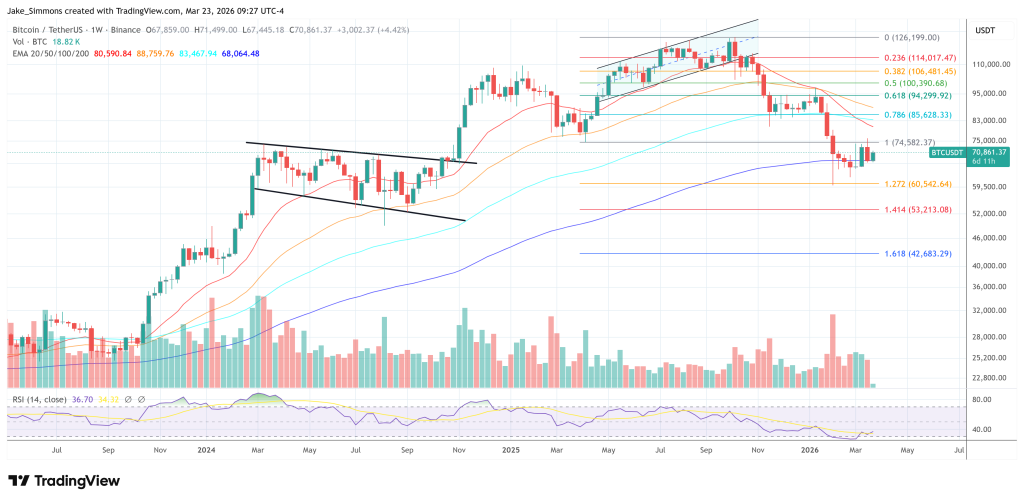
At press time, BTC traded at $70,861.
Recommended Articles


