

Ethereum Foundation unveils 'Strawmap' plan for Layer 1 upgrades through 2029

Source Fxstreet
  • Ethereum Foundation released Strawmap, outlining proposed Layer 1 upgrades and a structured timeline extending through 2029.
  • The roadmap highlights five north stars, including faster finality, higher throughput, post-quantum security, scalable Layer 2, and built-in privacy.
  • Vitalik Buterin proposed gradual reductions in slot time and faster finality to improve the user experience while maintaining network security.

The Ethereum Foundation (EF) has introduced Strawmap, outlining proposed Layer 1 upgrades through 2029, with goals focused on speed, scalability, security, privacy, and improved user experience.

Ethereum Foundation releases Strawmap, highlighting new protocol goals

The Ethereum Foundation’s Protocol team has introduced a new planning document called Strawmap, outlining a long-term vision for Ethereum’s Layer 1 development. The announcement was shared by Ethereum (ETH) researcher Justin Drake in an X post on Wednesday.

Strawmap combines the words “strawman” and “roadmap.” The document is designed to help researchers, developers, and governance participants understand how upcoming upgrades fit together. It presents Ethereum’s future upgrades in one visual format to encourage coordination across the ecosystem.

Strawmap outlines a projected timeline that runs through the end of the decade. It proposes seven network forks by 2029, following a rough six-month release cycle.
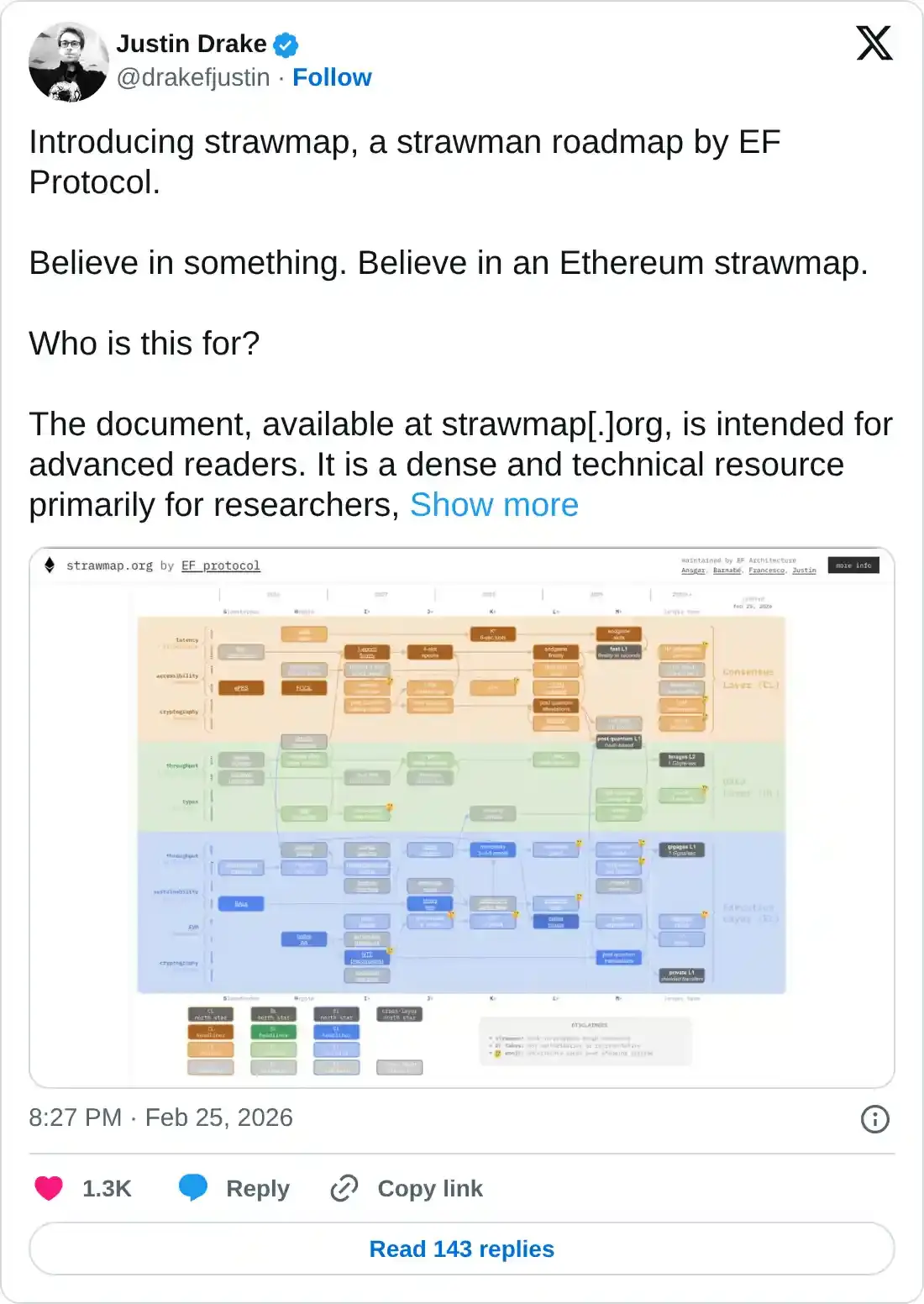
https://x.com/i/status/2026755969540108659

The layout features three color-coded horizontal layers representing the Consensus Layer, Data Layer, and Execution Layer. Within these, upgrades are grouped by themes, with arrows showing dependencies and underlined links to EIPs. Headliners are prominent, ambitious items, typically one per layer per fork to keep development cadence high.

At the core of the roadmap are five long-term priorities, described as “north stars.” These include building a faster Layer 1 to improve user experience with shorter slot times and near-instant finality. Another goal is a “gigagas” Layer 1 capable of processing around 1 gigagas per second, or roughly 10,000 transactions per second, powered by zkEVM technology and real-time proving. 

The roadmap also envisions a “teragas” Layer 2 that could handle up to 1 gigabyte per second, or about 10 million transactions per second, using data availability sampling. In addition, it targets a post-quantum Layer 1 secured by hash-based cryptography, as well as a private Layer 1 that enables native privacy features such as shielded ETH transfers.

Ethereum co-founder Vitalik Buterin responded to the proposal with a detailed explanation of how the “fast L1” goal could be achieved.

Buterin suggested gradually reducing slot times, which determine how often new blocks are produced.

He proposed using a square-root-of-two reduction method, moving step by step from 12 seconds to 8, then to 6, 4, 3, and possibly 2 seconds. He emphasized that the later reductions would depend on further research and testing.

“I expect that we’ll reduce slot time in an incremental fashion,” Buterin wrote, adding that changes would only happen when developers are confident the network can handle them safely.

He also discussed improving Ethereum’s peer-to-peer network by using tools such as erasure coding to reduce block propagation delays.

In addition to faster block times, Ethereum developers are exploring a new finality system called Minimmit, a one-round Byzantine Fault Tolerant mechanism. 

Strawmap was first developed during an Ethereum Foundation workshop in January 2026 to serve as a discussion framework rather than a fixed roadmap.

ETH is trading at $2,060 at the time of publication on Friday, down 0.1% over the past 24 hours.

Disclaimer: For information purposes only. Past performance is not indicative of future results.
placeholder
Bitcoin CME gaps at $35,000, $27,000 and $21,000, which one gets filled first?Prioritize filling the $27,000 gap and even try higher.
Author  FXStreet
Aug 22, 2023
Prioritize filling the $27,000 gap and even try higher.
placeholder
Natural Gas sinks to pivotal level as China’s demand slumpsNatural Gas price (XNG/USD) edges lower and sinks to $2.56 on Monday, extending its losing streak for the fifth day in a row. The move comes on the back of China cutting its Liquified Natural Gas (LNG) imports after prices rose above $3.0 in June. It
Author  FXStreet
Jul 01, 2024
Natural Gas price (XNG/USD) edges lower and sinks to $2.56 on Monday, extending its losing streak for the fifth day in a row. The move comes on the back of China cutting its Liquified Natural Gas (LNG) imports after prices rose above $3.0 in June. It
placeholder
Pinduoduo Earnings Incoming: Morgan Stanley Sees Long-Term Profit Potential​Insights – On November 21, Chinese e-commerce giant Pinduoduo (PDD) will release its Q3 2024 earnings.
Author  Mitrade
Nov 20, 2024
​Insights – On November 21, Chinese e-commerce giant Pinduoduo (PDD) will release its Q3 2024 earnings.
placeholder
Bitcoin briefly loses 2025 gains as crypto plunges over the weekend.Bitcoin experienced a sharp decline this weekend, briefly erasing its 2025 gains and dipping below its year-opening value of $93,507. The cryptocurrency fell to a low of $93,029 on Sunday, representing a 25% drop from its all-time high in October. Although it has rebounded slightly to around $94,209, the pressures on the market remain significant. The downturn occurred despite the reopening of the U.S. government on Thursday, which many had hoped would provide essential support for crypto markets. This year initially appeared promising for cryptocurrencies, particularly after the inauguration of President Donald Trump, who has established the most pro-crypto administration thus far. However, ongoing political tensions—including Trump's tariff strategies and the recent government shutdown, lasting a historic 43 days—have contributed to several rapid price pullbacks for Bitcoin throughout the year. Market dynamics are also being influenced by Bitcoin whales—investors holding large amounts of Bitcoin—who have been offloading portions of their assets, consequently stalling price rallies even as positive regulatory developments emerge. Despite these sell-offs, analysts from Glassnode argue that this behavior aligns with typical patterns seen among long-term investors during the concluding stages of bull markets, suggesting it is not indicative of a mass exodus. Notably, Bitcoin is not alone in its struggles, as Ethereum and Solana have also recorded declines of 7.95% and 28.3%, respectively, since the start of the year, while numerous altcoins have faced even steeper losses. Looking ahead, questions linger regarding the viability of the four-year cycle thesis, particularly given the increasing institutional support and regulatory frameworks now in place in the crypto landscape. Matt Hougan, chief investment officer at Bitwise, remains optimistic, suggesting a potential Bitcoin resurgence in 2026 driven by the “debasement trade” thesis and a broader trend toward increased adoption of stablecoins, tokenization, and decentralized finance. Hougan emphasized the soundness of the underlying fundamentals, pointing to a positive outlook for the sector in the longer term.
Author  Mitrade
Nov 17, 2025
Bitcoin experienced a sharp decline this weekend, briefly erasing its 2025 gains and dipping below its year-opening value of $93,507. The cryptocurrency fell to a low of $93,029 on Sunday, representing a 25% drop from its all-time high in October. Although it has rebounded slightly to around $94,209, the pressures on the market remain significant. The downturn occurred despite the reopening of the U.S. government on Thursday, which many had hoped would provide essential support for crypto markets. This year initially appeared promising for cryptocurrencies, particularly after the inauguration of President Donald Trump, who has established the most pro-crypto administration thus far. However, ongoing political tensions—including Trump's tariff strategies and the recent government shutdown, lasting a historic 43 days—have contributed to several rapid price pullbacks for Bitcoin throughout the year. Market dynamics are also being influenced by Bitcoin whales—investors holding large amounts of Bitcoin—who have been offloading portions of their assets, consequently stalling price rallies even as positive regulatory developments emerge. Despite these sell-offs, analysts from Glassnode argue that this behavior aligns with typical patterns seen among long-term investors during the concluding stages of bull markets, suggesting it is not indicative of a mass exodus. Notably, Bitcoin is not alone in its struggles, as Ethereum and Solana have also recorded declines of 7.95% and 28.3%, respectively, since the start of the year, while numerous altcoins have faced even steeper losses. Looking ahead, questions linger regarding the viability of the four-year cycle thesis, particularly given the increasing institutional support and regulatory frameworks now in place in the crypto landscape. Matt Hougan, chief investment officer at Bitwise, remains optimistic, suggesting a potential Bitcoin resurgence in 2026 driven by the “debasement trade” thesis and a broader trend toward increased adoption of stablecoins, tokenization, and decentralized finance. Hougan emphasized the soundness of the underlying fundamentals, pointing to a positive outlook for the sector in the longer term.
placeholder
WTI Price Forecast: Seems vulnerable near $90.50 as technical breakdown comes into playWest Texas Intermediate (WTI) – the benchmark US Crude Oil price – plummets to a nearly two-week trough during the Asian session on Wednesday in reaction to news that the US and Iran have agreed to a two-week ceasefire.
Author  FXStreet
Yesterday 01: 48
West Texas Intermediate (WTI) – the benchmark US Crude Oil price – plummets to a nearly two-week trough during the Asian session on Wednesday in reaction to news that the US and Iran have agreed to a two-week ceasefire.
Related Instrument
goTop
quote