


CZ Dismisses Centralization Fears Amid Scrutiny Over Binance’s Grip on USD1 Stablecoin
Binance is making headlines on social media for multiple reasons. Among them, a Forbes report revealed that the exchange and its users control the overwhelming majority of USD1, a stablecoin issued by World Liberty Financial (WLFI).
With the WLFI venture linked to US President Donald Trump and his family, the disclosure has sparked debate over concentration risk, exchange influence, and the growing overlap between crypto markets and politics.
Binance’s USD1 Dominance Rekindles Debate Over Stablecoin Centralization
A February 9 Forbes investigation found that Binance holds approximately 87% of USD1’s circulating supply—around $4.7 billion out of roughly $5.4 billion in total.
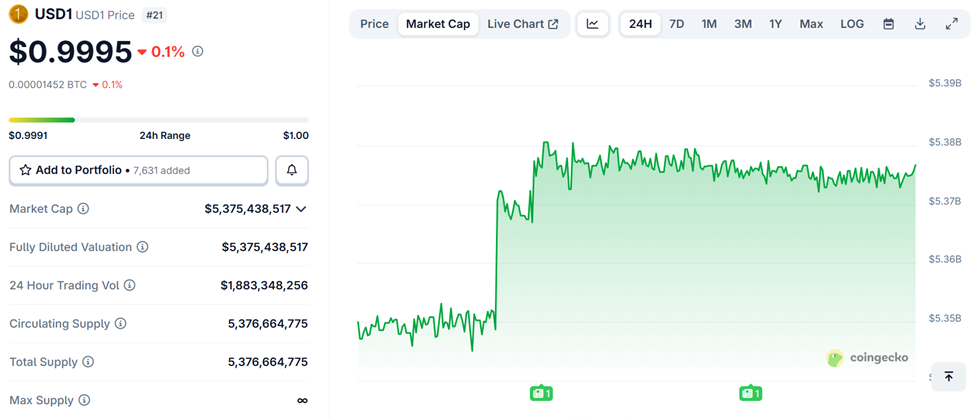 USD1 Circulating Supply. Source: CoinGecko
According to the report, this represents the highest single-exchange concentration recorded among major stablecoins. Blockchain analytics data from Arkham Intelligence corroborates this data.
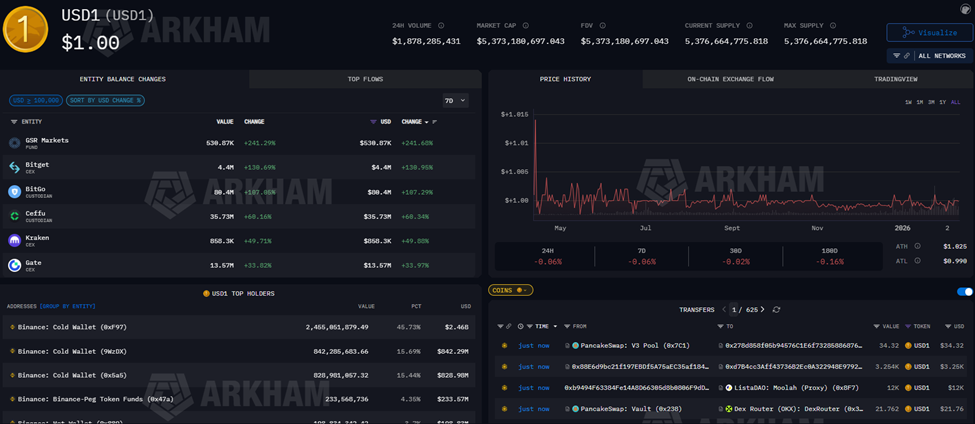 USD1 Concentration on Binance. Source: Arkham Intelligence
The findings fuel discussions about whether such a high level of concentration could create systemic risks or undermine the decentralization narrative often associated with stablecoins.
CZ Pushes Back on Centralization Narrative
Changpeng Zhao (CZ), the founder and former CEO of Binance, responded publicly to the debate, dismissing the concerns as overstated. In posts on X (Twitter), CZ argued that Binance historically holds large shares of many stablecoins simply because of its scale as the largest exchange.
“Binance (users) hold the largest % of most stablecoins (USDT, USDC, USD1, U … you name it) compared to all other CEXs. Not news,” wrote CZ.
Further, the Binance executive noted that when measuring centralized exchange holdings broadly, Binance typically accounts for roughly 60–70% across multiple assets.
Supporters echoed that view, arguing that the assets largely belong to customers rather than the exchange itself, and that high concentrations on a dominant trading venue are not unusual in crypto markets.
Political Links Add Fuel to the Debate
USD1’s ties to World Liberty Financial have amplified the controversy. WLFI, launched in 2024, lists Trump as co-founder emeritus alongside Donald Trump Jr., Eric Trump, and Barron Trump.
A Trump-affiliated entity reportedly owns a significant stake in the company, and financial disclosures show Trump earned tens of millions of dollars from the venture.
The Forbes report also noted that promotions tied to USD1 may have contributed to the concentration. In late January, Binance hosted campaigns and incentives linked to WLFI tokens, including distributions designed to reward USD1 holders. Such promotions can quickly increase liquidity on a single platform, particularly when paired with new trading pairs and marketing efforts.
These developments have led some analysts to question whether exchange incentives can shape the distribution of stablecoins more than organic market demand.
Analysts Warn of Concentration Risks
The general sentiment is that heavy concentration at a single exchange introduces theoretical risks, even if immediate threats to stability are limited.
These risks could include counterparty exposure in extreme scenarios or the potential for exchanges to exert influence over liquidity and market structure.
Independent crypto researcher Molly White described the concentration as unusual, though not entirely surprising given Binance’s role in promoting USD1.
She noted that high concentration can create leverage dynamics and raises questions about ownership transparency in large exchange-held balances.
Others were more critical. Former SEC adviser Corey Frayer argued that the structure and distribution of USD1 raise broader concerns about the stablecoin’s purpose and governance, as well as the identities of major holders behind large exchange balances.
“USD1 was never meant to be a real stablecoin,” Forbes reported, citing Frayer.
Binance and World Liberty Financial have both denied that the concentration implies control or undue influence.
Binance has described its involvement as limited to standard listing, infrastructure, and market-access services. Meanwhile, WLFI representatives have characterized exchange listings as a normal distribution channel.
Nevertheless, the episode has reignited a deeper industry debate: whether stablecoins can truly function as neutral financial infrastructure when liquidity and user activity are heavily concentrated on centralized platforms.
Recommended Articles


