


Bitcoin Bulls Hear ‘Fed–Treasury Accord’ And Smell Yield-Curve Control
Kevin Warsh’s push for a new Fed–Treasury “accord” is reigniting a familiar market argument: whether Washington is drifting toward a softer-rate, higher-liquidity regime that tends to favor hard assets, including bitcoin and crypto, even if it raises the stakes for bonds.
The debate flared after Bloomberg reported that Kevin Warsh floated the idea of “a new accord with the Treasury Department,” echoing the 1951 agreement that redefined the relationship between the two institutions. Bloomberg reported over the weekend that the concept could amount to a limited bureaucratic revamp, but a more ambitious effort could “see increased volatility and concern over the US central bank’s independence,” depending on how explicitly it links the Fed’s balance sheet decisions to Treasury financing.
Looming over the idea is the political pressure to treat debt-service costs as a policy constraint. Bloomberg pointed to interest costs “running at an annual clip of around $1 trillion,” and quoted SGH Macro Advisors’ Tim Duy warning that an accord could be read as something more than process reform. “Rather than insulating the Fed, it could look more like a framework for yield-curve control,” Duy said. “A public agreement that synchronizes the Fed’s balance sheet with Treasury financing explicitly ties monetary operations to deficits.”
Can Bitcoin Get The Bid?
In bitcoin circles, the accord conversation is being interpreted through the lens of yield-curve control (YCC) and debt monetization, not just the path of the policy rate. Luke Gromen framed it bluntly, citing a recent FFTT view: “Our base case is that Warsh will be as dovish as Trump needs.” He added a familiar punchline for macro traders: “Math > Narratives (again).”
“Our base case is that Warsh will be as dovish as Trump needs.” -FFTT, last week
Math > Narratives (again) pic.twitter.com/aHMDlz2jzM
— Luke Gromen (@LukeGromen) February 8, 2026
Analyst Lukas Ekwueme took the argument further: “Warsh, the next Fed chair, will inflate the debt away. He is in favor of yield curve control. This means pegging US short-term interest rates to an artificially low level. The Fed commits to buying unlimited amounts above that level to push interest rates down.”
In that telling, the Fed pegs yields at “an artificially low level” and backs the peg with potentially unlimited purchases — a structure Ekwueme compared to the World War II era. He argued the political logic is straightforward: nominating someone “more hawkish than Powell” would clash with Trump’s prior attacks on the Fed for being too hawkish, making a dovish tilt the more consistent outcome.
Bull Theory, a crypto-focused account, echoed the historical parallel while stressing that Warsh’s public framing is also about reducing the Fed’s entanglement in long-duration government financing. The account argued Warsh could prefer a portfolio shift toward Treasury bills, a smaller balance sheet, and clearer limits on when large bond-buying programs can occur — potentially with “closer coordination with the Treasury on debt issuance.” But it also warned the market shouldn’t confuse “limits” with “tightening” if the end result is a policy mix that suppresses real yields and keeps liquidity conditions easy.
CoinFund President Christopher Perkins added: “I continue to think that the crypto markets got the Warsh appointment wrong. A new Fed-Treasury Accord is the plan…has been all along. Additional coordination, or any shift in responsibilities to Scott Bessent and the US Treasury will bullish for crypto IMO–once things settle. At least for the next 3 years.”
For bitcoin, the central question is the direction of real yields and the credibility of the “independence” anchor because both feed into how investors price fiat debasement risk and liquidity scarcity.
The pro-crypto interpretation is consistent: if an accord evolves into a framework that caps parts of the curve or otherwise lowers real yields, it can push capital out the risk-free complex and into assets that behave like inflation hedges or duration substitutes. Bull Theory put it in plain terms: “If Warsh’s framework leads to lower real yields, rate cuts, and easier liquidity conditions, that usually supports risk assets like equities, gold, and crypto. Because when bond returns fall, capital looks for higher-return alternatives.”
The caveat is that the same setup could increase volatility in rates markets. Bloomberg flagged that an ambitious accord could spook investors about the Fed’s independence, while Bull Theory argued that reduced Fed support for long-term yields alongside heavy Treasury issuance could steepen the curve and lift term premiums.
For crypto traders, that combination can create a two-speed regime: supportive liquidity narratives on one hand, and sudden risk-off impulses if bond volatility spills into broader financial conditions.
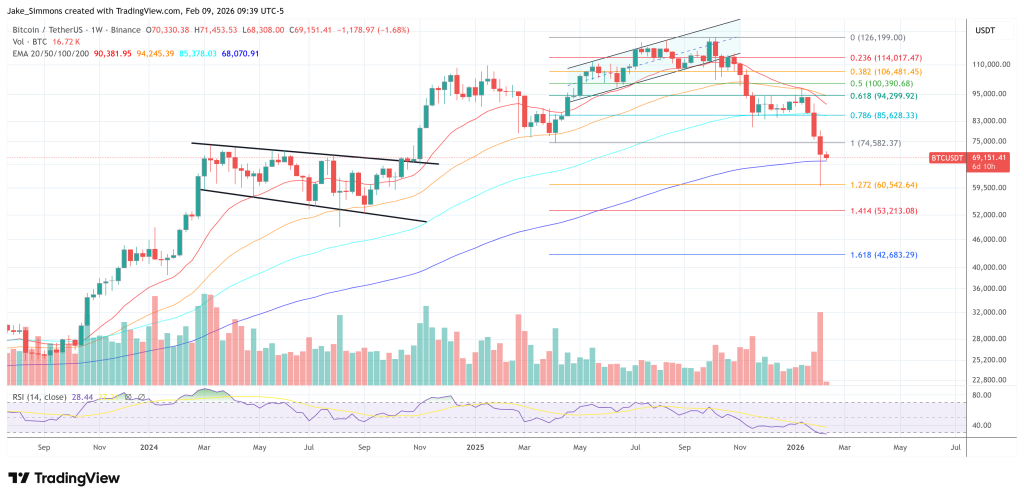
At press time, BTC traded at $69,151.
Recommended Articles


