


How To Price XRP? Ripple CTO Says The Answer Isn’t In The Ledger
What gives XRP its value? In an exchange on X, Ripple CTO David Schwartz – known as “JoelKatz” – tried to answer that question without pretending crypto already behaves like traditional assets. He didn’t lean on marketing language about instant settlement or global payments. He talked about power, control, censorship, incentive design, and speculation.
How Does XRP Get Its Value?
First, Schwartz reframed what XRP is actually for. He argued that the XRP Ledger is built for people and institutions that don’t want an intermediary sitting in the middle of their transactions. He put it in blunt terms: “Do you want to use a blockchain where people can be their own bank and no middlemen tax their transactions or do you want to be someone else’s bank and tax their transactions? If you want the latter, there are dozens of blockchains for you. If you want the former, there’s XRP.”
In that framing, XRP is not just another token. It’s the only counterparty-free asset native to XRPL. Everything else on the ledger is an IOU from someone – a promise by an issuer, bank, fintech, money transmitter, or gateway. XRP is the exception. It exists on-ledger, without an issuer, and can move between any accounts without anyone else’s permission, freeze authority, or seizure authority.
Schwartz made that explicit: “XRP is the only asset without a counterparty that can be accessed by every account in every jurisdiction with no risk of default, freeze, or clawback.”
That point is central to how Ripple has always positioned XRP: the ledger is multi-currency, but only one asset on it is universally clean. What Schwartz is arguing is that this special status is not cosmetic. It is economic. He said: “I do think XRP’s special place on XRPL ensures that XRP will capture some of the value XRPL transactions generate.”
To understand that claim, you have to understand how most blockchains try to “capture value.” The dominant 2020–2025 playbook in crypto is explicit extraction. Protocols design fee switches, burn mechanisms, staking capture, MEV capture, sequencer rent, or other tolls, and then say to the market: holding this token entitles you to a share of that toll.
Schwartz is openly saying XRPL is not built like that. The XRP Ledger was not designed to tax users at the protocol layer. In his view, that’s a feature, not a bug. He described XRPL as a public good, not a rent machine.
He explained it by analogy: “When you ask what eBay is good for, you normally don’t think about it being a good way to enrich the people who invest in eBay. You think of it as a way of bringing buyers and sellers together with the buyers and sellers wanting the costs to be as low as possible. The buyers and sellers shouldn’t want eBay’s investors taxing their transactions as much as they can get away with because that is mostly money the buyers have to pay but sellers don’t get.”
Then he applied that logic directly to XRPL: “I think of XRPL as a public good that doesn’t tax people who want to use its capabilities. I am not arguing that it is the best design or even that it’s better than most other designs. But it is different. XRP really is about being your own bank and having no middlemen passively taxing your transactions.”
XRP Price Is Driven By Speculation
This is where the philosophical tension becomes an economic tension. If XRPL is designed not to skim value from users, then how does XRP appreciate? Why should holding XRP benefit from the ledger’s success?
Schwartz’s answer is that XRP’s role as the only universal, non-freezable settlement asset on XRPL is itself enough to force some level of demand if XRPL becomes important infrastructure. In other words, the ledger doesn’t have to tax flow in order for XRP to matter. XRP matters if the ledger matters.
But Schwartz did not pretend that this mechanism is currently driving price on its own. In fact, he went in the opposite direction and said something most executives in crypto either won’t admit or can’t afford to say in public.
He said the market is still pricing the future, not the present: “The funny thing is that I think that most of the value of most cryptocurrencies comes from expected future speculation. So if what you care about future price changes, what people think will happen is much more important than what has happened.”
Then he pointed at bitcoin to make the point unavoidable: “Look at bitcoin. Most of the current investment thesis is something like, ‘Imagine if most companies start storing 1% of their treasury in bitcoin, what will that do to the price?’. What that’s saying is that in the future, more people will speculate on future price appreciation than speculate currently.”
And he went even further: “It’s not even based on expected future utility, it’s based on expected future speculation! I want to believe utility matters, I really do.”
That last line is probably the most revealing thing Schwartz said. He is not saying “XRP price today is purely a function of measurable payment volume today.” He’s saying that’s not how crypto is priced, period. Crypto, in his view, is reflexive: people buy because they believe other people will one day buy for the same reason, at higher size and higher urgency.
That leads to the next objection: if value is driven by expectation of an “explosion scenario,” shouldn’t tokens be basically worthless until that scenario actually hits scale?
Schwartz rejected that. He argued that markets continuously reprice probability, not outcomes: “There may come a day when we look at today’s cryptocurrency values as, in comparison, nothing. But the idea that values will be very low and then suddenly rise is just not how speculation works. As the probability of explosion or size of expected explosion grows, value follows.”
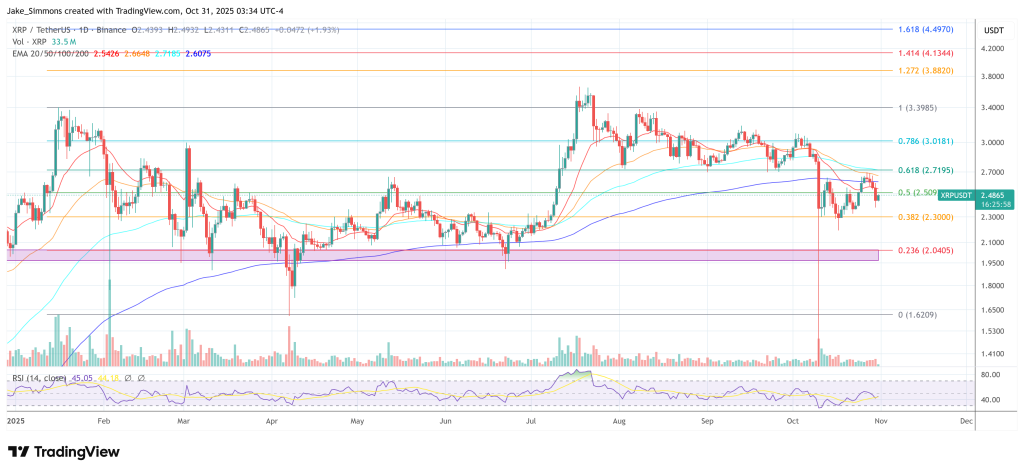
At press time, XRP traded at $2.48.
Recommended Articles


