


Gold rises as safe-haven demand increases on Iran war
- Gold climbs on safe-haven demand amid the ongoing Iran war.
- The Iran conflict enters day six, with US-Israeli strikes and broad Iranian retaliation across the Middle East.
- Dollar-denominated Gold gains as the USD declines on fragile hopes of a shorter Middle East conflict.
Gold price (XAU/USD) extends its gains for the second successive session on Thursday as traders seek safety amid the ongoing war in the Middle East. The Iran conflict has entered its sixth day with US and Israeli strikes across Iranian territory and widespread Iranian missile and drone retaliation across the Middle East, including attacks on regional targets and military sites, prolonging the crisis and its impact.
A US submarine reportedly sank an Iranian warship off the coast of Sri Lanka, escalating hostilities. US Defense Secretary Pete Hegseth called it the “first such attack on an enemy since World War II.” The broader campaign has entered its sixth day, heightening fears of a prolonged conflict.
The dollar-denominated Gold attracts investors as the US Dollar (USD) weakens on tentative hopes that the Middle East conflict may be shorter than feared. It is worth noting that a weaker US Dollar makes the precious metal cheaper for buyers with foreign currencies, boosting demand.
Reuters cited The New York Times reporting that Iran’s Ministry of Intelligence signalled to the US Central Intelligence Agency (CIA) a willingness to explore talks to end the war. However, Tehran later denied the report, leaving the conflict’s duration and economic fallout uncertain.
Meanwhile, the US is set to introduce a temporary 15% global tariff this week, replacing the 10% rate enacted after the Supreme Court invalidated most of President Donald Trump’s earlier levies. Treasury Secretary Scott Bessent said the rate could return to previous levels within five months as fresh trade probes advance.
The upside in non-yielding Gold may be capped as surging oil and gas prices rekindle inflation fears, prompting traders to push back expectations for Federal Reserve (Fed) rate cuts. Meanwhile, the US 10-year Treasury yield rose for a fourth straight session, climbing to 4.11% as markets assessed developments in the Iran conflict, tariff updates, and incoming economic data.
Gold rises to near $5,200 as bullish bias prevails
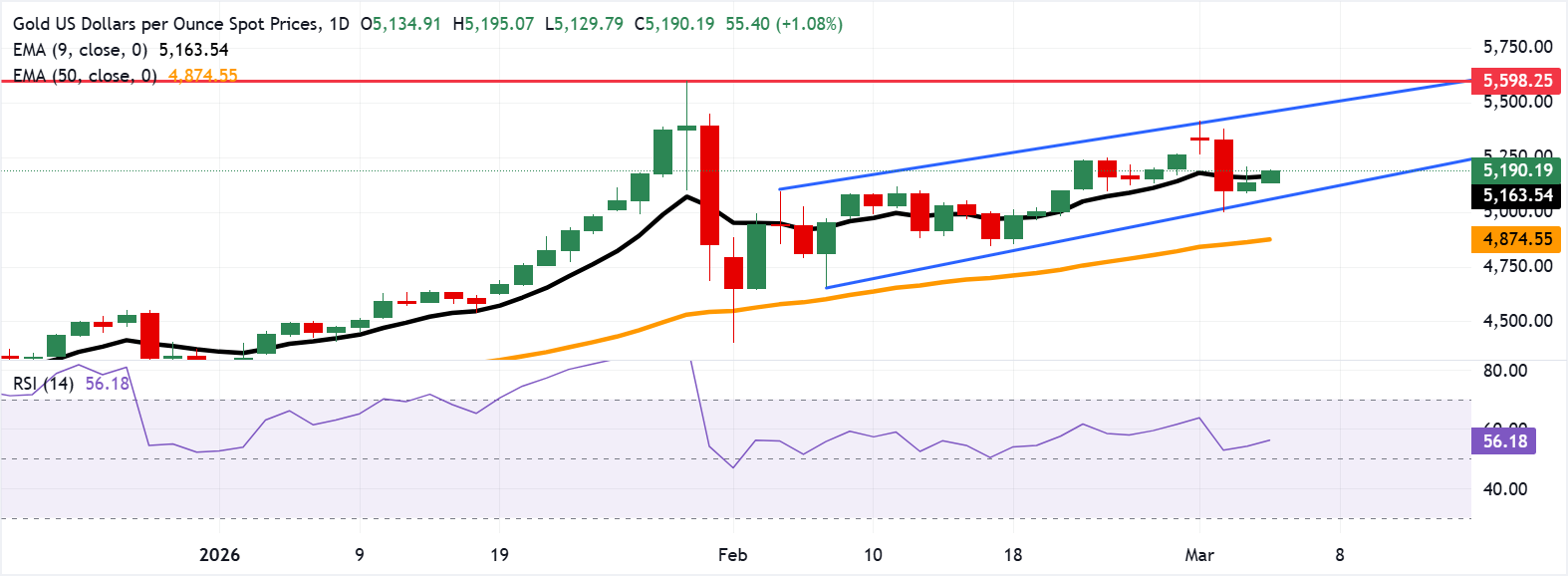
Gold price (XAU/USD) is trading around $5,190 at the time of writing. The technical analysis of the daily chart suggests bullish bias as the metal price remains within the ascending channel pattern.
Additionally, the near-term bias is mildly bullish as the Gold price holds above the rising 50-day Exponential Moving Average (EMA) and consolidates after reclaiming the short-term nine-day EMA, which now tracks just below the market. Momentum remains positive but not overstretched, with the 14-day Relative Strength Index (RSI) hovering in the mid-50s, indicating steady buying pressure rather than exuberant strength and keeping scope for further upside while this structure persists.
The XAU/USD pair may explore the region around the upper boundary of the ascending channel at $5,470, followed by the all-time high of $5,598, reached on January 29. On the downside, the immediate support lies at the nine-day EMA of $5,163, followed by the lower boundary of the channel at $5,070. A break below the channel would expose the 50-day EMA at $4,874.
(The technical analysis of this story was written with the help of an AI tool.)
Gold FAQs
Gold has played a key role in human’s history as it has been widely used as a store of value and medium of exchange. Currently, apart from its shine and usage for jewelry, the precious metal is widely seen as a safe-haven asset, meaning that it is considered a good investment during turbulent times. Gold is also widely seen as a hedge against inflation and against depreciating currencies as it doesn’t rely on any specific issuer or government.
Central banks are the biggest Gold holders. In their aim to support their currencies in turbulent times, central banks tend to diversify their reserves and buy Gold to improve the perceived strength of the economy and the currency. High Gold reserves can be a source of trust for a country’s solvency. Central banks added 1,136 tonnes of Gold worth around $70 billion to their reserves in 2022, according to data from the World Gold Council. This is the highest yearly purchase since records began. Central banks from emerging economies such as China, India and Turkey are quickly increasing their Gold reserves.
Gold has an inverse correlation with the US Dollar and US Treasuries, which are both major reserve and safe-haven assets. When the Dollar depreciates, Gold tends to rise, enabling investors and central banks to diversify their assets in turbulent times. Gold is also inversely correlated with risk assets. A rally in the stock market tends to weaken Gold price, while sell-offs in riskier markets tend to favor the precious metal.
The price can move due to a wide range of factors. Geopolitical instability or fears of a deep recession can quickly make Gold price escalate due to its safe-haven status. As a yield-less asset, Gold tends to rise with lower interest rates, while higher cost of money usually weighs down on the yellow metal. Still, most moves depend on how the US Dollar (USD) behaves as the asset is priced in dollars (XAU/USD). A strong Dollar tends to keep the price of Gold controlled, whereas a weaker Dollar is likely to push Gold prices up.
Recommended Articles


