


EUR/USD trims losses amid US Dollar's weakness in risk-off markets
- The Euro picks up from weekly lows but struggles to return above 1.1600.
- The pair is trading within Monday's range, with investors wary of taking excessive risk.
- ADP's weekly reading and US Factory Orders data might set the US Dollar's direction on Tuesday.
EUR/USD recovers some of the last two days' losses, trading around 1.1600 at the time of writing on Tuesday after hitting lows at 1.1585. Investors, however, remain cautious about placing large US Dollar (USD) short bets, awaiting a backlog of US economic data later this week.
US data released on Monday beat expectations, with the New York manufacturing Index improving to the highest level in nearly one year in November, and construction spending, the first of a large array of delayed data releases, increasing against expectations in August.
However, Federal Reserve (Fed) Governor Christopher Waller warned that the adoption of Artificial Intelligence (AI) technology will weaken demand for employment by US businesses and that the central bank will have to be ready to respond by cutting interest rates.
All in all, hopes of a Fed rate cut in December remain steady below 50% with investors awaiting more economic data. The European calendar is practically void on Tuesday, but in the US, the ADP weekly employment report and Factory Orders data will give some fundamental background for the US Dollar. The highlight of the week, however, will be September's Nonfarm Payrolls report, due on Thursday.
Euro Price Today
The table below shows the percentage change of Euro (EUR) against listed major currencies today. Euro was the strongest against the Australian Dollar.
| USD | EUR | GBP | JPY | CAD | AUD | NZD | CHF | |
|---|---|---|---|---|---|---|---|---|
| USD | -0.05% | 0.04% | -0.06% | 0.02% | 0.25% | 0.12% | -0.28% | |
| EUR | 0.05% | 0.08% | 0.00% | 0.07% | 0.30% | 0.17% | -0.22% | |
| GBP | -0.04% | -0.08% | -0.10% | -0.01% | 0.21% | 0.09% | -0.32% | |
| JPY | 0.06% | 0.00% | 0.10% | 0.10% | 0.31% | 0.17% | -0.22% | |
| CAD | -0.02% | -0.07% | 0.01% | -0.10% | 0.23% | 0.10% | -0.30% | |
| AUD | -0.25% | -0.30% | -0.21% | -0.31% | -0.23% | -0.13% | -0.52% | |
| NZD | -0.12% | -0.17% | -0.09% | -0.17% | -0.10% | 0.13% | -0.40% | |
| CHF | 0.28% | 0.22% | 0.32% | 0.22% | 0.30% | 0.52% | 0.40% |
The heat map shows percentage changes of major currencies against each other. The base currency is picked from the left column, while the quote currency is picked from the top row. For example, if you pick the Euro from the left column and move along the horizontal line to the US Dollar, the percentage change displayed in the box will represent EUR (base)/USD (quote).
Daily digest market movers: Currencies waver within range amid cautious markets
- The Euro (EUR) recovers some of the previous losses but remains trading within a narrow range. Traders await more US data for a clearer picture of the US economy and the Fed's monetary easing prospects.
- On Monday, the New York Empire State Manufacturing Index beat expectations with an increase to 18.7 in November, from October's10.7 reading and against market expectations of a deterioration to 6.0
- In the same line, Construction Spending rose 0.2% in August, according to a delayed release from the US Census Bureau, beating expectations of a 0.1% decline. Apart from that, July's reading was revised up to a 0.2% gain from the 0.1% contraction previously reported.
- August's factory orders are expected to bounce to a 1.4% increase, compared to the 1.3% decline seen in July, the last release before the US government shutdown.
- Apart from that, speeches from Federal Reserve Governor Michael Barr and Richmond Fed President Thomas Barkin might give some more clues about the outcome of December's meeting.
Technical Analysis: EUR/USD remains on the defensive near 1.1600
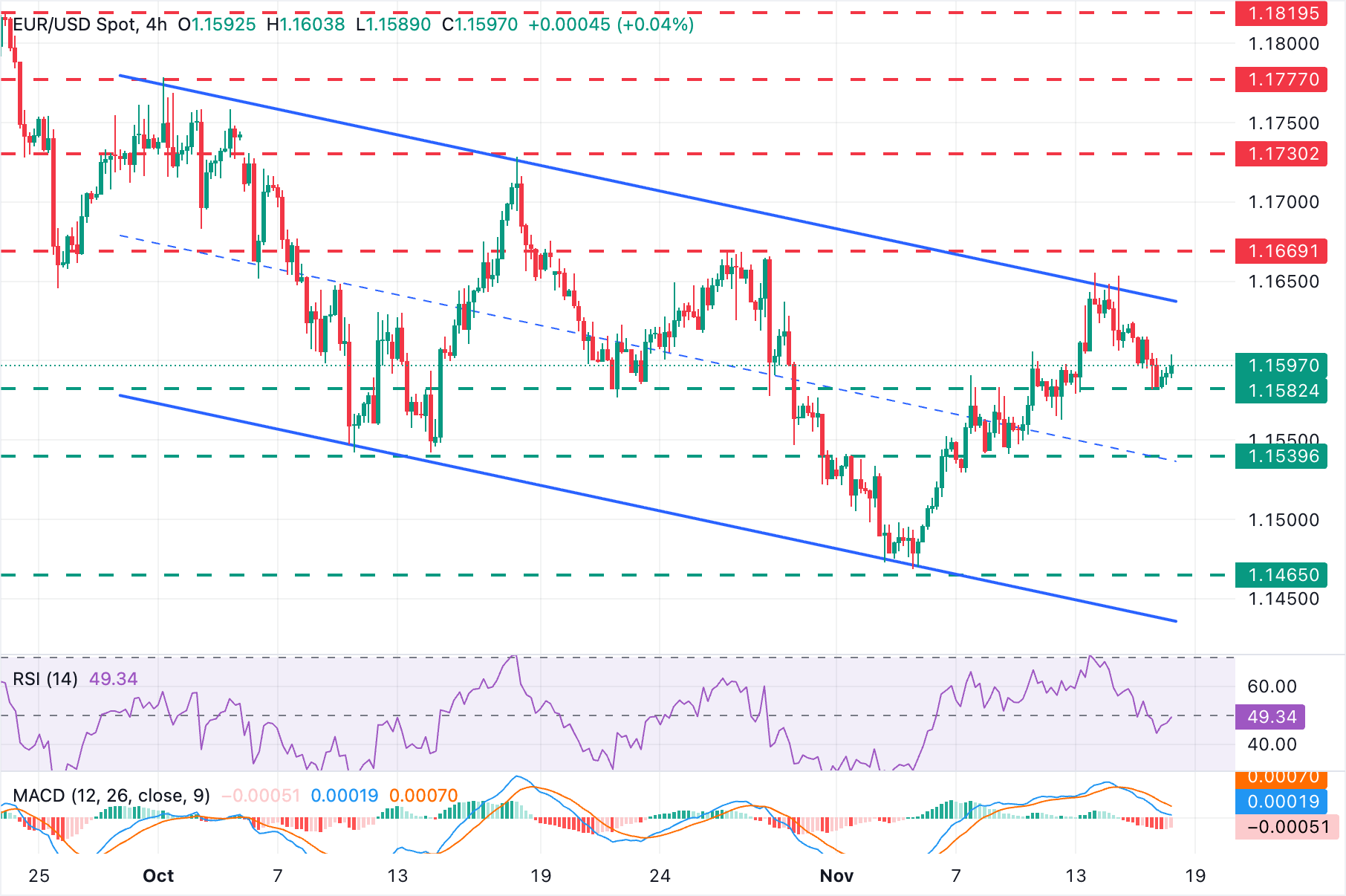
EUR/USD is bouncing up from lows, but the pair's recovery attempts remain frail so far, with the cautious market mood not particularly supportive. Bulls are struggling to return above 1.1600. The 4-hour Relative Strength Index (RSI) indicator remains below the key 50 level, and the Moving Average Convergence Divergence (MACD) is trending lower. In this context, the pair is likely to remain on the defensive.
The broader picture shows the pair pulling back from a trendline resistance, with Monday's low at 1.1585 still at a short distance. Further down, the November 7, 10, and 11 lows in the 1.1535-1.1545 area, and the November 5 lows, near 1.1470, emerge as the next bearish targets.
To the upside, a previous support area around 1.1610 is holding bulls ahead of the top of the bearish channel, which now lies at the 1.1635 area. Above, the October 28 and 29 highs around 1.1670 would come into focus.
Risk sentiment FAQs
In the world of financial jargon the two widely used terms “risk-on” and “risk off'' refer to the level of risk that investors are willing to stomach during the period referenced. In a “risk-on” market, investors are optimistic about the future and more willing to buy risky assets. In a “risk-off” market investors start to ‘play it safe’ because they are worried about the future, and therefore buy less risky assets that are more certain of bringing a return, even if it is relatively modest.
Typically, during periods of “risk-on”, stock markets will rise, most commodities – except Gold – will also gain in value, since they benefit from a positive growth outlook. The currencies of nations that are heavy commodity exporters strengthen because of increased demand, and Cryptocurrencies rise. In a “risk-off” market, Bonds go up – especially major government Bonds – Gold shines, and safe-haven currencies such as the Japanese Yen, Swiss Franc and US Dollar all benefit.
The Australian Dollar (AUD), the Canadian Dollar (CAD), the New Zealand Dollar (NZD) and minor FX like the Ruble (RUB) and the South African Rand (ZAR), all tend to rise in markets that are “risk-on”. This is because the economies of these currencies are heavily reliant on commodity exports for growth, and commodities tend to rise in price during risk-on periods. This is because investors foresee greater demand for raw materials in the future due to heightened economic activity.
The major currencies that tend to rise during periods of “risk-off” are the US Dollar (USD), the Japanese Yen (JPY) and the Swiss Franc (CHF). The US Dollar, because it is the world’s reserve currency, and because in times of crisis investors buy US government debt, which is seen as safe because the largest economy in the world is unlikely to default. The Yen, from increased demand for Japanese government bonds, because a high proportion are held by domestic investors who are unlikely to dump them – even in a crisis. The Swiss Franc, because strict Swiss banking laws offer investors enhanced capital protection.
Recommended Articles


