


Japanese Yen languishes near multi-month low against bullish USD amid BoJ uncertainty
- The Japanese Yen continues to be undermined by the BoJ rate hike uncertainty.
- Receding safe-haven demand further weighs on the JPY amid a bullish US Dollar.
- The Fed’s hawkish tilt supports the USD despite the US government shutdown.
The Japanese Yen (JPY) remains on the defensive against a bullish US Dollar (USD) at the start of a new week and is currently placed near its lowest level since February 14, touched last Thursday. Traders remain uncertain about the timing of the next rate hike by the Bank of Japan (BoJ) amid speculations that Japan's new Prime Minister Sanae Takaichi will pursue aggressive fiscal spending plans and resist policy tightening. This, to a larger extent, overshadows strong consumer inflation figures from Tokyo – Japan's capital city – released on Friday and continues to weigh on the JPY.
Moreover, the upbeat mood across the global financial markets is seen undermining the JPY's safe-haven status. The USD, on the other hand, stands firm near its highest level since early August and seems poised to climb further on the back of the US Federal Reserve's (Fed) hawkish tilt. This further lends support to the USD/JPY pair and backs the case for additional near-term gains. However, concerns about economic risks stemming from a prolonged US government shutdown and speculations that Japanese authorities could intervene to stem further JPY weakness might cap the currency pair.
Japanese Yen bears retain control as hopes for fiscal stimulus continue to fuel BoJ uncertainty
- The Bank of Japan held rates steady last Thursday despite two dissenting votes, with board members Naoki Tamura and Hajime Takata pushing for a hike to 0.75%. In the post-meeting press conference, BoJ Governor Kazuo Ueda said that there are no preset ideas about the timing of the next rate hike.
- Moreover, Japan's new Prime Minister, Sanae Takaichi, has a pro-stimulus stance, advocating for significant fiscal spending to tackle inflation and boost the economy. This reaffirms expectations that the BoJ could delay raising interest rates further and continues to undermine the Japanese Yen on Monday.
- Meanwhile, traders trimmed their bets for another interest rate cut by the US central bank in December following Federal Reserve Chair Jerome Powell's hawkish comments last Wednesday. This assists the US Dollar to stand firm near a three-month peak and further acts as a tailwind for the USD/JPY pair.
- US President Donald Trump again urged Republican senators to scrap the filibuster rule in the Senate as the US government shutdown enters Day 33 on Monday amid a deadlock in Congress. This, however, does little to dent the underlying bullish sentiment surrounding the USD or the currency pair.
- Trump said on Sunday that, for now, he is not considering a deal that would allow Ukraine to obtain long-range Tomahawk missiles for use against Russia. This, along with the optimism over the de-escalation of US-China trade tensions, undermines the JPY's safe-haven status and favors the USD/JPY bulls.
- Traders now look forward to the US economic docket – featuring the release of the ISM Manufacturing PMI. Apart from this, comments from influential FOMC members would play a key role in driving the USD demand and providing some impetus to the currency pair later during the North American session.
USD/JPY seems poised to climb further towards reclaiming the 155.00 psychological mark
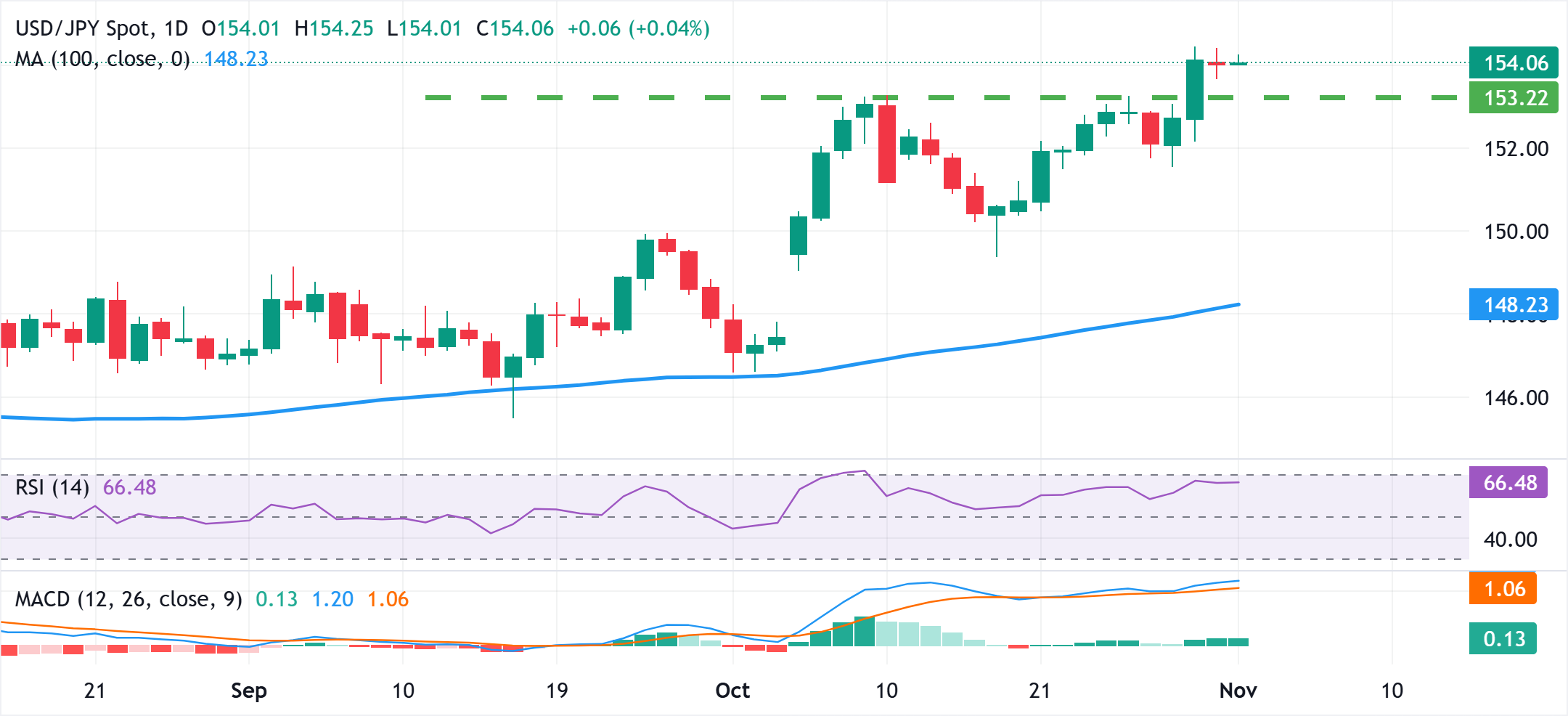
From a technical perspective, last week's breakout through the 153.25-153.30 hurdle, and a subsequent strength beyond the 154.00 mark, was seen as a key trigger for the USD/JPY bulls. Moreover, oscillators on the daily chart are holding comfortably in positive territory and are still away from being in the overbought zone. This, in turn, backs the case for a move towards the 154.75-154.80 intermediate hurdle en route to the 155.00 psychological mark.
On the flip side, any corrective pullback below the 154.00 mark is likely to find decent support near Friday's trough, around the 153.65 region. This is followed by the 153.30-153.25 resistance-turned-support and the 153.00 round figure, which, if broken decisively, might expose the 152.15 region. Some follow-through selling below the 152.00 mark would negate the near-term positive bias and drag the USD/JPY pair to the 151.55-151.50 area en route to the 151.10-151.00 key support.
Japanese Yen FAQs
The Japanese Yen (JPY) is one of the world’s most traded currencies. Its value is broadly determined by the performance of the Japanese economy, but more specifically by the Bank of Japan’s policy, the differential between Japanese and US bond yields, or risk sentiment among traders, among other factors.
One of the Bank of Japan’s mandates is currency control, so its moves are key for the Yen. The BoJ has directly intervened in currency markets sometimes, generally to lower the value of the Yen, although it refrains from doing it often due to political concerns of its main trading partners. The BoJ ultra-loose monetary policy between 2013 and 2024 caused the Yen to depreciate against its main currency peers due to an increasing policy divergence between the Bank of Japan and other main central banks. More recently, the gradually unwinding of this ultra-loose policy has given some support to the Yen.
Over the last decade, the BoJ’s stance of sticking to ultra-loose monetary policy has led to a widening policy divergence with other central banks, particularly with the US Federal Reserve. This supported a widening of the differential between the 10-year US and Japanese bonds, which favored the US Dollar against the Japanese Yen. The BoJ decision in 2024 to gradually abandon the ultra-loose policy, coupled with interest-rate cuts in other major central banks, is narrowing this differential.
The Japanese Yen is often seen as a safe-haven investment. This means that in times of market stress, investors are more likely to put their money in the Japanese currency due to its supposed reliability and stability. Turbulent times are likely to strengthen the Yen’s value against other currencies seen as more risky to invest in.
Recommended Articles


