




Should You Forget Bitcoin and Buy XRP Instead?
Key Points
Since 2018, Bitcoin is up more than 600%, while XRP has lost 44% of its value.
While XRP is capable of explosive upside potential, it simply can't keep pace with Bitcoin over an extended period of time.
Long-term buy-and-hold investors are better off sticking with Bitcoin and forgetting about XRP.
- 10 stocks we like better than Bitcoin ›
It's easy to see why some crypto investors have already given up on Bitcoin (CRYPTO: BTC) in favor of more speculative cryptocurrencies such as XRP (CRYPTO: XRP).
After all, Bitcoin is down more than 20% from its all-time high of $126,000 it had reached last October. And it's still badly underperforming gold. Even with a mini-rally to start the year, Bitcoin has yet to top a price of $100,000 in 2026.
Where to invest $1,000 right now? Our analyst team just revealed what they believe are the 10 best stocks to buy right now. Continue »
But forgetting about Bitcoin would be a mistake, especially if you're planning to rotate into XRP instead. Here's why.
Short-term vs. long-term performance
It all comes down to the difference between short-term and long-term performance. Over just a few months, XRP has shown explosive upside potential. For example, in the period from November 2024 to January 2025, XRP had skyrocketed by 580%.

Image source: Getty Images.
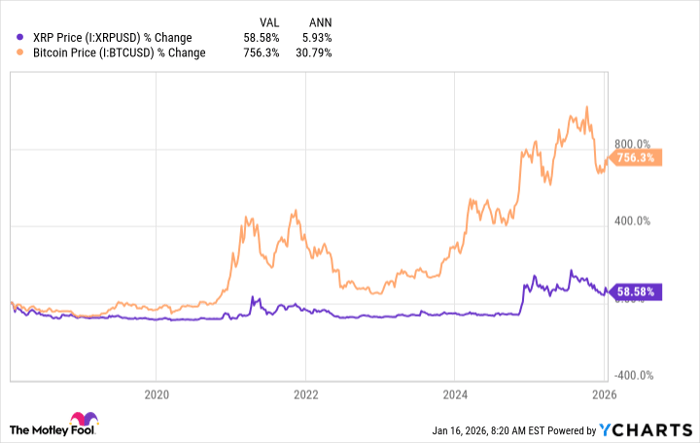
But over the long haul, XRP has had trouble putting together any type of consistency. Just consider the following chart. It shows the relative performance of Bitcoin and XRP since January 2018. That's when XRP hit its all-time high of $3.84. Since then, Bitcoin has soared 756%, while XRP is up just 59%.
XRP Price data by YCharts.
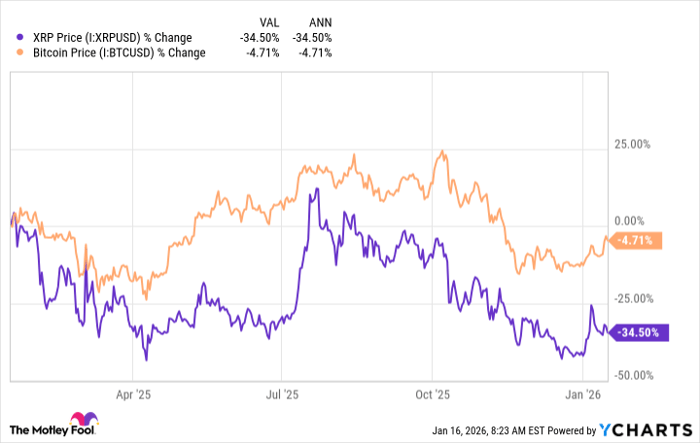
Or consider a 12-month comparison between Bitcoin and XRP that tracks their performance since January 2025. Over this period, Bitcoin is down nearly 5%, while XRP has lost nearly 35% of its value. Even with a huge price spike over the summer, XRP couldn't keep pace with Bitcoin.
XRP Price data by YCharts.
To use a sports analogy, XRP is a sprinter, while Bitcoin is a marathon runner. If you're a long-term, buy-and-hold investor, you want marathon runners in your portfolio, not sprinters. Even better, you want marathon runners capable of very fast mile split times. In other words, you want cryptocurrencies such as Bitcoin that you can buy and hold for decades.
Bitcoin's historical track record
When you look at Bitcoin's historical track record, everything becomes clear. Since 2012, Bitcoin has never had back-to-back losing years. And in 10 of those years, it was the top-performing asset in the world. In many years, Bitcoin posted triple-digit returns, massively outperforming every other asset class.
Simply stated, Bitcoin can compound returns year after year, delivering spectacular performance over the long haul. Yes, Bitcoin is prone to cycles of boom and bust, but the "boom" years are so phenomenal that they more than make up for the "bust" years. From 2017 to 2025, Bitcoin grew at a compound annual growth rate (CAGR) of 44%.
So don't give up on Bitcoin quite yet. If history is any guide, it will continue to outperform XRP over the long haul, surprising and delighting investors in the process.
Should you buy stock in Bitcoin right now?
Before you buy stock in Bitcoin, consider this:
The Motley Fool Stock Advisor analyst team just identified what they believe are the 10 best stocks for investors to buy now… and Bitcoin wasn’t one of them. The 10 stocks that made the cut could produce monster returns in the coming years.
Consider when Netflix made this list on December 17, 2004... if you invested $1,000 at the time of our recommendation, you’d have $474,578!* Or when Nvidia made this list on April 15, 2005... if you invested $1,000 at the time of our recommendation, you’d have $1,141,628!*
Now, it’s worth noting Stock Advisor’s total average return is 955% — a market-crushing outperformance compared to 196% for the S&P 500. Don't miss the latest top 10 list, available with Stock Advisor, and join an investing community built by individual investors for individual investors.
See the 10 stocks »
*Stock Advisor returns as of January 19, 2026.
Dominic Basulto has positions in Bitcoin and XRP. The Motley Fool has positions in and recommends Bitcoin and XRP. The Motley Fool has a disclosure policy.
Recommended Articles


