




CEO Jensen Huang Just Delivered Bad News for Nvidia's Rivals for 2026
Key Points
There's been a persistent shortage of the robust chips needed to process artificial intelligence (AI).
Nvidia has been the undisputed leader in the data center GPU market.
The company announced that its next-generation Vera Rubin chips were rolling off the production line a full six months ahead of schedule, and its backlog has grown.
- 10 stocks we like better than Nvidia ›
Last year was a bit unnerving for Nvidia (NASDAQ: NVDA) stock investors. After a blistering run that lasted more than two years, the stock plunged 37% from an all-time high in early 2025, before rebounding and ascending new heights. The ongoing battle with inflation, concerns about the impact of tariffs on the economy, and uncertainty about the future of artificial intelligence (AI) led to significant volatility for the chipmaker last year.
Nvidia gained 977% over the past three years (as of this writing), as its graphics processing units (GPUs) have become the gold standard for AI processing. After its relentless run, however, the stock is taking a well-deserved breather and currently sits 12% below its peak hit in early November.
Where to invest $1,000 right now? Our analyst team just revealed what they believe are the 10 best stocks to buy right now, when you join Stock Advisor. See the stocks »
A new year represents new opportunities for Nvidia, and the stock could be setting the stage for the next leg of its ascent. At an annual trade event last week, CEO Jensen Huang made an announcement that could have significant implications for Nvidia stock investors and sets the stage for 2026.
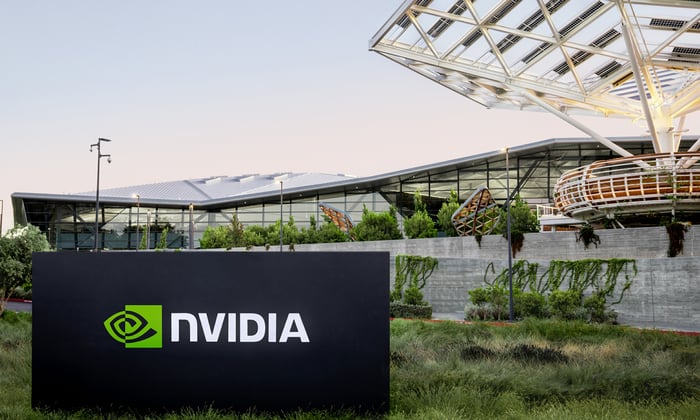
Image source: Nvidia.
You want chips with that?
CES (formerly the Consumer Electronics Show) is the premier technology event, taking place in Las Vegas every January and showcasing product innovations, futuristic gadgets, and advancements in AI. Huang, who is something of a rock star in tech circles, is frequently the event's keynote speaker, and this year was no different.
In a surprise development, Huang announced that Nvidia's next-generation AI chip -- Vera Rubin -- is now in full production, a full six months ahead of schedule:
Vera Rubin is designed to address this fundamental challenge that we have: The amount of computation necessary for AI is skyrocketing. Today, I can tell you that Vera Rubin is in full production.
Nvidia says its Rubin architecture reduces AI token processing costs by as much as 90%, using 75% fewer GPUs.
The company already has a significant competitive advantage in the semiconductor industry, with an aggressive one-year release cadence, bucking the existing industry practice of releasing new processors every two years. This relentless pace of innovation, announced in late 2023, has catapulted Nvidia ahead of the competition, making it even more difficult for rivals to gain ground.
The revelation that the company's next-generation processor was already rolling off the production line caught industry watchers off guard, as it extends Nvidia's already sizable advantage. The company had previously announced that Rubin would reach full production in the second half of 2026.
While this might not seem like a big deal, it has significant implications for Nvidia investors.
The growing specter of competition
The rapid adoption of AI has led to a persistent and ongoing shortage of chips with the necessary computational horsepower for AI processing. Nvidia's state-of-the-art chips have long been in short supply, forcing customers to seek viable alternatives.
In fact, one of the biggest risks to Nvidia is the threat of growing competition, particularly from well-heeled technology companies, many of whom are already developing rival processors.
- Advanced Micro Devices is Nvidia's most recognized competitor, making a splash with its MI350X data center GPU. The company just announced the MI440 series, which will begin shipping early this year.
- Broadcom is the leader in application-specific integrated circuits (ASICs), which can be customized to perform specific tasks more efficiently. The company has been making inroads as a more energy-efficient alternative to Nvidia's GPUs.
- Alphabet has been developing its custom Tensor Processing Units (TPUs) for internal use for more than a decade. The company turned heads this week on reports that it may lease its chips to Meta Platforms, which would be a first for the company.
- Late last year, Amazon announced the latest version of its Trainium chip, which it says provides 30% to 40% lower AI training costs than GPU-based alternatives.
There are more potential competitors, but you get the point.
The implications for Nvidia investors
Despite fierce competition in the AI chip market, Nvidia has maintained its lead by providing its best-in-class chips long before its rivals. The announcement that Vera Rubin chips are at full production only increases that advantage.
Nvidia also has clear visibility into its future sales. Late last year, Huang stated that the company's backlog exceeded $500 billion, which would be filled over the six quarters ending in early 2027.
Since that announcement, Nvidia has reported revenue of $57 billion, and forecast $65 billion for its soon-to-be-reported fourth quarter. That suggests potential sales of as much as $378 billion next year, which would represent growth of 155%.
Even that might be conservative. At an investor event last week, CFO Colette Kress said demand has only increased since Nvidia provided its $500 billion estimate, and the company would "definitely" surpass its previous outlook.
Nvidia's industry-leading position, relentless innovation, and growing backlog suggest the runway ahead is long. And at just 24 times next year's expected sales, I'd argue the stock is a steal.
Should you buy stock in Nvidia right now?
Before you buy stock in Nvidia, consider this:
The Motley Fool Stock Advisor analyst team just identified what they believe are the 10 best stocks for investors to buy now… and Nvidia wasn’t one of them. The 10 stocks that made the cut could produce monster returns in the coming years.
Consider when Netflix made this list on December 17, 2004... if you invested $1,000 at the time of our recommendation, you’d have $474,847!* Or when Nvidia made this list on April 15, 2005... if you invested $1,000 at the time of our recommendation, you’d have $1,146,655!*
Now, it’s worth noting Stock Advisor’s total average return is 958% — a market-crushing outperformance compared to 196% for the S&P 500. Don't miss the latest top 10 list, available with Stock Advisor, and join an investing community built by individual investors for individual investors.
See the 10 stocks »
*Stock Advisor returns as of January 17, 2026.
Danny Vena, CPA has positions in Alphabet, Amazon, Broadcom, Meta Platforms, and Nvidia. The Motley Fool has positions in and recommends Advanced Micro Devices, Alphabet, Amazon, Meta Platforms, and Nvidia. The Motley Fool recommends Broadcom. The Motley Fool has a disclosure policy.
Recommended Articles


