

Tesla Recently Saw EV Deliveries Decline Nearly 16%. However, Investors Are Focusing Their Attention Elsewhere
Key Points
Tesla's core electric vehicle business has struggled amid rising competition and industry headwinds in the U.S.
However, investors have largely looked past these concerns.
The market appears to be more focused on Tesla's emerging robotaxi fleet and other initiatives.
- These 10 stocks could mint the next wave of millionaires ›
The electric vehicle maker and robotaxi company Tesla (NASDAQ: TSLA) recently reported its EV deliveries for the fourth quarter of 2025. Once again, the numbers showed a stark decline from the prior year, as the electric vehicle market continues to suffer during the transition under the Trump administration, which has eliminated several incentives for the industry.
However, investors are largely looking past these concerns and focusing on other aspects of Tesla's business, which they hope will be material drivers of the stock in the years to come.
Where to invest $1,000 right now? Our analyst team just revealed what they believe are the 10 best stocks to buy right now, when you join Stock Advisor. See the stocks »
EV business struggled, but as expected
Tesla reported EV deliveries of 418,227 for the fourth quarter of 2025. According to CNBC, Wall Street analysts had been expecting approximately 426,000 deliveries, so the company missed the consensus by about 2%. Fourth-quarter deliveries declined by nearly 16% year over year. For the year, Tesla delivered 1.64 million vehicles, a decrease of approximately 9% from 2024.
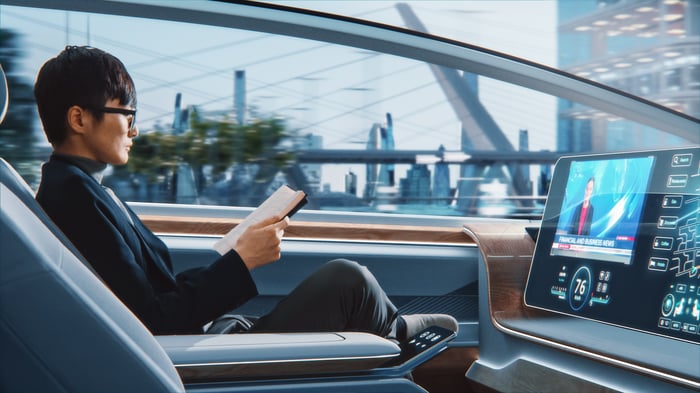
Image source: Getty Images.
The company said that 97% of its total deliveries in the fourth quarter came from its Model 3 Sedan and Model Y SUV. Deliveries of the company's Model S, Model X, and Cybertrucks were minimal during the quarter.
Fewer deliveries are nothing new and have become an industrywide trend. President Donald Trump's large legislative spending package, passed last year, eliminated a $7,500 federal EV tax credit that had been viewed as a key incentive for those purchasing EVs. Furthermore, Tesla has experienced competition globally from players like BYD, which recently surpassed Tesla as the world's largest EV maker.
Investors are focused on robotaxis and robots
Despite the EV struggles, the market has been aware of the problem for much of the year and largely looked past it. That's because investors are now much more focused on the company's emerging robotaxi fleet and Optimus humanoid robots. Last year, Tesla soft-launched its self-driving robotaxis in Austin and San Francisco, marking a key milestone that CEO Elon Musk had discussed for years. The company plans to launch in five new cities in the coming months.
However, up until recently, many of Tesla's robotaxis have not been fully autonomous, as the launches have been geofenced with some sort of supervision, whether it is remote supervision or safety monitors on each trip. In mid December, Musk confirmed that some of Austin's robotaxis were operating without any supervision in the vehicles.
Tesla's potential advantage is that it can supposedly manufacture its fully autonomous self-driving vehicles at a much lower cost than competitors like Waymo, according to a Bloomberg analysis.
The robotaxi will be key to moving Tesla's stock higher. Wedbush analyst Dan Ives sees Tesla robotaxis operating in 30 cities by the end of 2026, which will add significant value to the stock. Cathie Wood of Ark Invest, another Tesla bull, has a $2,600 price target on Tesla by 2029, which implies a ton of upside, given Tesla's current share price of roughly $450. Much of this will be driven by robotaxis. Wood and her team believe the robotaxi business will comprise 90% of the company's enterprise value and earnings by 2029.
Investors also believe Tesla's humanoid Optimus robots could bring significant value to the company. Musk has discussed the potential for wider-scale production of the robots this year, which could save people a significant amount of time due to their ability to complete household chores.
Overall, I think it's clear that Tesla's current $1.5 trillion market cap and future price appreciation hinge largely on robotaxis, and to some extent, Optimus robots. I'd advise investors to be cautious here. Tesla is undoubtedly an impressive company, but the stock is currently valued at over 200 times forward earnings.
That's a lot to pay for a company that still has a lot to accomplish in terms of robotaxis and humanoid robots. It remains unclear whether and when Tesla will perfect the technology and the rate of adoption. At these levels, I do not find the risk-reward trade-off to be attractive.
Don’t miss this second chance at a potentially lucrative opportunity
Ever feel like you missed the boat in buying the most successful stocks? Then you’ll want to hear this.
On rare occasions, our expert team of analysts issues a “Double Down” stock recommendation for companies that they think are about to pop. If you’re worried you’ve already missed your chance to invest, now is the best time to buy before it’s too late. And the numbers speak for themselves:
- Nvidia: if you invested $1,000 when we doubled down in 2009, you’d have $487,932!*
- Apple: if you invested $1,000 when we doubled down in 2008, you’d have $50,843!*
- Netflix: if you invested $1,000 when we doubled down in 2004, you’d have $493,290!*
Right now, we’re issuing “Double Down” alerts for three incredible companies, available when you join Stock Advisor, and there may not be another chance like this anytime soon.
See the 3 stocks »
*Stock Advisor returns as of January 6, 2026.
Bram Berkowitz has no position in any of the stocks mentioned. The Motley Fool has positions in and recommends Tesla. The Motley Fool recommends BYD Company. The Motley Fool has a disclosure policy.
Recommended Articles


