

More 401(k) Savers Are Making This Incredibly Smart Move -- Should You Follow?
Key Points
More individuals are taking advantage of a Roth 401(k), which most employers now offer.
You contribute after-tax money to a Roth 401(k) and can take tax-free withdrawals in retirement.
A Roth 401(k) is a good option if you expect your tax bracket to be higher near or in retirement.
- The $23,760 Social Security bonus most retirees completely overlook ›
Saving for retirement is all about being proactive and taking advantage of the resources available to you, including the many retirement accounts. Most Americans are accustomed to using a 401(k). It's by far the most popular retirement account in the U.S.
A 401(k) is a great option because it largely operates behind the scenes and allows people to save and invest for retirement passively. The "set it and forget it" nature of a 401(k) is a huge benefit because it eliminates the need to manually transfer funds and invest them.
Where to invest $1,000 right now? Our analyst team just revealed what they believe are the 10 best stocks to buy right now. Continue »
That said, there is one move that 401(k) savers are making that may be worth considering: Taking advantage of a Roth 401(k).
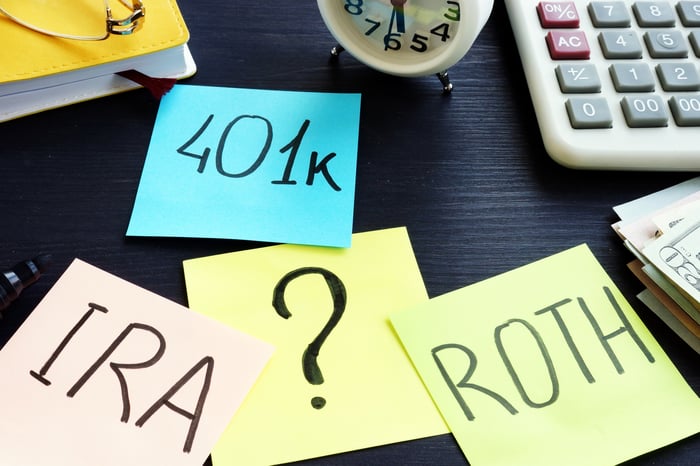
Image source: Getty Images.
What separates a Roth 401(k) from a standard 401(k)?
Like IRAs, there are two types of 401(k)s: traditional and Roth. With a traditional 401(k), your contributions are automatically taken from your paycheck pre-tax, lowering your taxable income for the year. However, on the back end in retirement, you pay taxes on withdrawals.
Conversely, with a Roth 401(k), contributions are made with after-tax money, and in return, you get to take tax-free withdrawals in retirement as long as you're 59 1/2 years old and five tax years have passed since your first contribution (the clock starts Jan. 1 of the year you contributed).
Being able to grow and compound your contributions with tax-free withdrawals can easily save you thousands of dollars. And since you've already paid taxes on the money you contributed, Roth 401(k)s don't have required minimum distributions like traditional 401(k)s.
Luckily, most plans allow you to contribute to both at the same time, so you don't have to pick and choose between them. While more than 90% of 401(k) plans offer a Roth option, if your employer is among the few that doesn't -- or if you're self-employed or a freelancer -- you can take advantage of a solo Roth IRA.
What separates a Roth 401(k) from a Roth IRA?
Compared to Roth IRAs, Roth 401(k)s have a high contribution limit. In 2026, the most you can contribute to a Roth 401(k) is $24,500. If you're 50 or older, you can add an additional $8,000 ($32,500 total). As part of the SECURE 2.0 Act, people aged 60 to 63 can add an additional $11,250 ($35,750 total).
Both Roth 401(k)s and Roth IRAs allow you to take tax-free withdrawals in retirement. However, one key difference is how early withdrawals are treated. With a Roth IRA, you can withdraw your contributions, but not earnings, at any time without facing any early withdrawal penalties.
With a Roth 401(k), early withdrawals are taken proportionately from your contributions and earnings. For example, let's assume you have $20,000 in your account and $2,000 (10%) is from earnings. If you were to withdraw $5,000, $500 (10%) would be treated as earnings and subject to the early withdrawal penalty.
Does a Roth 401(k) make sense for you?
There is no income limit with a Roth 401(k), so it's a good option for a high earner who wants to take advantage of the Roth tax break without having to use methods like the backdoor Roth IRA process.
For those below the Roth IRA income limit, deciding whether a Roth 401(k) is right can come down to your current versus expected tax bracket in retirement. At some point, you must pay taxes on your earnings, whether it's when you first get paid or when you take withdrawals in retirement.
Using a Roth 401(k) could be a great option if you're relatively early in your career and expect your tax bracket to be higher when you're in retirement. This allows you to pay taxes now at a lower tax bracket and then take tax-free withdrawals when you're in a higher tax bracket in or near retirement.
Even for people in their peak earning years, a Roth 401(k) could make sense if you have time on your side to reap the benefits of having your money grow and compound.
The $23,760 Social Security bonus most retirees completely overlook
If you're like most Americans, you're a few years (or more) behind on your retirement savings. But a handful of little-known "Social Security secrets" could help ensure a boost in your retirement income.
One easy trick could pay you as much as $23,760 more... each year! Once you learn how to maximize your Social Security benefits, we think you could retire confidently with the peace of mind we're all after. Join Stock Advisor to learn more about these strategies.
View the "Social Security secrets" »
The Motley Fool has a disclosure policy.
Recommended Articles


