

Nvidia Earns 69% of Its Revenue From the U.S. Here's How Tariffs Could Affect That in 2026.
Key Points
Nvidia makes most of its revenue from sales to large U.S. tech companies.
President Trump has lifted a ban on sales of Nvidia's H200 processors to China, but the company must pay the federal government 25% of the revenue from those sales.
2026 could bring more international sales for Nvidia, but there's no indication that would result in reduced sales to domestic buyers.
- 10 stocks we like better than Nvidia ›
Nvidia (NASDAQ: NVDA) is one of the undisputed leaders in artificial intelligence hardware. Its parallel processors occupy a central role in data centers worldwide, as it holds an estimated 90% share of the market for AI accelerator chips.
Technology companies in the U.S. are snatching up Nvidia's processors at the fastest rate -- 69% of the company's revenue comes from domestic sources right now, according to research from The Motley Fool. However, ever since President Donald Trump announced earlier this year that he was imposing steep new tariffs on nearly every other country, Nvidia has been forced to navigate a shifting set of U.S. trade policies.
Where to invest $1,000 right now? Our analyst team just revealed what they believe are the 10 best stocks to buy right now. Continue »
How might those tariffs and Trump's various trade conflicts impact Nvidia's U.S. revenue in 2026? Here are a few points to consider.
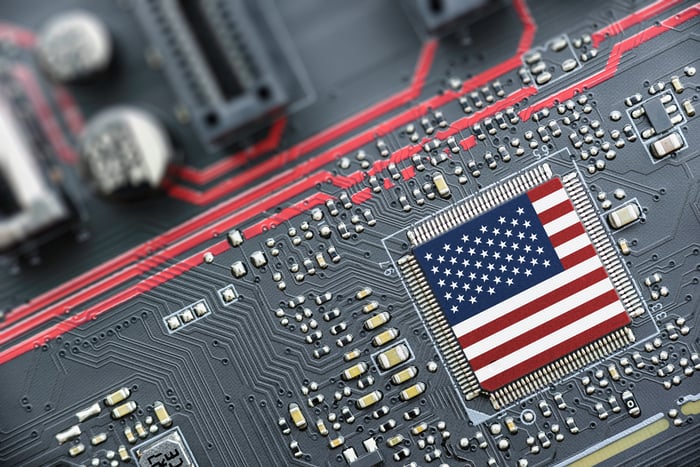
Image source: Getty Images.
Nvidia's U.S. chip demand should remain robust in 2026
Nvidia is a chip designer, not a chip manufacturer -- like other "fabless" operations, it hires other companies to actually produce its processors. Most of Nvidia's chips are made by the world's leading third-party chip foundry, Taiwan Semiconductor, also known as TSMC.
TSMC manufactures many of Nvidia's processors in Taiwan, which are then imported into the U.S. and sold to tech companies. Some semiconductor tariffs have already impacted Nvidia's bottom line, but the bulk of the company's trade-conflict-related headwinds have come as a result of U.S. restrictions preventing the export of its more advanced chips to China. In its fiscal 2026 first quarter alone (which ended April 27), the company took a $4.5 billion charge due to the lost value of H20 chips it made specifically for the Chinese market that it found itself unable to legally sell there.
Anything could change in 2026, but as of right now, tariffs and trade conflicts likely won't change the fact that the majority of Nvidia's sales will come from U.S.-based companies. Meta, Alphabet, OpenAI, and many others are already spending hundreds of billions of dollars annually to build data centers powered in part by vast quantities of Nvidia's processors, and that trend does not appear likely to slacken any time soon. And with Nvidia CEO Jensen Huang estimating that global spending on data center infrastructure will amount to between $3 trillion and $4 trillion between now and 2030, spending by U.S. tech giants will likely remain a very high percentage of the company's sales next year.
Nvidia's sales could rise in China in 2026
One recent change could modestly impact the mix of sources for Nvidia's revenues in 2026: Trump has decided that Nvidia can begin selling its H200 chips in China.
As of right now, those processors technically won't incur tariffs -- but they will cost Nvidia. Trump will reportedly only allow those H200 sales to China if Nvidia gives the U.S. government a 25% cut of the resulting revenues.
Currently, about 5% of Nvidia's chip sales go to customers in China, down from a high of 25% in 2022. It's unclear how much of Nvidia's revenue will come from China in 2026, and also unclear how much demand for the H200 there will be from Chinese companies, especially as the Chinese government has indicated that it wants its domestic companies to develop their own AI semiconductors. But some of the latest reporting indicated that Nvidia is considering further ramping up H200 production to match the anticipated increase in demand.
Of course, if demand for the H200 processor is high and Nvidia significantly increases its sales to China, the percentage of its revenue from that country could tick back up again.
Nvidia doesn't need to worry about slight shifts in its revenue diversification
Nvidia sells its processors worldwide, and demand for them is sky high. In its fiscal 2026 third quarter, which ended Oct. 26, Nvidia's data center sales rose 66% year over year to $51 billion. Given that there is no end in sight right now for data center spending, the chipmaker could experience continuing growth from this segment for years.
Nvidia's diluted earnings per share increased 67% to $1.30 in the most recent quarter, and the company remains a solid AI investment. What's more, it enjoys an impressive gross margin of nearly 74% -- sales of its processors, no matter where they are being shipped to, are extremely profitable.
The point here is that the company has, thus far, weathered an uncertain tariff and trade environment, and has continued to thrive. If some restrictions on semiconductor trade are lifted soon, which appears likely, it could result in even more growth for Nvidia.
Should you buy stock in Nvidia right now?
Before you buy stock in Nvidia, consider this:
The Motley Fool Stock Advisor analyst team just identified what they believe are the 10 best stocks for investors to buy now… and Nvidia wasn’t one of them. The 10 stocks that made the cut could produce monster returns in the coming years.
Consider when Netflix made this list on December 17, 2004... if you invested $1,000 at the time of our recommendation, you’d have $511,196!* Or when Nvidia made this list on April 15, 2005... if you invested $1,000 at the time of our recommendation, you’d have $1,047,897!*
Now, it’s worth noting Stock Advisor’s total average return is 954% — a market-crushing outperformance compared to 193% for the S&P 500. Don't miss the latest top 10 list, available with Stock Advisor, and join an investing community built by individual investors for individual investors.
See the 10 stocks »
*Stock Advisor returns as of December 18, 2025.
Chris Neiger has no position in any of the stocks mentioned. The Motley Fool has positions in and recommends Alphabet, Meta Platforms, Nvidia, and Taiwan Semiconductor Manufacturing. The Motley Fool has a disclosure policy.
Recommended Articles


