

23% of Warren Buffett's $317 Billion Portfolio Is Invested in 3 Artificial Intelligence (AI) Stocks
Key Points
Warren Buffett has steered the Berkshire Hathaway holding company to market-crushing returns for the last 60 years.
Buffett uses a simple long-term investment strategy, and he rarely chases hot stock market themes like artificial intelligence (AI).
However, at least three stocks in Berkshire's portfolio are successfully using AI to supercharge their legacy businesses.
- 10 stocks we like better than Amazon ›
Warren Buffett has served as Berkshire Hathaway's (NYSE: BRK.A)(NYSE: BRK.B) CEO since 1965, overseeing hundreds of acquisitions and stock purchases that have catapulted the conglomerate to a trillion-dollar valuation.
Buffett plans to step down on Jan. 1, capping off a stellar 60-year run. Had you invested $1,000 in Berkshire stock when he took the helm, you'd be sitting on a whopping $50.2 million today. The same investment in the S&P 500 (SNPINDEX: ^GSPC) would have grown to just $398,100 over the same period.
Where to invest $1,000 right now? Our analyst team just revealed what they believe are the 10 best stocks to buy right now, when you join Stock Advisor. See the stocks »
Buffett's simple investment strategy is the secret to Berkshire's success. He backs companies with reliable growth, steady profits, and shareholder-friendly initiatives like dividend schemes and stock buyback programs. As a long-term investor, he avoids chasing the hottest stock market themes -- even those as powerful as artificial intelligence (AI).
With that said, several existing holdings in Berkshire's $317 billion portfolio of publicly traded stocks are using AI to supercharge their core businesses. Here are three of them.
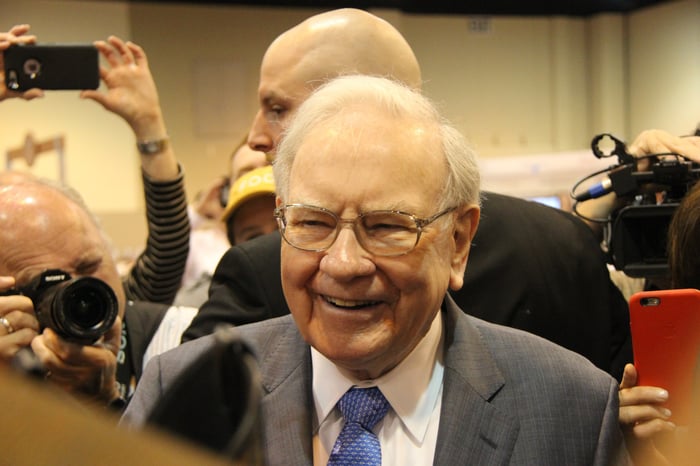
Image source: The Motley Fool.
1. Amazon: 0.7% of Berkshire Hathaway's portfolio
Amazon (NASDAQ: AMZN) helped pioneer the e-commerce industry, and after achieving scale, it aggressively expanded into other areas like cloud computing, digital advertising, and streaming. The company is now investing heavily in AI to improve efficiency and unlock new opportunities, and one of those opportunities is in the cloud.
The Amazon Web Services (AWS) cloud platform operates specialized data centers fitted with thousands of advanced chips, and it rents the computing capacity to businesses and developers. Some of those chips come from top suppliers like Nvidia, but Amazon also designed its own, like Trainium2, which is up to 40% cheaper to use when training AI models. Leading AI start-up Anthropic is using 500,000 Trainium2 chips to develop its latest Claude models.
AWS has a staggering $200 billion order backlog from customers who are waiting for more data center capacity to come online, and Amazon is on track to spend $125 billion to build more infrastructure this year to meet that demand.
Berkshire bought Amazon stock in 2019, but Buffett regrets not identifying the opportunity much sooner. Nevertheless, the stock's price has more than doubled since Berkshire acquired its position, and AI could fuel far more upside over the long term.
2. Alphabet (Google): 1.7% of Berkshire Hathaway's portfolio
AI chatbots like OpenAI's ChatGPT are growing in popularity, so there have been concerns that they could steal traffic away from traditional internet search engines like Google Search. Alphabet (NASDAQ: GOOG) (NASDAQ: GOOGL) owns Google and draws more than half of its revenue from the search engine, so this would have been very bad news for the company.
Fortunately, Alphabet acted fast to transform Google Search for the AI era. It introduced features like AI Overviews and AI Mode, which merge the traditional search experience with AI-generated content, giving users much faster access to information. Alphabet says these features have been a success in terms of user adoption and monetization, a key reason why Google Search's revenue growth has accelerated for two straight quarters.
Then there is Google Cloud, which competes directly with AWS. It sells access to data centers, ready-made large language models (LLMs), and other tools businesses need to develop AI software. It has an order backlog of $155 billion, which Alphabet is trying to fill by building more AI infrastructure. Part of the company's strategy is to produce more of its latest Tensor Processing Units (TPUs), which have become worthy alternatives to the AI chips supplied by Nvidia.
Alphabet stock has soared by 62% this year thanks to the incredible AI-driven momentum across its business. Berkshire only recently bought the stock during the third quarter of 2025 (ended Sept. 30), but it's still relatively cheap, so there could be plenty of upsides to come.
3. Apple: 20.6% of Berkshire Hathaway's portfolio
Buffett and his team spent approximately $38 billion acquiring shares of Apple (NASDAQ: AAPL) between 2016 and 2023. Heading into 2024, that position was worth over $170 billion and accounted for more than half the value of the conglomerate's entire portfolio. To cash in some gains and reduce risk, Berkshire has since sold more than 70% of its Apple stake, but the stock still has a dominant portfolio weighting of 20.6%.
There are more than 2.35 billion active iPhones, iPads, Mac computers, and other Apple devices worldwide, so this company is uniquely positioned to dominate the consumer segment of the AI race. Last year, it launched its own AI software suite called Apple Intelligence, which includes a series of writing tools, an image generator, and an improved version of the Siri voice assistant.
Every iPhone, iPad, and Mac computer is powered by an Apple-designed chip, which is increasingly optimized for AI software, so users get a unique balance of performance and battery efficiency. This flexibility will give Apple a key advantage over other device makers as AI becomes more powerful over time. According to Wall Street, the latest iPhone 17 lineup -- which features Apple's best chips yet -- is driving a much stronger upgrade cycle than expected.
As a result, I think Berkshire can still earn significant returns from its reduced Apple stake in the long run.
Should you buy stock in Amazon right now?
Before you buy stock in Amazon, consider this:
The Motley Fool Stock Advisor analyst team just identified what they believe are the 10 best stocks for investors to buy now… and Amazon wasn’t one of them. The 10 stocks that made the cut could produce monster returns in the coming years.
Consider when Netflix made this list on December 17, 2004... if you invested $1,000 at the time of our recommendation, you’d have $509,955!* Or when Nvidia made this list on April 15, 2005... if you invested $1,000 at the time of our recommendation, you’d have $1,089,460!*
Now, it’s worth noting Stock Advisor’s total average return is 968% — a market-crushing outperformance compared to 193% for the S&P 500. Don't miss the latest top 10 list, available with Stock Advisor, and join an investing community built by individual investors for individual investors.
See the 10 stocks »
*Stock Advisor returns as of December 18, 2025.
Anthony Di Pizio has no position in any of the stocks mentioned. The Motley Fool has positions in and recommends Alphabet, Amazon, Apple, Berkshire Hathaway, and Nvidia. The Motley Fool has a disclosure policy.
Recommended Articles


