

World's Richest Man Musk: Hard to Dethrone? Tesla Stock Breaks Through Again, Just One Step Away from a New High!
TradingKey - Tesla shares climbed almost 4.9% on December 15, hitting an intra-day high of $481.77, a nearly one-year peak that pushed CEO Elon Musk's fortune to new heights.
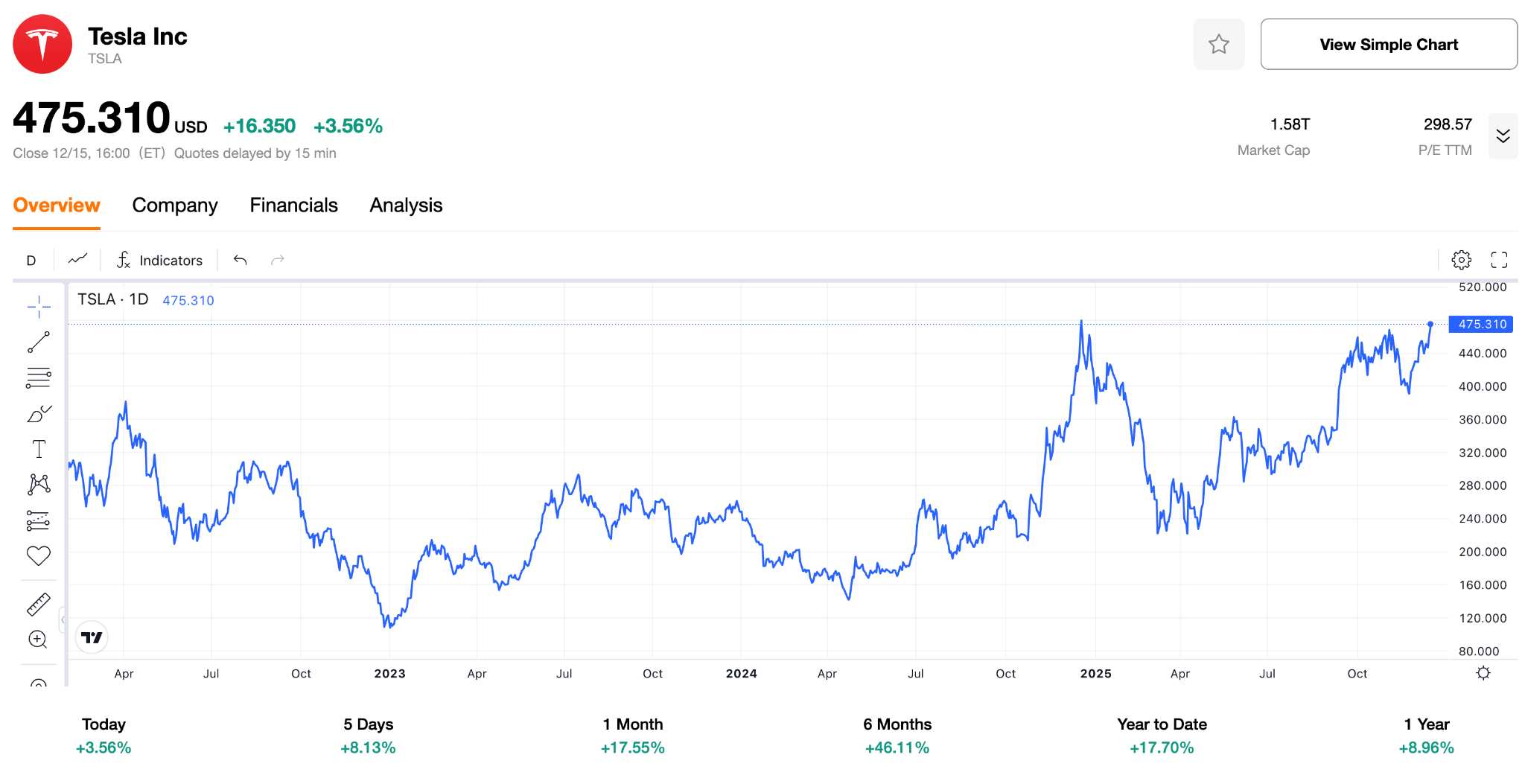
[Tesla Stock Chart, Source: TradingKey]
Reports indicate a breakthrough in Tesla's autonomous driving efforts. Musk confirmed that Tesla has begun Robotaxi tests without safety drivers in Austin, Texas, and other testing locations. This means vehicles no longer require front-seat safety monitors when operating on public roads.
Compared to previous assisted tests that still required safety monitors, this stage signals a continuous push of Tesla's technological boundaries. Consequently, it enhances investors' imagination regarding future revenue growth pathways.
Wedbush analyst Daniel Ives, in a research note this week, stated that Tesla's future valuation could double as its artificial intelligence, autonomous driving, and robotics businesses advance. Under the most optimistic scenario, it could reach $3 trillion, corresponding to a target price of approximately $600 per share. This target significantly exceeds the current share price of around $475.
Ives contends that beyond its core electric vehicle business, Tesla's strategic deployment in AI and robotics technology, particularly in autonomous ride-hailing services and dedicated "Cybercab" models, represents the core driver for future growth. This is expected to not only bring about structural changes in profitability but also potentially reshape the company's valuation framework.
Against the backdrop of Tesla's rising share price, Musk's personal fortune has swelled. As one of Tesla's largest individual shareholders, the value of his equity holdings increased with the stock's ascent. Furthermore, Musk is also the founder and CEO of the private space company SpaceX, which has recently garnered significant market attention amid its IPO preparations and ongoing valuation appreciation.
Reports suggest that SpaceX's internal transaction valuation at one point approached an $800 billion scale, further solidifying Musk's status as one of the world's wealthiest individuals. This diversified asset allocation ensures Musk's wealth benefits not only from Tesla's stock price but also from the combined drivers of growth expectations in space exploration, AI, and future technology businesses.
Despite the surging market sentiment, we believe the current situation warrants a cautious approach rather than blind optimism.
Currently, the majority of Tesla's revenue continues to stem from traditional electric vehicle sales, rather than from autonomous driving or service ecosystem revenues. The commercialization of full self-driving and related services still confronts multiple challenges, including regulatory hurdles, technological maturity, and intense market competition.
For one, Tesla's autonomous driving commercialization process has not yet truly entered a large-scale operational phase. It still lags behind major competitors such as Waymo, which have already achieved commercialized services. Waymo operates genuinely driverless taxi services in multiple cities and has accumulated extensive real-world operational data, posing a challenge to Tesla's potential late-mover advantages.
Furthermore, regulatory uncertainty remains a potential risk. The legality, regulatory requirements, and safety standards for fully autonomous vehicles are not yet unified across different countries and regions. This directly impacts the pace of Tesla's Robotaxi rollout and its market acceptance.
In addition, some Wall Street analysts warn that Tesla's price-to-earnings (PE) ratio far exceeds the support from the company's current fundamentals. Should the autonomous driving technology, which underpins its future narrative, fail to meet expectations, the stock could face significant downside threats.
Regardless of whether Tesla ultimately achieves the $3 trillion valuation envisioned by Ives, the current stock movement at least indicates significant market anticipation for Tesla's transformation from an electric vehicle manufacturer into an autonomous driving and AI service provider.
Recommended Articles


