

Down 60% From Its All-Time High, Should You Buy the Dip on CoreWeave's Stock?
Key Points
CoreWeave's capital expenditures outweigh its revenue.
The company has a long way to go before turning profitable.
- 10 stocks we like better than CoreWeave ›
CoreWeave (NASDAQ: CRWV) has taken investors on a roller coaster ride in 2025. It went public in late March and had a fairly mundane reception in the public markets because it was about the time tariff fears were at their highest.
It then spiked to a nearly 360% gain in June before tumbling back down to earth. If you bought at its initial public offering, you're still up around 80%. Unfortunately, if you bought at its high, you're down around 60%.
Where to invest $1,000 right now? Our analyst team just revealed what they believe are the 10 best stocks to buy right now. Continue »
That's a big loss, but it could be temporary if the right things happen in CoreWeave's business. On the flip side, if the company continues down its current path, the losses could grow.

Image source: Getty Images.
The business isn't profitable right now
CoreWeave is essentially a cloud computing service that's focused on providing its clients with the best artificial intelligence (AI) computing hardware possible. Currently, those are graphics processing units (GPUs) from Nvidia, and they aren't cheap.
CoreWeave goes through about $2 billion each quarter on data center capital expenditures (capex), which is huge considering its quarterly revenue. In the third quarter, its sales rose 134% year over year to $1.4 billion, so it's spending far more to build computing capacity than it's generating in revenue.
That's clearly a red flag for investors, but management's argument is that if it builds the capacity and has a large customer base, it will eventually be able to flip the profitability switch, much like Alphabet's Google Cloud or Microsoft's Azure.
It took significant scaling up for Google Cloud to become profitable, and there is a concerning issue with GPUs that could prevent this from happening within a reasonable time frame for CoreWeave. GPUs that are tasked with AI training don't last forever. Some estimates peg their lifespan at about a year, while others say up to five years. Regardless, they are relatively short-lived assets, and CoreWeave is losing money hand over fist as a result.
This could also factor into why its partners are growing. If an AI hyperscaler like Meta Platforms, one of its clients, can rent computing capacity from CoreWeave at a lower price than what it costs to build it, why would Meta not take that deal?
CoreWeave can become profitable by jacking up its prices, which could cause customers to switch, or by slowing its build-out plans. The latter also isn't a smart idea because the time to build out AI capacity is now, when companies are hungry for as much computing power as they can get their hands on.
This places the company in a tough spot, and investors are waking up to the realization that it will have to make some tough decisions to become profitable.
Free cash flow is the best metric to assess CoreWeave's progress
Regular metrics like net income or operating margin can be skewed when a company is spending a ton on capex. As a result, a metric like free cash flow (FCF) should be used. FCF is operating cash flow minus capex. CoreWeave's FCF is a negative $8 billion over the past 12 months, which is concerning considering it generated $4.3 billion in revenue.
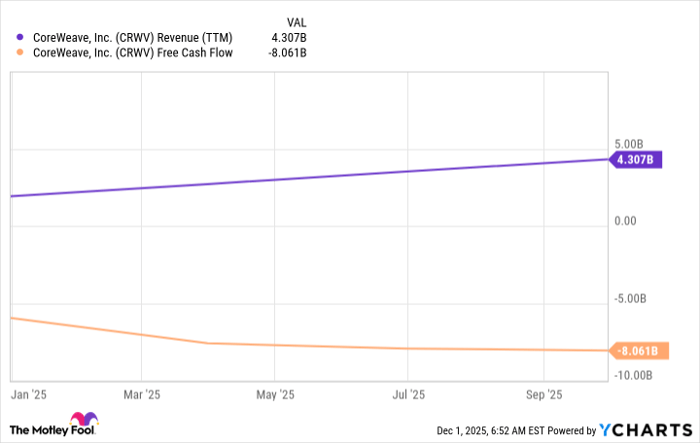
CRWV Revenue (TTM) data by YCharts; TTM = trailing 12 months.
A significant change will be required for CoreWeave to become a legitimate business, and it doesn't look like a promising investment right now. Even though the stock is down 60% from its highs, I don't think it's attractive unless we see real progress toward profitability.
If management could snap its fingers and become profitable, I would be interested in this business, since cloud computing companies have incredible potential. Until then, CoreWeave is just going on my list as a company to watch.
Should you invest $1,000 in CoreWeave right now?
Before you buy stock in CoreWeave, consider this:
The Motley Fool Stock Advisor analyst team just identified what they believe are the 10 best stocks for investors to buy now… and CoreWeave wasn’t one of them. The 10 stocks that made the cut could produce monster returns in the coming years.
Consider when Netflix made this list on December 17, 2004... if you invested $1,000 at the time of our recommendation, you’d have $560,649!* Or when Nvidia made this list on April 15, 2005... if you invested $1,000 at the time of our recommendation, you’d have $1,100,862!*
Now, it’s worth noting Stock Advisor’s total average return is 998% — a market-crushing outperformance compared to 194% for the S&P 500. Don’t miss out on the latest top 10 list, available when you join Stock Advisor.
See the 10 stocks »
*Stock Advisor returns as of December 1, 2025
Keithen Drury has positions in Alphabet, Meta Platforms, and Nvidia. The Motley Fool has positions in and recommends Alphabet, Meta Platforms, Microsoft, and Nvidia. The Motley Fool recommends the following options: long January 2026 $395 calls on Microsoft and short January 2026 $405 calls on Microsoft. The Motley Fool has a disclosure policy.
Recommended Articles


