

The Stock Market Sounds an Alarm, and the Federal Reserve Delivers Bad News About President Trump's Tariffs
Key Points
The S&P 500 has climbed 16% this year, but there is a growing disconnect between the stock market and business fundamentals.
The Federal Reserve recently published research that suggests President Trump’s tariffs will raise unemployment and slow economic growth.
The S&P 500 recently traded above 23 times forward earnings, a valuation so rich it has been seen during just two other periods in the last four decades.
- 10 stocks we like better than S&P 500 Index ›
The S&P 500 (SNPINDEX: ^GSPC) has advanced 16% year to date despite President Trump raising the average tariff rate to its highest level since the 1940s. So far, excitement about artificial intelligence (AI) has more than offset any misgivings about the economy. But there is a growing disconnect between the stock market and business fundamentals.
The Federal Reserve recently published a study that suggests President Trump's tariffs will increase unemployment and slow economic growth. The research is particularly concerning because the S&P 500 recently achieved one of its most expensive valuations in 40 years. The combination of economic weakness and an expensive stock market could lead to trouble for investors.
Where to invest $1,000 right now? Our analyst team just revealed what they believe are the 10 best stocks to buy right now. Continue »
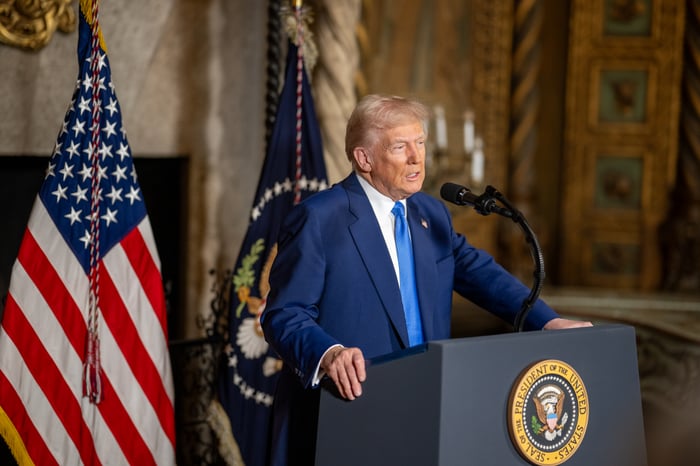
Image source: Official White House photo.
Research from the Federal Reserve says tariffs will increase unemployment and slow economic growth
Earlier this year, President Trump said, "From 1789 to 1913, we were a tariff-backed nation, and the United States was proportionately the wealthiest it has ever been."
That statement is patently false. Real GDP per person has increased tenfold since 1900, which means Americans generally have a much higher living standard today.
Trump has made similar claims on other occasions. "Tariff power will bring America national security and wealth the likes of which has never been seen before," he wrote on social media in November. Trump has even proposed using tariffs to eliminate individual income tax, or else to pay Americans (excluding high earners) a $2,000 dividend check.
Unfortunately, those plans are disconnected from reality. The new tariffs are projected to bring in $210 billion in 2026. That sum is nowhere near enough to offset individual income tax, which totaled $2.6 trillion last year. Nor is it enough to cover $2,000 dividend checks, which would cost more than $600 billion, depending on who actually gets the payments, according to the Tax Foundation.
However, there is a more fundamental problem with Trump's tariffs: Historical information suggests they will not make America wealthier. A recent study from the Federal Reserve Bank of San Francisco examines 150 years' worth of data and arrives at this conclusion: Tariffs will lead to higher unemployment and slower economic growth.
The study attributes those outcomes to economic uncertainty. Consumer sentiment tends to worsen during periods of uncertainty, which reduces economic growth by suppressing demand and prompting companies to hire fewer people. Indeed, those circumstances are already coming to fruition: Consumer sentiment fell to the second-lowest reading in history in November after the unemployment rate increased to 4.4% in October, the highest level in four years.
The S&P 500's historically high valuation makes the prospect of slower economic growth even more concerning
In late October, the S&P 500 recorded a forward price-to-earnings (P/E) ratio above 23 for only the third time in four decades. The other two incidents ended poorly. The first time was before the dot-com bubble burst; the index eventually fell 49%. The second time was before the COVID-19 bear market; the index eventually fell 25%.
The S&P 500's valuation has since moderated to 22.6 times forward earnings, but that is still a premium to the 40-year average of 15.9, according to Yardeni Research. It is possible investors are more comfortable with higher valuations today because profit margins are likely to expand as AI makes companies more efficient, meaning earnings could increase more quickly than anticipated in the future.
However, history suggests the stock market is likely to struggle in the near term. After topping 22 times forward earnings, the S&P 500 has returned an average of 2.9% annually in the next three years, according to Torsten Slok, chief economist at Apollo Global Management. That's well below the long-term average of about 10% annually.
The current market environment warrants caution, but that does not mean investors should sell all their stocks. Instead, now is a good time to make sure your portfolio includes only high-conviction stocks that you would be comfortable holding through a downturn. Now is also a good time to build a cash position. Doing so will let you capitalize on the next sell-off.
Should you invest $1,000 in S&P 500 Index right now?
Before you buy stock in S&P 500 Index, consider this:
The Motley Fool Stock Advisor analyst team just identified what they believe are the 10 best stocks for investors to buy now… and S&P 500 Index wasn’t one of them. The 10 stocks that made the cut could produce monster returns in the coming years.
Consider when Netflix made this list on December 17, 2004... if you invested $1,000 at the time of our recommendation, you’d have $588,530!* Or when Nvidia made this list on April 15, 2005... if you invested $1,000 at the time of our recommendation, you’d have $1,102,885!*
Now, it’s worth noting Stock Advisor’s total average return is 1,012% — a market-crushing outperformance compared to 193% for the S&P 500. Don’t miss out on the latest top 10 list, available when you join Stock Advisor.
See the 10 stocks »
*Stock Advisor returns as of December 1, 2025
Trevor Jennewine has no position in any of the stocks mentioned. The Motley Fool has no position in any of the stocks mentioned. The Motley Fool has a disclosure policy.
Recommended Articles


