




Strategy's Bitcoin treasury in focus as MSTR crashes alongside crypto market
- Strategy’s unrealized losses surpass $6 billion as Bitcoin tumbles below $70,000.
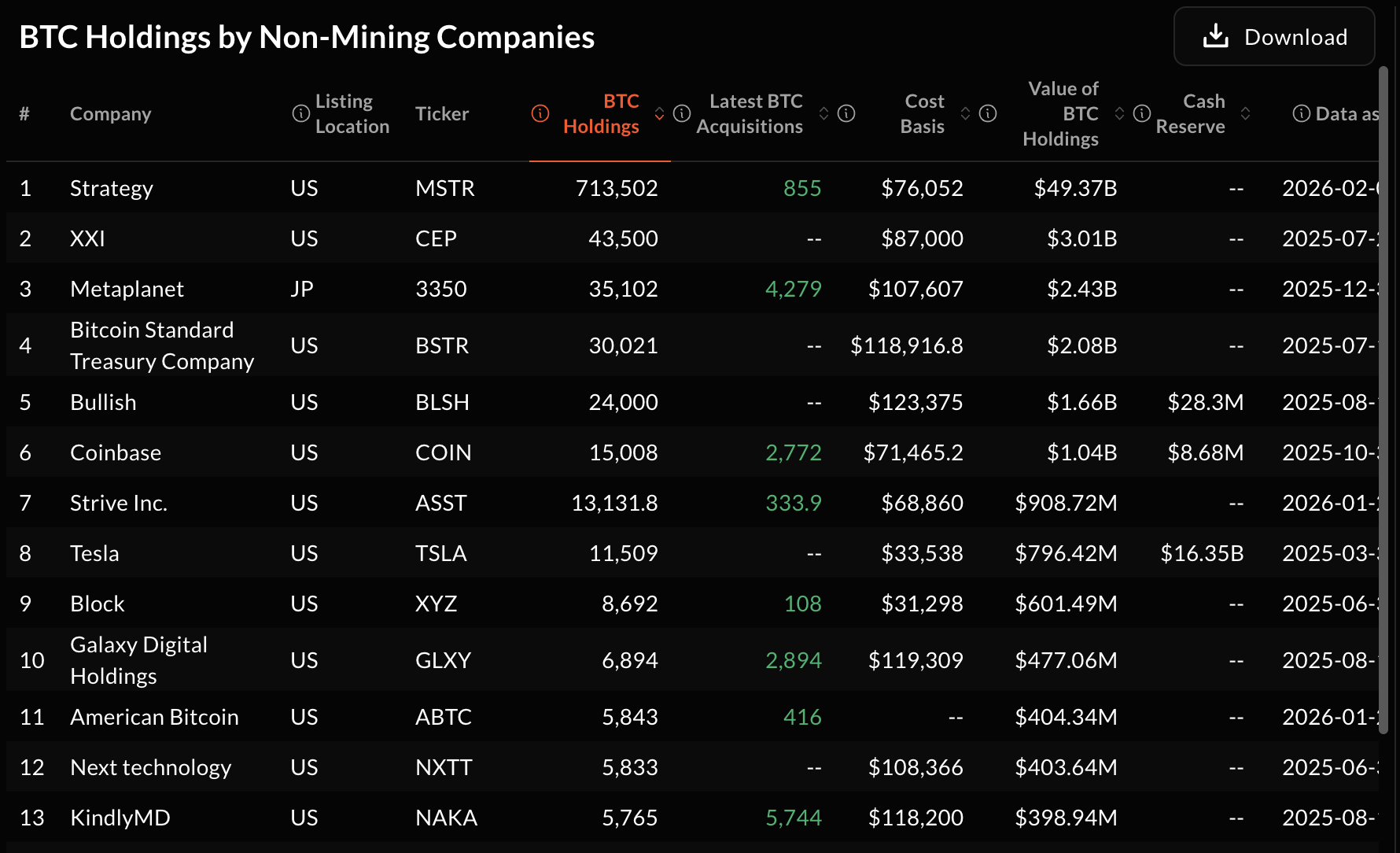
- Strategy is the largest corporate digital asset holder, with 713,502 BTC acquired at a cost of $76,052.
- MSTR stock is down over 11% intraday ahead of the company's earnings call.
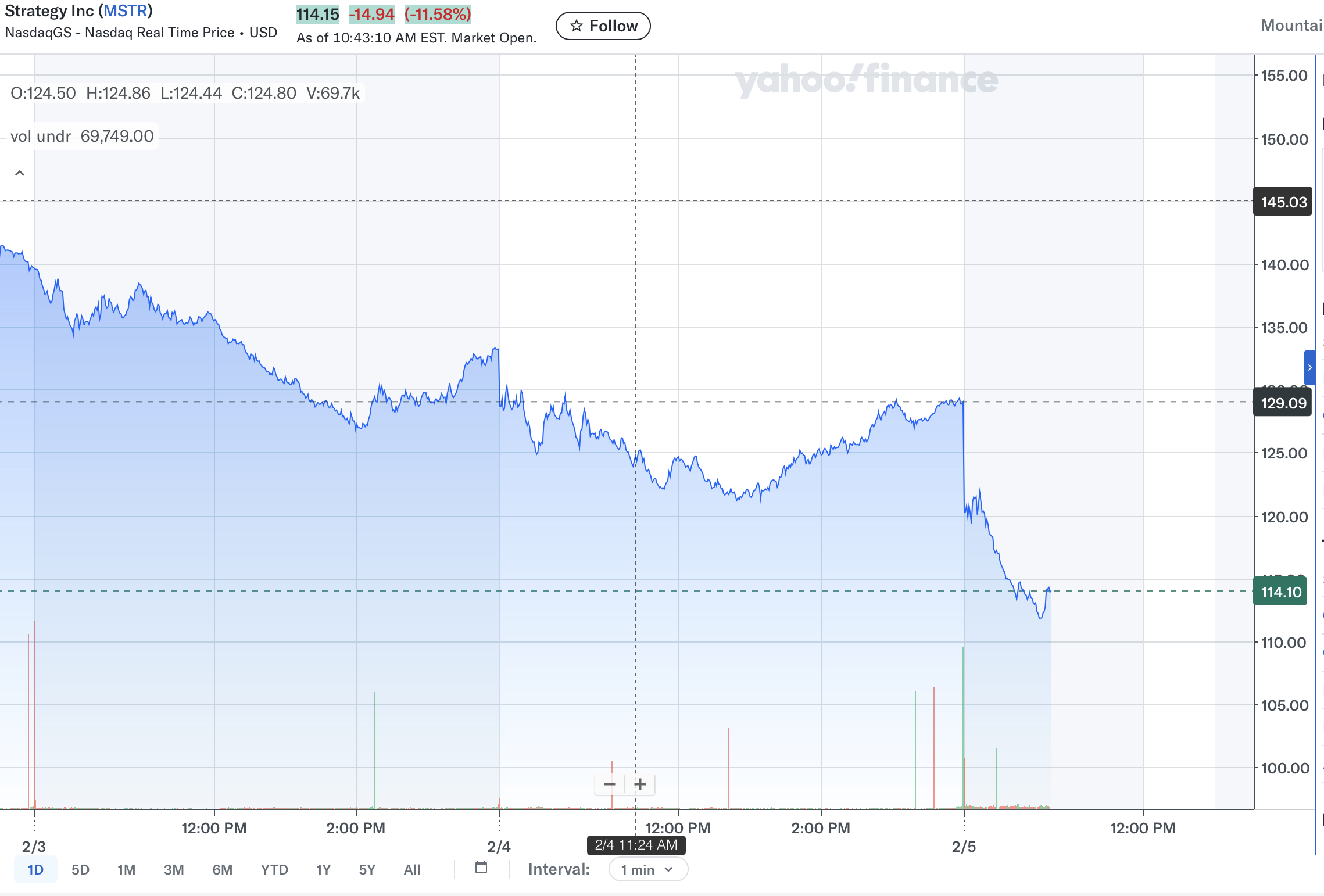
Strategy (MSTR), the largest corporate holder of Bitcoin (BTC), is in focus ahead of its earnings call on Thursday amid an intensifying crypto market sell-off. Also caught in the headwinds is the MSTR stock, trading at $114 at the time of writing, down over 12% intraday.
Bitcoin sell-off pushes Strategy’s treasury into heavy losses
Strategy’s flagship Bitcoin treasury is sitting on unrealised losses of approximately $6 billion as Bitcoin extends its correction below $70,000. Bitcoin has crashed by over 25% since January 1 and 31% from its yearly high of $97,924, reached on January 14.
The sell-off in the crypto market comes amid a combination of factors, including macroeconomic uncertainty following the Federal Reserve (Fed) pausing its monetary policy easing cycle in January, leaving interest rates unchanged in the 3.50%-3.75% range. Fed Chair Jerome Powell maintained a hawkish stance in the post-meeting conference on January 28, sending jitters across high-risk assets.
United States (US) President Donald Trump, in his push for reforms at the central bank, nominated Kevin Warsh to succeed Jerome Powell as the next Fed Chair immediately after the Federal Open Market Committee (FOMC) meeting.
Although the nomination briefly sent relief across the crypto market, participants continue to reassess Warsh’s previous hawkish stance as Fed governor. Risk-off sentiment remains dominant amid the sharp sell-off affecting Bitcoin and altcoins.
Despite recent market drawdowns, the company has remained unwavering in its commitment to its Bitcoin strategy. Strategy announced on Monday that it acquired 855 BTC for $75.3 million at an average price of $87,974, bringing its cumulative holdings to 713,503 BTC.
MSTR stock plunges ahead of earnings report
Strategy is expected to report its earnings later on Thursday, after Wall Street’s close. Investors and crypto enthusiasts will be watching what Strategy’s Chairman Michael Saylor has to say about the current Bitcoin price crash.
Saylor’s sentiment on Bitcoin performance is likely to carry weight, given that Strategy remains the undisputed largest corporate holder of Bitcoin.
Meanwhile, MSTR stock edges lower, trading at around $114 at the time of writing on Thursday. The sell-off coincides with Bitcoin’s crash to $67,000 and the broader crypto market drawdown. A further correction could push MSTR below the $100 level, bringing into focus Strategy’s bet on Bitcoin and whether the company can withstand the headwinds.
The sell-off in Bitcoin remains of great concern, especially with the price well below the 50-day Exponential Moving Average (EMA) at $87,420, the 100-day EMA at $92,146 and the 200-day EMA at $98,831. All three moving averages are in a sharp decline, signaling robust bearish momentum.
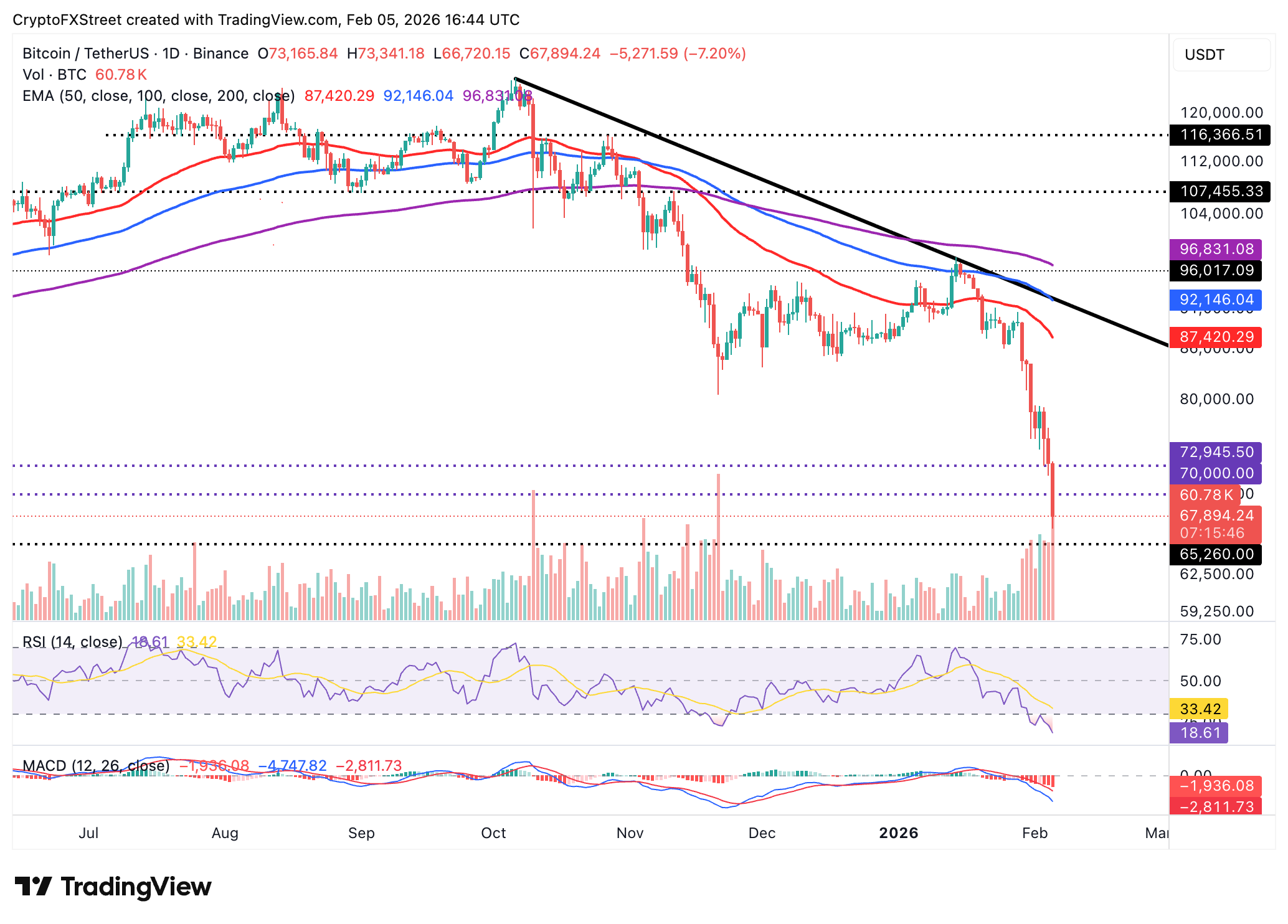
Similarly, the Relative Strength Index (RSI) is at 18.6, indicating an oversold condition and confirming the bearish outlook. Moreover, the Moving Average Convergence Divergence (MACD) indicator remains below its signal line, while red histogram bars expand, prompting investors to reduce risk exposure. Below the $67,000 immediate support level, Bitcoin risks extending the downtrend and testing the demand zone at $65,000 for the first time since November 2024.
Bitcoin, altcoins, stablecoins FAQs
Bitcoin is the largest cryptocurrency by market capitalization, a virtual currency designed to serve as money. This form of payment cannot be controlled by any one person, group, or entity, which eliminates the need for third-party participation during financial transactions.
Altcoins are any cryptocurrency apart from Bitcoin, but some also regard Ethereum as a non-altcoin because it is from these two cryptocurrencies that forking happens. If this is true, then Litecoin is the first altcoin, forked from the Bitcoin protocol and, therefore, an “improved” version of it.
Stablecoins are cryptocurrencies designed to have a stable price, with their value backed by a reserve of the asset it represents. To achieve this, the value of any one stablecoin is pegged to a commodity or financial instrument, such as the US Dollar (USD), with its supply regulated by an algorithm or demand. The main goal of stablecoins is to provide an on/off-ramp for investors willing to trade and invest in cryptocurrencies. Stablecoins also allow investors to store value since cryptocurrencies, in general, are subject to volatility.
Bitcoin dominance is the ratio of Bitcoin's market capitalization to the total market capitalization of all cryptocurrencies combined. It provides a clear picture of Bitcoin’s interest among investors. A high BTC dominance typically happens before and during a bull run, in which investors resort to investing in relatively stable and high market capitalization cryptocurrency like Bitcoin. A drop in BTC dominance usually means that investors are moving their capital and/or profits to altcoins in a quest for higher returns, which usually triggers an explosion of altcoin rallies.
Recommended Articles


