




India’s E-Rupee Goes Global While Bitcoin Hyper ($HYPER) Redefines Layer 2 Speed
The Reserve Bank of India (RBI) isn’t just tweaking the system; it’s actively recalibrating the entire financial architecture. By pushing the e-rupee (CBDC) toward cross-border interoperability, India is effectively ditching the slow, correspondent banking models of the past.
Negotiations are already underway with multiple jurisdictions to enable direct CBDC bridges. The goal? Slashing settlement times from days to mere seconds and cutting transaction costs that currently eat up to 5% of remittance values.
That validation matters. When major economies prioritize ‘programmable money’ and atomic settlement, they’re tacitly admitting that legacy rails like SWIFT are growing obsolete. The data points to a massive efficiency gap. Traditional cross-border payments struggle with liquidity fragmentation and operating hours; blockchain solutions don’t sleep.
While central banks try to wall off these efficiencies within permissioned ledgers, the decentralized market is solving the same problems on the world’s most secure network. Speed isn’t just a fiat concern. It’s the primary bottleneck for Bitcoin’s adoption in decentralized finance (DeFi).
As institutional interest shifts toward scalable infrastructure, Bitcoin Hyper ($HYPER) has stepped up, engineering a bridge between Bitcoin’s security and high-frequency execution.
Integrating Solana Speeds Into Bitcoin’s Security Architecture
Bitcoin’s technical Achilles’ heel has always been the trade-off between security and scalability. Base layer transactions are bulletproof but sluggish, often taking 10 to 60 minutes for finality. That makes high-frequency trading (or buying a coffee) impractical.
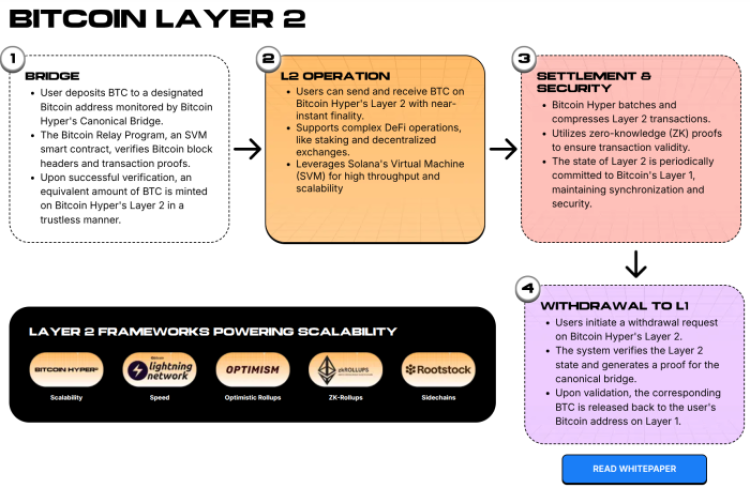
Bitcoin Hyper tackles this head-on by integrating the Solana Virtual Machine (SVM) directly into a Bitcoin Layer 2 framework, a critical architectural shift.
Source: Bitcoin Hyper
Using the SVM, Bitcoin Hyper achieves sub-second transaction processing while anchoring the state back to the Bitcoin mainnet. This lets developers build complex applications, from high-speed exchanges (DEXs) to gaming platforms, using Rust, without wrestling with main chain congestion.
It effectively transforms Bitcoin from a passive store of value into a programmable beast capable of handling thousands of transactions per second. This infrastructure play is distinct from other scaling solutions like Stacks or Lightning. Lightning focuses on payments; Bitcoin Hyper’s SVM integration enables full smart contract capabilities.
For developers, this opens the door to creating decentralized applications (dApps) that tap into Bitcoin’s liquidity but perform with the snap of a centralized database. The protocol uses a decentralized canonical bridge, ensuring that assets move seamlessly between the L1 and L2 layers without centralized custodians.
Find out more with our ‘What is Bitcoin Hyper?’ guide.
Market Capital Flows Toward Scalable Infrastructure
The market’s appetite for Bitcoin-native infrastructure is clear in the current capital rotation. Investors are looking past meme tokens (well, mostly) and toward protocols that solve fundamental utility constraints. Bitcoin Hyper has caught this wave, securing substantial backing during its early funding stages.
According to official presale data, the project has already raised over $31M, signaling strong confidence in the ‘Bitcoin with smart contracts’ narrative.

Source: X
With the token currently priced at $0.013675, the valuation reflects an entry point before the anticipated mainnet launch and subsequent exchange listings. This fundraising velocity suggests the market views Layer 2 solutions not just as technical upgrades, but as a necessary evolution.
For Bitcoin to compete with Ethereum’s DeFi ecosystem, this shift isn’t optional—it’s mandatory.
Numbers aside, the protocol’s economic model incentivizes sticking around. High APY staking options are available immediately after the Token Generation Event (TGE), rewarding users who secure the network.
Unlike some presales that often dump tokens on day one, Bitcoin Hyper implements a structured approach. This includes a 7-day vesting period for presale stakers to mitigate volatility. This focus on sustainable tokenomics aligns with the project’s goal of building a robust, developer-centric ecosystem rather than a fleeting speculative vehicle.
Zoom around the world with Bitcoin Hyper.
This article is for informational purposes only and does not constitute financial advice. Cryptocurrencies are high-risk assets; investors should conduct their own due diligence before deploying capital.
Recommended Articles


