

Is Cardano Dead? Is ADA Still Worth Investing In?
ADA Latest News
Unlike Ripple (XRP), Solana (SOL), Binance Coin (BNB) and other major cryptocurrencies, ADA coin has been a somewhat enigmatic presence, maintaining a top-ten market capitalization despite its understated profile. As of this writing, ADA's market capitalization stands at $15.2 billion, ranking tenth, behind cryptocurrencies such as Dogecoin (DOGE), Tron (TRX) and others.
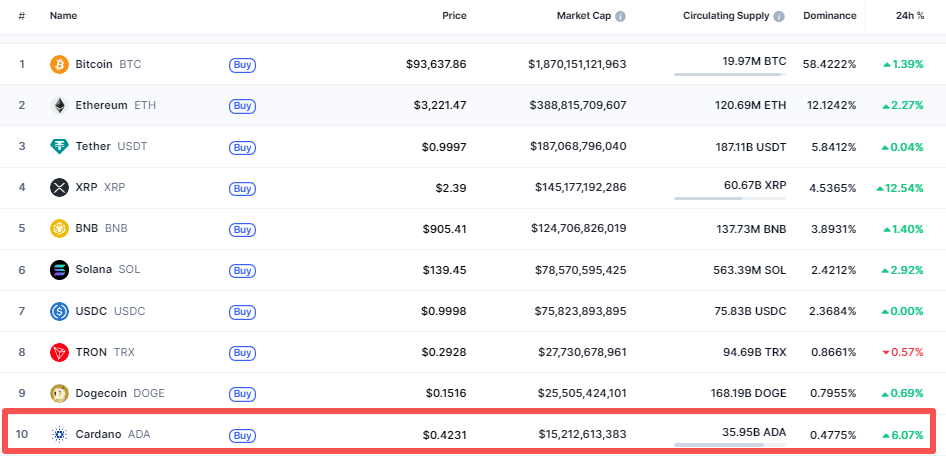 Top Ten Cryptocurrencies by Market Cap, Source: CoinMarketCap.
Previously, Cardano founder Charles Hoskinson was frequently active on social media, occasionally commenting on or criticizing various projects or events, which often drew criticism himself. This active presence, however, inadvertently highlighted Cardano's existence. Nevertheless, this situation underwent a significant shift in 2025.
By the end of 2025, Charles Hoskinson announced a reduction in his social media involvement to dedicate more effort to critical technological upgrades, particularly the Midnight project. While this has further diminished Cardano's public visibility, it also signifies that Cardano is entering a new phase of technological and ecosystem application development, a trajectory highly similar to Solana's quiet development following the FTX incident.
What is ADA?
Cardano is, following Bitcoin (BTC), and Ethereum (ETH), a third-generation blockchain platform. Its objective is to address two shortcomings inherited from the preceding two blockchain generations—namely, Bitcoin's scalability and Ethereum's energy efficiency—with the aim of becoming a more ideal blockchain infrastructure, primarily evidenced by its sustainability, scalability, and interoperability.
Like other public blockchains, Cardano also possesses its own native token, ADA. Internally, ADA functions as Cardano's governance tool, simultaneously ensuring the secure operation of the entire network. Externally, ADA also serves as a payment medium, facilitating functions such as payments, transfers, and transactions.
What are the differences between ADA, BTC, and ETH?
BTC is the cryptocurrency with the strongest consensus, and ETH boasts the largest ecosystem. So, what are ADA's characteristics, and how does it differ from BTC and ETH? Details are as follows:
Characteristics | Bitcoin (BTC) | Ethereum (ETH) | Cardano (ADA) |
Inception | 2009, proposed by Satoshi Nakamoto | 2015, developed by Vitalik Buterin and others | 2017, founded by Charles Hoskinson (one of Ethereum's co-founders) |
Positioning | Decentralized currency, digital gold | Smart contract and decentralized application platform | Third-generation blockchain, emphasizing scalability, interoperability, and sustainability |
Consensus Mechanism | Proof of Work (PoW) | Initially PoW, but shifted to Proof of Stake (PoS) in 2022 | Proof of Stake (PoS) |
Energy Consumption | High | Low | Extremely Low |
Transaction Speed | Approximately 7 transactions/second | Approximately 15–30 transactions/second (faster after upgrades) | Theoretically hundreds of transactions/second, with layered architecture supporting higher throughput |
Issuance Policy | No additional issuance | Annual issuance rate approximately 0.5%-2% | Annual issuance approximately 2%-3% (staking rewards, decreasing annually) |
Primary Use Cases | Store of value, cross-border payments | Smart contracts, decentralized applications, financial innovation | Smart contracts, governance, staking rewards, with future expansions into privacy and cross-chain functionalities |
Does Cardano still have a future?
Although Cardano does not rank first in any single aspect within the industry, leading to significant differences compared to Bitcoin and Ethereum, it has nevertheless endured for over 8 years, remaining resilient. Its market capitalization has consistently ranked among the top ten globally, which sufficiently demonstrates its widespread adoption and inherent value.
With the exception of Bitcoin, the development of any public blockchain relies on robust ecosystem applications, and the valuation of its native token is inextricably linked to its Total Value Locked (TVL). This, however, is precisely where Cardano shows weakness. As of press time, Cardano's TVL is less than $200 million In contrast, Ethereum, ranked first, boasts a TVL of $74 billion, accounting for 58% of the total market, while Solana, ranked second, has $8 billion, representing 7%. It is evident that Cardano's ecosystem development is significantly lagging.
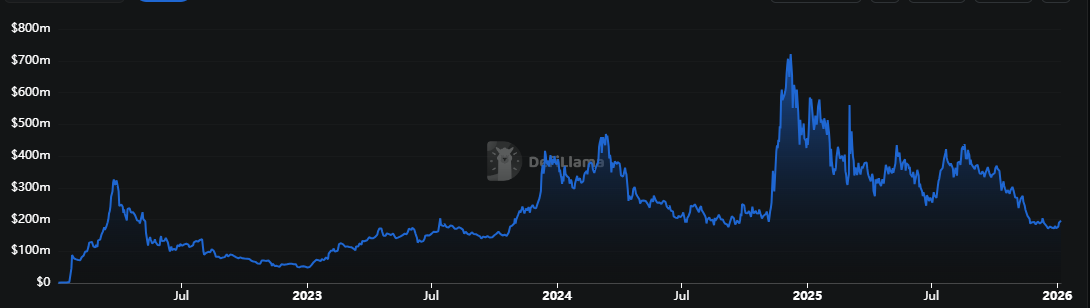 Cardano's TVL, Source: DefiLlama.
Although Solana is a newcomer, it understands how to differentiate its competition from Ethereum. Ethereum primarily relies on DeFi and NFTs, whereas Solana has chosen to leverage meme coins. Currently, Cardano has also adopted this development strategy, attempting to expand into the privacy sector via sidechains and bridge Solana's liquidity. From an investor's perspective, Should Cardano's plan succeed, it is expected to expand its potential market by 200 times.
Cardano also faces a regulatory issue; if handled properly, its future prospects could be even more optimistic. There is no clear consensus yet on whether ADA is classified as a commodity or a security, which has constrained the development of an ADA spot ETF. Currently, the market generally believes that if the U.S. CLARITY Act is passed, ADA would be classified as a commodity, which would facilitate SEC approval for its spot ETF, allowing it to enter traditional financial markets, especially the U.S. capital market. In short, Given its current capabilities, if Cardano achieves success in its ecosystem development or regulatory clarity, its future prospects would be even more promising, making it a cryptocurrency worth considering for a small portfolio allocation.
Where to buy ADA?
Currently, ADA's spot and futures products are listed on major centralized exchanges (CEXs) and decentralized exchanges (DEXs). Nearly 100 CEX platforms have listed ADA; however, liquidity varies across platforms, with Binance offering the strongest liquidity, followed by OKX and Bybit.
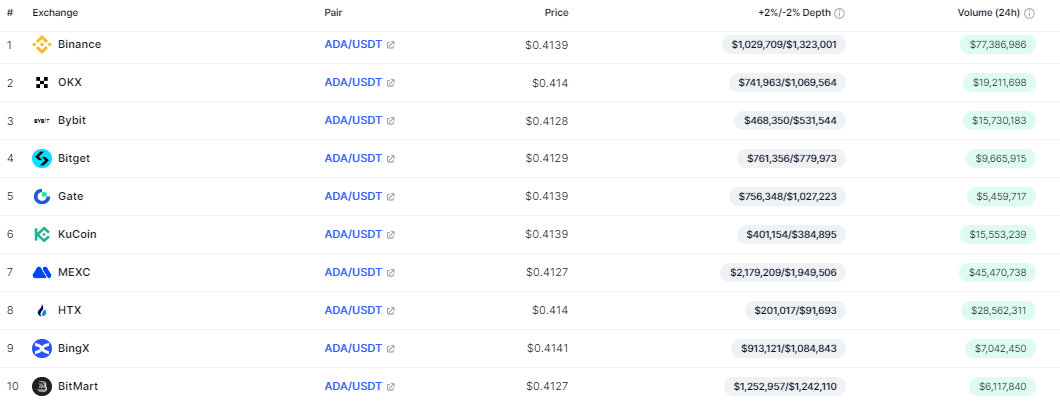 Top Ten Centralized Exchanges Listing ADA, Source: CoinMarketCap.
Compared to CEXs, the number of DEXs listing ADA is notably smaller, strictly limited to four. Furthermore, their liquidity is substantially lower than that of centralized exchanges. This disparity not only affects transaction speed but can also result in additional slippage. Therefore, users should exercise caution when choosing a specific platform.
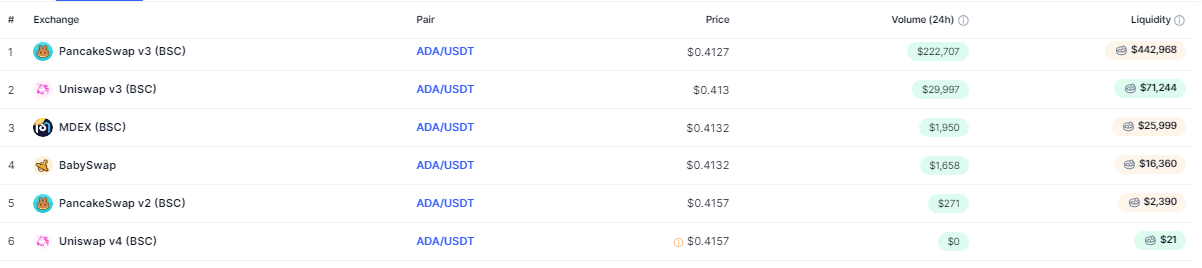 Decentralized Exchanges Listing ADA, Source: CoinMarketCap.
How to buy ADA?
The process of purchasing Cardano (ADA) is relatively simple, typically involving: account registration, identity verification (KYC completion), depositing funds (fiat or stablecoin), and buying ADA. Details are as follows:
- Select an Exchange: All the platforms mentioned above are suitable; however, it is advisable to choose platforms with high liquidity and strong regulatory compliance to avoid any unnecessary complications.
- Register and Complete KYC: Register an account using email or phone number and complete identity verification (upload ID documents, take a selfie). This step is only required for CEX platforms; DEX platforms do not require it.
- Deposit Funds: You can use bank transfer, credit/debit card, Apple Pay, Google Pay and other methods to buy directly, or deposit stablecoins such as USDT, USDC.
- Place an Order to Buy ADA: On the exchange page, search for ADA, find the trading pair ADA/USDT or ADA/USDC, enter the amount, and confirm the transaction.
Conclusion
Cardano's ecosystem applications significantly lag behind those of Ethereum and Solana. However, its market capitalization has consistently remained among the top ten globally, indicating strong consensus and a certain level of value support. Currently, ADA founder Charles Hoskinson is shifting focus towards technological upgrades and privacy sidechains. If it can successfully bridge liquidity and achieve breakthroughs on the regulatory front, ADA still possesses potential for growth.
Recommended Articles


