
Bitcoin New Era Loading? Halving Narrative Is Evolving Beyond Fixed Timelines

Source Newsbtc

The idea that Bitcoin’s halving operates on a fixed four-year timetable has become one of the most oversimplified narratives in the crypto markets. While the halving still reduces new supply, its influence is no longer confined to predictable timelines or uniform outcomes. As BTC matures into a globally traded asset, the forces shaping its market behavior have expanded beyond the event.

How The Cycle Narrative Became Oversimplified

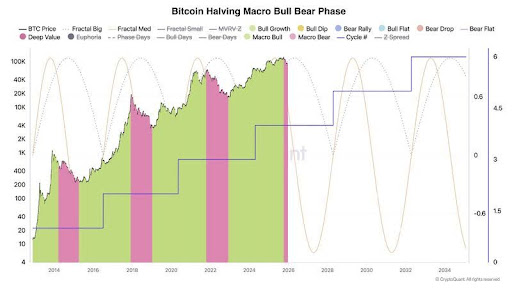
In an X post, an analyst known as Deg_ape revealed that the Bitcoin halving cycle was never a rigid four-year clock. BTC’s cycle has always been about phase transitions, shifting liquidity conditions, and market behavior, but never about buying every four years and selling four years later. This cycle actually maps macro bear phases that expand, contract, overlap, and stretch based on macro flows and positioning. 

The four-year cycle still exists, but it is not a linear process. Deg_ape explains that BTC halvings act as a structural anchor, not a price guarantee. This is why market tops usually arrive later than most expect and why bear markets last longer than people can tolerate. Trying to time the BTC market cycle without understanding that these phase dynamics can lead to expensive mistakes.
Bitcoin

Kyle Chassé has pointed out that Bitcoin dipped, and traders stopped watching the printer, which is a big mistake. This is the most dangerous divergence in the market as price is down, but liquidity is vertical. While traders were panicking and selling their slips, the US Treasury and the Fed quietly injected around $130 billion of fresh liquidity into the system. 

This shows that liquidity would lead the price, but it won’t do it instantly. There’s a big lag as liquidity will flood the market first, then the assets will reprice. However, a red candle on a green liquidity chart isn’t a crash, but a mispricing. While the printer is screaming up, the price chart is whispering down.

Why Retail Holders Are Capitulating At A Historic Rate

A crypto analyst known as OnChainCollege outlined that retail holders are under pressure. On-chain data shows the deepest 30-day balance decline among retail wallets since 2018, a level typically associated with periods of extreme fear and capitulation. While retail balances are falling sharply, larger holder cohorts are quietly absorbing the difference. 

The market sentiment has split into two groups with polar-opposite perspectives from retail that are reacting to price action against larger holders that are responding to structure, liquidity, and long-term positioning. In the meantime, the OG whales have continued to distribute throughout this bull market, but Mega whales and institutional participants are stepping in as the marginal buyers.

Bitcoin
Disclaimer: For information purposes only. Past performance is not indicative of future results.
placeholder
Gold's Historic 2025 Rally: Can the Momentum Last Through 2026?Following a historic surge in 2025 that saw prices climb over 60% and break records more than 50 times, gold investors are now looking ahead to assess whether the precious metal can sustain its momentum into 2026. Despite outperforming most major asset classes and heading for its best annual performance since 1979, analysts are divided on the outlook—with some seeing further room for gains and others cautioning that risks are rising.
Author  Mitrade
Dec 09, Tue
Following a historic surge in 2025 that saw prices climb over 60% and break records more than 50 times, gold investors are now looking ahead to assess whether the precious metal can sustain its momentum into 2026. Despite outperforming most major asset classes and heading for its best annual performance since 1979, analysts are divided on the outlook—with some seeing further room for gains and others cautioning that risks are rising.
placeholder
Oracle's Weak Earnings Prompt Concerns Over AI Spending, Pressuring Nvidia and Industry RivalsOracle's disappointing earnings and soaring expenses have raised fears about AI spending sustainability, causing Nvidia and other related stocks to decline amidst heightened competition and concerns over mounting debt.
Author  Mitrade
Dec 11, Thu
Oracle's disappointing earnings and soaring expenses have raised fears about AI spending sustainability, causing Nvidia and other related stocks to decline amidst heightened competition and concerns over mounting debt.
placeholder
Cryptocurrencies Extend Losses as Year-End Caution and Thinning Liquidity Weigh on MarketThe cryptocurrency market declined on Monday, mirroring a pullback in global risk assets as investors turned cautious ahead of key U.S. economic data. The broad-based retreat highlighted thinning liquidity and growing risk aversion across financial markets as the year draws to a close.
Author  Mitrade
Dec 16, Tue
The cryptocurrency market declined on Monday, mirroring a pullback in global risk assets as investors turned cautious ahead of key U.S. economic data. The broad-based retreat highlighted thinning liquidity and growing risk aversion across financial markets as the year draws to a close.
placeholder
Asian Stocks Rise, Oil Jumps as Trump Orders Blockade on Venezuela TankersAsian equities advanced on Wednesday, supported by strong buying in technology shares, while oil prices surged more than 1% following an escalation of U.S. sanctions pressure on Venezuela.
Author  Mitrade
Yesterday 07: 44
Asian equities advanced on Wednesday, supported by strong buying in technology shares, while oil prices surged more than 1% following an escalation of U.S. sanctions pressure on Venezuela.
placeholder
BOJ Set to Hike Rates Amid Inflation Pressures and Yen Weakness The Bank of Japan is expected to raise its benchmark interest rate to 0.75% on December 19, marking its first increase since early 2025, amidst ongoing inflation and a weakening yen. Analysts predict additional hikes in 2026 as the central bank navigates renewed monetary policy normalization under Governor Kazuo Ueda.
Author  Mitrade
6 hours ago
The Bank of Japan is expected to raise its benchmark interest rate to 0.75% on December 19, marking its first increase since early 2025, amidst ongoing inflation and a weakening yen. Analysts predict additional hikes in 2026 as the central bank navigates renewed monetary policy normalization under Governor Kazuo Ueda.
goTop
quote