

Bitcoin Under Pressure As Yen Carry Trade Unwind Hits Global Markets
The yen carry trade unwind has been hovering over markets lately — the kind of “plumbing” story that most people ignore right up until volatility spikes and everything suddenly feels connected. Graham Stephan put it into a Bitcoin and crypto-friendly frame yesterday.
In a Dec. 15 post, the popular YouTuber described the yen carry trade as Wall Street’s long-running “infinite money glitch” — and argued it’s breaking down just as the Fed is signaling a shift in its outlook for next year. “Wall Street found an ‘infinite money’ glitch 20 years ago. They called it the Yen Carry Trade. It just broke, right when the Fed announced its plans for next year,” Stephan wrote.
What The Yen Carry Trade Unwind Means For Bitcoin
He presented it as a straightforward trade that scaled because the size was big enough to matter. “For decades, the ‘Yen Carry Trade’ has been the secret engine behind global liquidity. The mechanics were simple enough that a child could understand them, but profitable enough to move trillions of dollars.”
Stephan then laid out the basic steps in plain English: borrow cheaply in Japan, rotate into higher-yield US assets, keep the spread. “Borrow Cheap: Investors borrowed money in Japan, where interest rates were effectively 0%… Invest Abroad: They took that ‘free money’ and bought US Treasuries paying 4-5%… Profit: They pocketed the difference without using any of their own money.”
His argument is that the setup turns toxic when the rate differential compresses and the currency leg moves the wrong way. He framed the timing as especially awkward for risk assets: Japan tightening to support the yen while the Fed eases. “Japan is finally raising rates to save its own currency right at the time when the Fed has started slashing rates. The gap between the rates is getting squeezed. The ‘free money’ isn’t free anymore.”
From there, he leaned into the mechanical consequence: when funding gets more expensive and the currency shifts, leveraged positions don’t get a long debate window — they get cut. “As Japanese rates rise, that trade flips. Investors are now being forced to sell their US assets to pay back their Yen loans. Instead of money flowing into the US markets, it is being sucked out to pay debts in Tokyo. This is a massive liquidity drain happening right under our noses.”
That’s also where his Bitcoin read comes in. Not “Bitcoin is broken,” but that Bitcoin is where risk appetite and leverage tend to show up early — and where forced selling can look brutal when it hits.
Stephan expanded on the same theme in a Substack post, pulling the Fed into the timeline more directly and warning readers to brace for turbulence. “You better get ready for a bumpy ride,” he wrote, claiming the Fed cut rates “for the third time this year,” and that the central bank “has officially ended ‘Quantitative Tightening’ and is quietly moving back toward printing money.”
He added a “pilot flying blind” angle as well, arguing the Fed cut “without any inflation data whatsoever” due to shutdown-related disruptions. He attached a specific interpretation of balance-sheet policy, too: “Finally, the most important news of the day: Quantitative Tightening (QT) is over… They even announced they will buy $40 billion of Treasuries over the next 30 days. The tightening era is dead. The ‘stimulus’ era is now being rebooted, and the money printer is being turned on.”
Taken together, his thesis ends up with Bitcoin sitting between two forces that don’t necessarily move on the same clock: a potentially sharp deleveraging impulse from carry unwinds, and a slower easing impulse if policy conditions loosen. One can hit price violently in a short window; the other can take time to express itself cleanly.
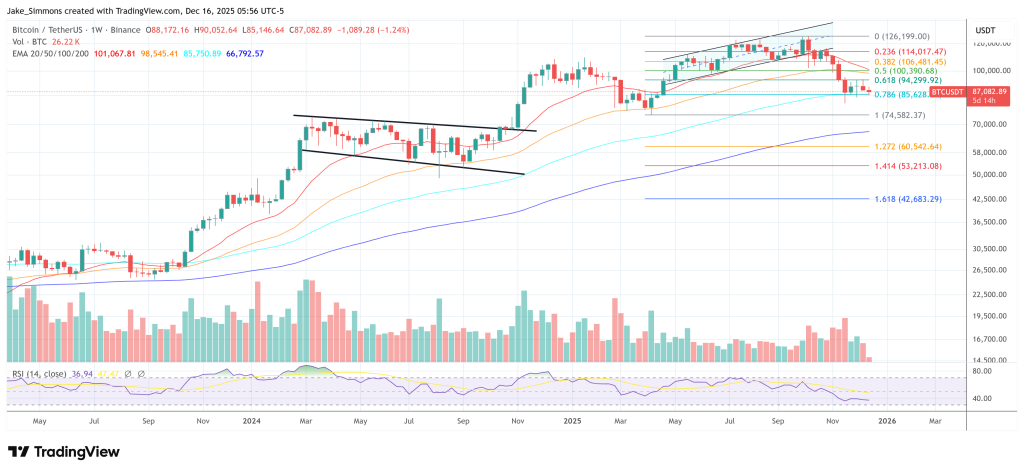
Stephan closed with a familiar Bitcoin-with-training-wheels framing: volatility is normal, drawdowns happen, and mining economics create a reference point. “Bitcoin isn’t broken. It’s just volatile, and this isn’t the first time this is happening. Statistically, Bitcoin has seen drastic crashes of 50% or more, but it has never dropped below its “electrical cost” (the cost to mine one coin), which sits around $71,000 today. If we get close to that number, history suggests it’s a strong buy zone,” he concluded.
At press time, BTC traded at $87,082.
Recommended Articles


