

Bitcoin Cash Unveiled: Why Did BCH Price Surpass BTC? Can it Soar to $1,000 in the Future?
Bitcoin Cash (BCH) News
TradingKey - On December 4, 2025, Bitcoin Cash (BCH) led the crypto market, surging over 8% to near $600, pushing its market capitalization into the global top 10. In the past year, Bitcoin Cash's price has cumulatively risen over 30%, significantly outperforming Bitcoin (BTC).
On December 2, 2025, Nasdaq-listed mF International (NASDAQ: MFI) announced it had raised $500 million, with the proceeds earmarked for purchasing Bitcoin Cash to establish a BCH treasury.
On May 15, 2025, Bitcoin Cash completed its Velma hard fork, successfully introducing VM Limits and BigInt CHIPs to further enhance smart contract and DeFi capabilities, positioning it to compete with public chains such as Ethereum (ETH), Solana (SOL), and Tron (TRX).
What is Bitcoin Cash? How is it related to Bitcoin? Why has its price soared against market trends, and will it continue to rise and break past $1,000 in the future? This article will delve into these questions and analyze them individually.
What is Bitcoin Cash (BCH)?
Similar to Ethereum and its native token ETH, Bitcoin Cash is a public blockchain, with BCH serving as its native cryptocurrency. Literally, one might infer Bitcoin Cash relates to both Bitcoin and cash. In fact, Bitcoin Cash (BCH) forked from Bitcoin (BTC), akin to a child growing up and forming their own household; they share a father-son relationship. Why did Bitcoin Cash separate from Bitcoin to establish its own entity? The reason stems from their differing core philosophies, which can also be understood as distinct objectives.
The genesis of this split was increasing Bitcoin transaction volume, which led to network congestion and high fees. This ignited a fundamental debate within the Bitcoin community over "what Bitcoin's future should be," consequently dividing the community into "small block proponents" and "large block proponents." The former emphasized security and scarcity, while the latter advocated for increasing block capacity to enhance transaction efficiency. Unable to reconcile their views, the two factions ultimately created Bitcoin Cash in August 2017 through a "hard fork."
What are the similarities and differences between Bitcoin Cash (BCH) and Bitcoin?
Bitcoin Cash (BCH) emerged as a protocol experiment, diverging from Bitcoin's (BTC) conservative path. It maintains Bitcoin's original vision for payments but opted for a technical approach centered onlarge blocks, low fees, and on-chain scaling.This contrasts sharply with Bitcoin's evolution towards a settlement layer and digital gold status.
Bitcoin Cash (BCH) | Bitcoin (BTC) | ||
|---|---|---|---|
Similarities | Transaction Experience | Both are irreversible, permissionless, and global. | |
Open-Source Nature | Both are open-source projects driven by community consensus. | ||
Token Supply | Both have an identical total supply of 21 million tokens. | ||
Differences | Launch Date | August 1, 2017 | January 3, 2009 |
Primary Purpose | "Electronic Cash", prioritized as a medium for everyday payments. | "Digital Gold", prioritized as a store of value and settlement layer. | |
Founder | A development team led by former Facebook engineer Amaury Sechet | Satoshi Nakamoto | |
Block Size | Initially 8MB, later upgraded to 32MB | 1MB | |
Transaction Speed | 100+TPS | 3–7 TPS | |
Transaction Fees | Typically below $0.01 | Can reach tens of dollars during peak periods | |
What achievements has Bitcoin Cash (BCH) made in its development?
Over its 8-year development, Bitcoin Cash (BCH) has achieved notable successes, primarily spanning technology, applications, market, and ecosystem aspects, as detailed below:
Achievement Area | Description |
Technical Development | - The block cap has been increased to 32MB. Furthermore, it successfully processed over 2 million transactions in a single block during stress tests, demonstrating its technical viability. |
Ecosystem Applications | Bitcoin Cash currently hosts only 6 DeFi protocols, with a Total Value Locked (TVL) of less than $9 million. Even at its peak in March 2024, TVL reached just $24 million, significantly lagging Ethereum's current $71 billion. |
Commercial Payments | - Tens of thousands of online and offline merchants globally accept BCH payments through major processors like BitPay and Coinbase Commerce. |
On-Chain Data | Active addresses increased by 35% in Q4 2025 compared to the start of the year. Concurrently, on-chain transaction volume grew by 50% to $15 billion. |
Market Performance | With a circulating supply of nearly 20 million BCH, its market capitalization stands at $11.7 billion, ranking it tenth globally. This places it above tokens such as Chainlink (LINK) and Stellar (XLM). |
What challenges does Bitcoin Cash (BCH) face?
Despite some past achievements, Bitcoin Cash faces severe structural challenges in realizing its peer-to-peer electronic cash vision, stemming from intense external competition and internal governance issues.
1. Intense Market Positioning Competition
- Crowded Payments Arena: BCH's "electronic cash" positioning faces direct competition from Litecoin (LTC), Dogecoin (DOGE), and newer, faster, and cheaper public chains such as Solana.
- Stablecoin Dominance: In practical payment scenarios, merchants and users prefer price-stable USDT and USDC over volatile BCH, significantly limiting its utility as "electronic cash."
2. Significant Lag in Ecosystem Adoption
- The ecosystem remains relatively closed and niche, failing to attract large-scale developers to build irreplaceable applications. Innovations like SLP tokens have not achieved mainstream adoption, and ecosystem activity is far lower than other major public chains.
- While BCH technically boastslow transaction fees and high throughput, its merchant adoption rate remains significantly lower than BTC and other mainstream cryptocurrencies. This limits BCH's practicality and convenience as a daily payment method.
3. Community Division Hinders Effective Governance
- Following its hard fork from BTC, BCH has itself undergone multiple forks, most notably the Bitcoin SV (BSV) split. These forks have led to fragmentation among developers, community members, and miners, scattering resources across different chains and weakening BCH's overall strength and cohesion. Each fork requires additional resources to maintain the new chain, diverting attention and development from the original.
- Compared to more mature cryptocurrency projects like Ethereum and Solana, BCH's governance structure may lack clarity. This can lead to a lack of transparency and efficiency in decision-making processes, which in turn impacts community confidence in the project's development direction.
How has the price of Bitcoin Cash (BCH) performed?
Bitcoin Cash has endured a long journey of decline and consolidation over the past seven years, moving from its post-fork peak to eventual marginalization. This path encompassed three main phases: a rapid surge, a sharp crash, and prolonged volatility.
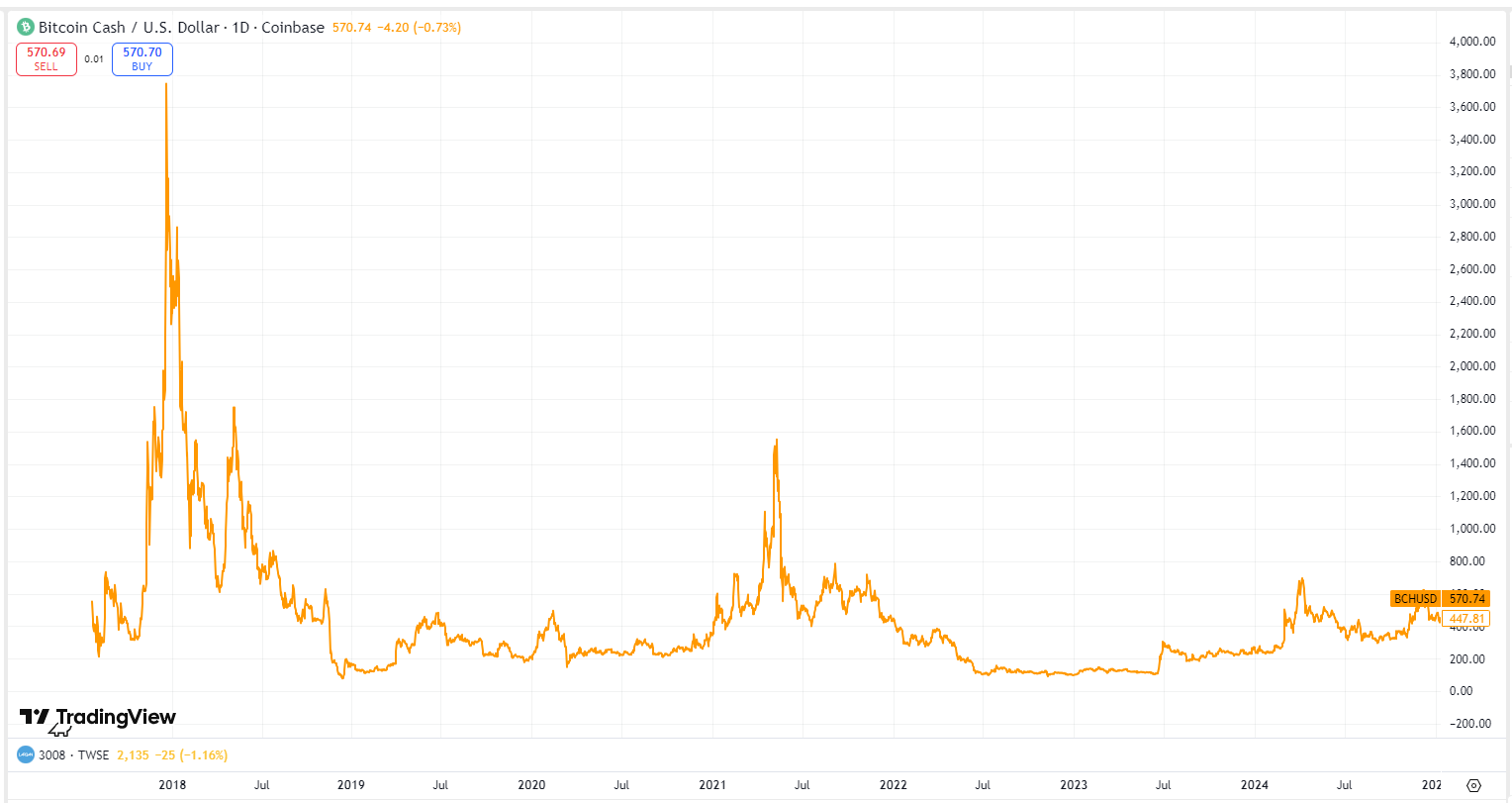 BCH Price Chart (2017-2024), Source: TradingView.
Phase One: Post-Fork Bonus and Frenzied Peak (2017)
- Starting Point: After forking from Bitcoin on August 1, 2017, Bitcoin Cash's initial price was approximately $300.
- Surge: Riding the tailwinds of the 2017 bull market, and fueled by narrative speculation branding it "the real Bitcoin," BCH soared to an all-time high of $4,355 in December 2017.
Phase Two: Bubble Burst and Internal Crisis (2018)
- Crash: As the bull market concluded, the price steadily declined. More critically, in November 2018, the BCH community experienced another hard fork due to a protocol dispute, splitting off Bitcoin SV and triggering a crisis of confidence.
- Low Point: Following the fork, the price plummeted to a low of $75, representing a decline of over 98% from its peak. This internal division inflicted lasting damage on both its brand and price.
Phase Three: Market Correlation and Gradual Marginalization (2020-2024)
- 2021 Bull Market: While it rebounded alongside the broader market, BCH only recovered to approximately $1,600. It failed to approach its historical high, and its gains significantly lagged mainstream cryptocurrencies like BTC and ETH.
- Normalized Performance: Subsequently, its price primarily traded within a broad range of $100 to $700, losing its ability to trade independently.
Bitcoin Cash (BCH) Price Prediction for the Next Five Years
Bitcoin Cash has outperformed Bitcoin year-to-date, gaining 31% while BTC fell 11%, despite an initial Q1 drop of nearly 40%. Entering 2025, Bitcoin Cash weakened alongside Bitcoin, but with a sharper decline, falling nearly 40% in the first quarter, compared to Bitcoin's 20% pullback. In April 2025, Bitcoin Cash rebounded in tandem with Bitcoin's price. By July 2025, both assets showed highly consistent gains and losses, reflecting a 20% increase from the start of the year. Since then, Bitcoin Cash has seen stronger gains and smaller declines than BTC, exhibiting a robust performance. To date, BCH has cumulatively risen 31%, while BTC has fallen over 11%.
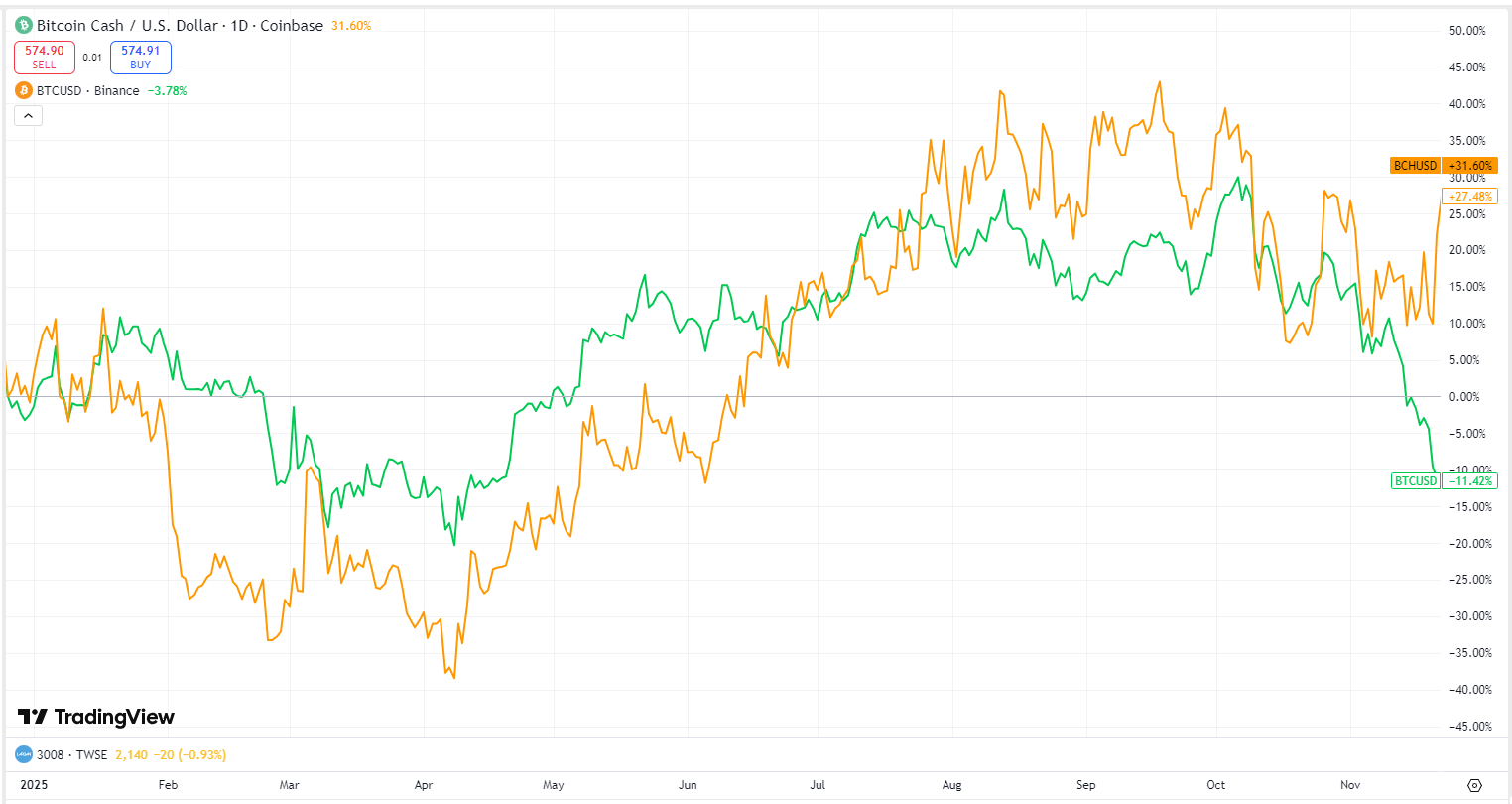 BCH, BTC Year-to-Date Performance in 2025, Source: TradingView.
Bitcoin Cash's recent, albeit temporary, strong performance can be attributed to several key factors, including:
1.Market Rotation and Speculation: This is the primary driver. After BTC reached new all-time highs, some profit-taking capital tends to seek out "value pockets"—assets with relatively lagging gains. As an early mainstream cryptocurrency, BCH easily recaptures attention, leading to short-term speculative interest.
2.Marginal Fundamental Improvements: Although BCH's overall ecosystem is still considered niche, data indicates an increase in its on-chain active addresses and network usage during specific periods. This marginal improvement in fundamentals provides a narrative backdrop for price appreciation.
3.Whale Activity: In July 2025, a single-day accumulation of 103,520 BCH (approximately $62 million) by whales was observed on-chain, directly pushing the price up by over 75%.
From a technical analysis perspective, Bitcoin Cash faces short-term resistance between $600 and $700. For a breakthrough above this resistance zone, BCH will likely need external catalysts rather than relying solely on its own momentum. These catalysts include more institutions establishing BCH treasuries, a strengthening Bitcoin, or further interest rate cuts by the Federal Reserve. Should these catalytic factors materialize, Bitcoin Cash's price could break above $700 this year and reach $1,000 in 2026, potentially even challenging its previous bull market highs. A highly probable tailwind is the Federal Reserve's continued rate cuts this year and next.
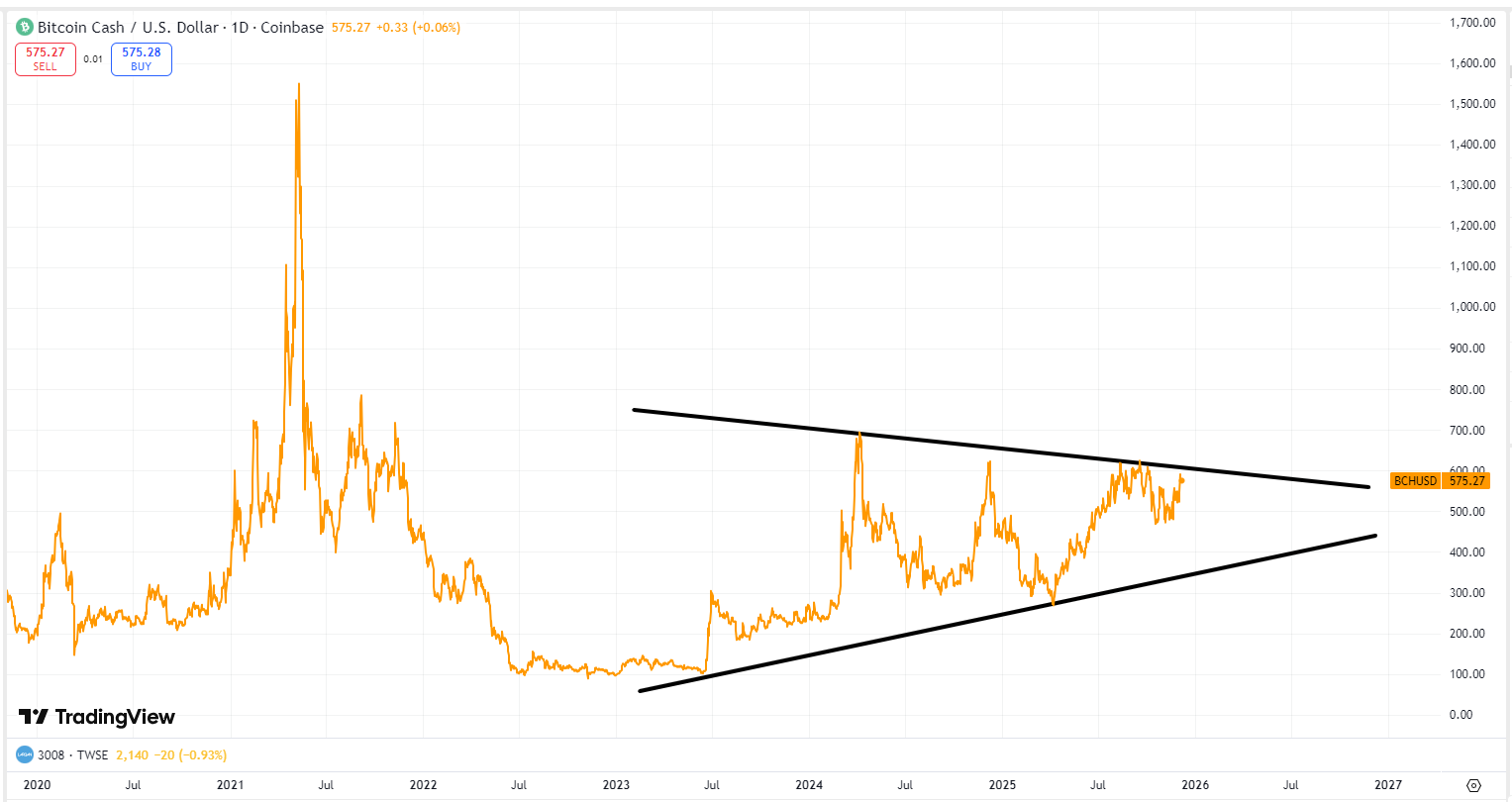 BCH Price Chart, Source: TradingView.
Conversely, without new positive catalysts, not only could Bitcoin Cash's price retreat, but Bitcoin itself might gradually enter a bear market due to its four-year cycle. This could lead to a prolonged bear market until the next halving event in 2028, after which a new bull market might emerge.
Is Bitcoin Cash (BCH) a good investment?
Bitcoin Cash (BCH) is not considered a favorable investment compared to Bitcoin, fundamentally struggling with significant structural challenges and a poor risk-reward profile. It is a project fighting for survival, facing severe structural challenges, and offers low cost-effectiveness. However, this does not mean it is entirely uninvestable, as investment decisions depend on an individual's goals and risk tolerance.
Specifically, for investors preferring low-risk assets, BCH's volatility may be too high for a core portfolio allocation. Conversely, for those comfortable with high-risk assets and who value its high volatility, BCH could represent a suitable target for short-term speculation, provided strict stop-loss discipline is maintained.
Conclusion
Bitcoin Cash (BCH) is poised for a resurgence in 2025, driven by marginal fundamental improvements, market rotation, and speculation, alongsidesignificant whale capital inflows. While it has recently outperformed Bitcoin (BTC), breaking above $1,000 will ultimately hinge on broader Bitcoin market trends and sustained institutional demand.
Recommended Articles


