

XRP Price Suppressed By ‘Layered, Coordinated’ Manipulation, Pundit Alleges
Crypto pundit Versan Aljarrah, the founder of Black Swan Capitalist, published a lengthy post on X on Aug. 7 alleging that the XRP price is being deliberately constrained by a multi-pronged architecture spanning exchanges, regulation, and liquidity infrastructure. Framing the situation as “The Biggest Financial Cover-Up,” Aljarrah writes that “the current price of XRP doesn’t reflect its utility, its adoption, or its strategic position,” and claims the “suppression mechanisms in place are layered, coordinated, and strategically embedded within the very exchanges, regulations, and infrastructure that claim to support a free market.”
Is The XRP Price Manipulated?
Anchoring his thesis to the SEC’s December 2020 enforcement action against Ripple, Aljarrah characterizes the timing as deliberate and disruptive rather than investor-protective. “This wasn’t about investor protection. It was strategic economic warfare,” he argues, asserting that “just days after XRP began gaining traction on Bloomberg and other news outlets,” the lawsuit was filed “under direct orders from central planners and Wall Street.”
He ties that filing to what he describes as momentum in XRP’s real-world payments utility, citing Ripple’s relationship with MoneyGram and “other key global payment corridors.” According to Aljarrah, the case “froze US institutional capital, forced XRP off most trading platforms, and created uncertainty around its legal status,” echoing a view he attributes to @Jvallee2000 that the action was about “disrupting momentum and eliminating competition through regulatory overreach.”
The core of his market-structure critique targets centralized exchanges. Aljarrah claims that whenever “liquidity begins to build or organic volume starts to rise,” XRP encounters “clear patterns of coordinated resistance.” He alleges the presence of “algorithmic trading bots, spoof orders, and systematic wash trading” that “consistently stall momentum or create fake volume to obscure real demand,” and argues that if XRP “were treated like any other digital asset,” it would exhibit “sharp upward price action as utility driven demand increases.” Instead, he says, the market repeatedly “bumps into artificial sell walls at key resistance points and high volume transactions that mysteriously have no impact whatsoever on the spot price,” which he calls “no accident.”
Aljarrah devotes particular attention to how he believes enterprise payments activity is insulated from public price discovery. He describes Ripple’s On-Demand Liquidity flows as settling in XRP “but [being] intentionally kept off the radar of traditional market activity.” In his telling, “volume is somehow routed through OTC desks, private liquidity hubs, and arranged corridor partners to minimize slippage and limit the market exposure.” That routing, he argues, enables XRP to “function as a global bridge asset without triggering visible price increases on public exchanges.” He concedes uncertainty on the precise mechanics—“I’m not sure how this is done but maybe this has anything to do with it?”—and points readers to an external video clip as a possible illustration.
He then situates these alleged microstructure effects within what he portrays as a structurally restricted US market during critical adoption years. “Coinbase, Kraken, and other major exchanges delisted and restricted XRP following the SEC lawsuit, effectively cutting off access for retail investors,” Aljarrah writes, while claiming Ripple’s expansion “globally, particularly across Asia and the Middle East,” left US participants “sidelined under the guise of regulatory uncertainty.” He characterizes the dynamic bluntly: “The US was playing both sides, and there’s proof of it.”
XRP Adoption In The Dark?
The post also advances a narrative of divergence between XRP’s intended function and its observed trading correlations. Aljarrah says XRP has been “treated as a long term utility instrument for a new monetary system, unlike 99% of the crypto market,” yet its price action remains tethered to “violent, speculative assets like $BTC and $ETH, neither of which offer any real utility.” He alleges “institutional accumulation behind the scenes,” asserting that while “retail investors were kept in the dark and blocked from key markets, institutional players gained early access through private investment vehicles, regulatory sandboxes, and cross-border corridor testing.” Summarizing this view, he insists: “The flows are real, yet none of it shows up on public charts. Meaning, XRP is being adopted. It’s being used. But its price is being managed.”
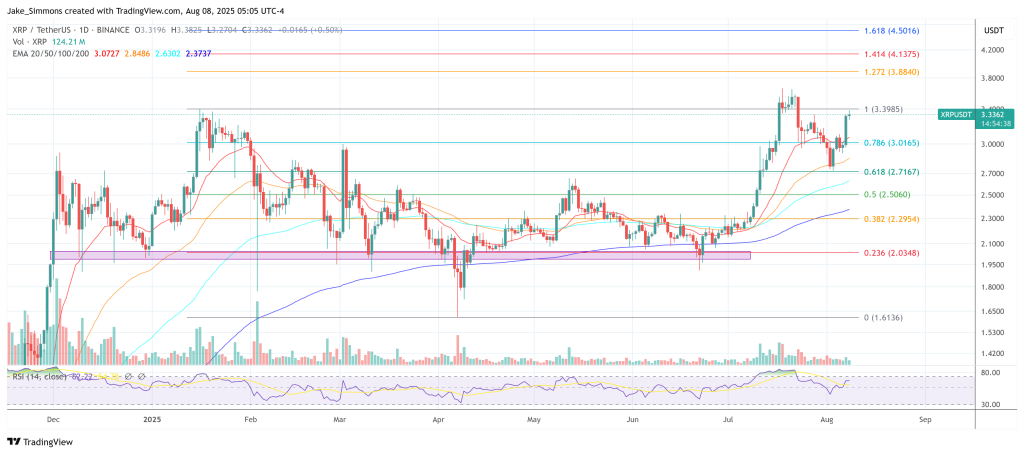
Price level rhetoric features prominently in Aljarrah’s conclusion. “You can’t accept XRP’s role in real time settlements, central bank integrations, and global remittance adoption at a stagnant $3 price tag without acknowledging how tightly it’s being controlled,” he writes, adding a categorical forecast: “If XRP were allowed to operate in a truly open and fair global marketplace, without artificial barriers, I guarantee you it wouldn’t be hovering around three dollars.” He closes by asserting a deliberate, time-bound design to the current state of play: “There’s a deliberate framework designed to suppress XRP until the infrastructure is fully built and legacy systems are ready to migrate.” The open issue he poses—“how long will the suppression continue while the very institutions enforcing it prepare to flip the switch?”—serves as his final provocation.
Aljarrah’s post presents a comprehensive allegation that links legal timing, exchange behavior, liquidity routing, and institutional access to a single outcome: visible underpricing relative to utility. The claims are framed as assertions rather than accompanied by underlying order-book data, corridor-level volumes, or documentary evidence. But his position, in his own words, is unambiguous: “XRP is being adopted. It’s being used. But its price is being managed.”
At press time, XRP traded at $3.33.
Recommended Articles


