




EUR/USD slips as Trump drops tariff threats, lifts the US Dollar
- EUR/USD falls over 0.30% after Trump cancels planned tariffs tied to Greenland negotiations.
- Improved risk sentiment lifts US equities and supports the Dollar, pressuring the shared currency.
- Focus turns to US GDP, Jobless Claims, Core PCE and ECB policy accounts.
EUR/USD retreats late Wednesday during the North American session, registers losses of over 0.30% as US President Donald Trump refrained from its threats of imposing tariffs over eight European countries over discussions of Greenland.
Euro retreats as easing US–EU trade tensions boost the Greenback
In Davos Switzerland, US President Donald Trump posted on Truth Social that “Based upon a very productive meeting that I have had with the Secretary General of NATO, Mark Rutte, we have formed the framework of a future deal with respect to Greenland and, in fact, the entire Arctic Region.” He added that “Based upon this understanding, I will not be imposing the tariffs that were scheduled to go into effect on February 1.”
On the post, risk appetite improved as shown by US equity markets, which recovered as three of the four US equity indices ended Wednesday’s session with gains between 1.16% and 1.21%.
The US Dollar recovered some ground as shown by the US Dollar Index (DXY). The DXY, which tracks the buck’s value versus six currencies, is up 0.20% at 98.75.
Other data revealed that the US Supreme Court expressed skepticism about Trump’s authority to fire Fed Governor Lisa Cook, revealed CNBC.
Across the pond, the Eurozone docket featured speeches by members of the European Central Bank, led by President Christine Lagarde and Kocher.
Ahead on Thursday, the economic docket will feature US Q3 2025 Gross Domestic Product final reading, jobless claims and the Fed’s preferred inflation gauge, the Core Personal Consumption Expenditures (PCE) Price Index. In the European Union, the schedule will feature the ECB’s Monetary Policy Meeting Accounts and EU’s Consumer Confidence data.
Daily digest market movers: Euro on the defensive as Trump TACO trade re-emerges
- US President Donald Trump reunion with the North Atlantic Treaty Organization (NATO) Secretary General Mark Rutte created a framework of a future deal over Greenland. Trump called the framework “fantastic,” but offered no details.
- A Reuters poll revealed that over 100 economists expect the Fed to hold rates unchanged in January. Also, the majority expect the US central bank to stand pat until the current Fed Chair Jerome Powell finishes his term In May.
- US Pending Home Sales plunged 9.3% in December, marking the weakest reading since July. The report highlighted that inventory of existing homes remains constrained, as many homeowners are locked into mortgage rates below 5%, reducing incentives to list properties and weighing on transaction activity.
- Newswires reported that the European Union is delaying the ratification of the US-EU trade agreement.
- ECB Kocher said that using trade policy threats to exert political pressure, increasing the risks for global economy. In other words, ECB’s Lagarde said that monetary policy “is in a good place” and that the bloc’s economy would be stronger if not for tariffs.
Euro Price This week
The table below shows the percentage change of Euro (EUR) against listed major currencies this week. Euro was the strongest against the Japanese Yen.
| USD | EUR | GBP | JPY | CAD | AUD | NZD | CHF | |
|---|---|---|---|---|---|---|---|---|
| USD | -0.86% | -0.58% | 0.33% | -0.56% | -1.26% | -1.67% | -0.67% | |
| EUR | 0.86% | 0.28% | 1.18% | 0.30% | -0.43% | -0.82% | 0.18% | |
| GBP | 0.58% | -0.28% | 0.66% | 0.01% | -0.70% | -1.10% | -0.10% | |
| JPY | -0.33% | -1.18% | -0.66% | -0.87% | -1.56% | -1.96% | -0.98% | |
| CAD | 0.56% | -0.30% | -0.01% | 0.87% | -0.68% | -1.09% | -0.11% | |
| AUD | 1.26% | 0.43% | 0.70% | 1.56% | 0.68% | -0.40% | 0.58% | |
| NZD | 1.67% | 0.82% | 1.10% | 1.96% | 1.09% | 0.40% | 1.01% | |
| CHF | 0.67% | -0.18% | 0.10% | 0.98% | 0.11% | -0.58% | -1.01% |
The heat map shows percentage changes of major currencies against each other. The base currency is picked from the left column, while the quote currency is picked from the top row. For example, if you pick the Euro from the left column and move along the horizontal line to the US Dollar, the percentage change displayed in the box will represent EUR (base)/USD (quote).
Technical outlook: Euro drops below 1.1700 as risk appetite improves
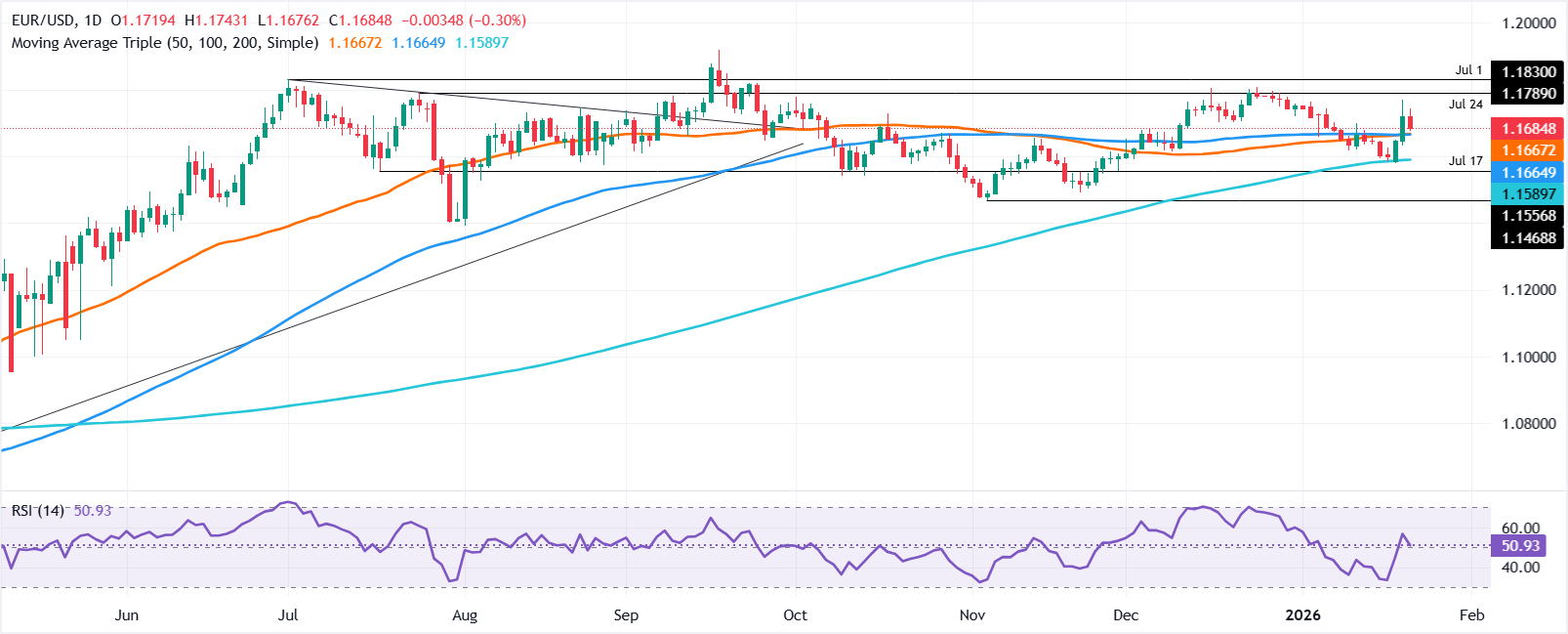
EUR/USD retreated after hitting a daily high of 1.1743, dropping below the 1.1700 figure, which opens the path for lower prices. The Relative Strength Index (RSI) shows a shift of momentum from bullish to bearish. Therefore, in the short term, the pair could test lower prices.
If EUR/USD drops below the 50-day Simple Moving Average (SMA} at 1.1662, the next support would be the 1.1600 mark ahead of the 200-day SMA at 1.1590.
Conversely if the pair climbs above 1.1700 the first resistance would be January 21 high at 1.1743, followed by the January 20 swing high at 1.1769.
Euro FAQs
The Euro is the currency for the 20 European Union countries that belong to the Eurozone. It is the second most heavily traded currency in the world behind the US Dollar. In 2022, it accounted for 31% of all foreign exchange transactions, with an average daily turnover of over $2.2 trillion a day. EUR/USD is the most heavily traded currency pair in the world, accounting for an estimated 30% off all transactions, followed by EUR/JPY (4%), EUR/GBP (3%) and EUR/AUD (2%).
The European Central Bank (ECB) in Frankfurt, Germany, is the reserve bank for the Eurozone. The ECB sets interest rates and manages monetary policy. The ECB’s primary mandate is to maintain price stability, which means either controlling inflation or stimulating growth. Its primary tool is the raising or lowering of interest rates. Relatively high interest rates – or the expectation of higher rates – will usually benefit the Euro and vice versa. The ECB Governing Council makes monetary policy decisions at meetings held eight times a year. Decisions are made by heads of the Eurozone national banks and six permanent members, including the President of the ECB, Christine Lagarde.
Eurozone inflation data, measured by the Harmonized Index of Consumer Prices (HICP), is an important econometric for the Euro. If inflation rises more than expected, especially if above the ECB’s 2% target, it obliges the ECB to raise interest rates to bring it back under control. Relatively high interest rates compared to its counterparts will usually benefit the Euro, as it makes the region more attractive as a place for global investors to park their money.
Data releases gauge the health of the economy and can impact on the Euro. Indicators such as GDP, Manufacturing and Services PMIs, employment, and consumer sentiment surveys can all influence the direction of the single currency. A strong economy is good for the Euro. Not only does it attract more foreign investment but it may encourage the ECB to put up interest rates, which will directly strengthen the Euro. Otherwise, if economic data is weak, the Euro is likely to fall. Economic data for the four largest economies in the euro area (Germany, France, Italy and Spain) are especially significant, as they account for 75% of the Eurozone’s economy.
Another significant data release for the Euro is the Trade Balance. This indicator measures the difference between what a country earns from its exports and what it spends on imports over a given period. If a country produces highly sought after exports then its currency will gain in value purely from the extra demand created from foreign buyers seeking to purchase these goods. Therefore, a positive net Trade Balance strengthens a currency and vice versa for a negative balance.
Recommended Articles


