

Japanese Yen edges lower ahead of BoJ meeting; bullish potential seems intact
- The Japanese Yen bulls opt to move to the sidelines ahead of the key BoJ meeting this week.
- Bets for an imminent BoJ rate hike on Friday and a weaker risk tone should underpin the JPY.
- Dovish Fed expectations might cap the attempted USD recovery move and the USD/JPY pair.
The Japanese Yen (JPY) edges lower during the Asian session on Wednesday as bulls turn cautious and opt to wait for the Bank of Japan (BoJ) policy update before placing fresh bets. Hence, the focus will remain glued to the outcome of a two-day BoJ meeting on Friday. Investors will look for cues about the central bank's policy path going into 2026, which will play a key role in determining the near-term trajectory for the JPY. Heading into the key central bank event, the growing acceptance of an imminent BoJ rate hike this week might continue to act as a tailwind for the JPY.
Apart from this, the prevalent risk-off environment – as depicted by a generally weaker tone around the equity markets – should contribute to limiting losses for the safe-haven JPY. The US Dollar (USD), on the other hand, struggles to capitalize on the previous day's modest recovery from its lowest level since early October amid bets for more interest rate cuts by the US Federal Reserve (Fed). This marks a significant divergence in comparison to hawkish BoJ expectations, which should benefit the lower-yielding JPY and back the case for a further depreciation for the USD/JPY pair.
Japanese Yen might continue to draw support from hawkish BoJ expectations and a softer risk tone
- The Japanese Yen attracts some sellers during the Asian session on Wednesday amid some repositioning ahead of the highly-anticipated two-day Bank of Japan policy meeting, starting on Thursday. The central bank is widely expected to raise interest rates on Friday, and the bets were reaffirmed by the recent shift in rhetoric from BoJ Governor Kazuo Ueda.
- Ueda reiterated last week that the likelihood of the central bank's baseline economic and price outlook materializing had been gradually increasing. The BoJ is getting closer to attaining its inflation target, Ueda added. This offsets concerns about Japan's deteriorating fiscal condition, amid Prime Minister Sanae Takaichi's massive spending plan, and should underpin the JPY.
- The global risk sentiment remains on the defensive amid renewed worries about the health of China's economy and fears of the AI bubble burst. Moreover, the mixed US Nonfarm Payrolls report released on Tuesday fueled concerns about deteriorating labor market conditions in the world's largest economy and also tempered investors' appetite for perceived riskier assets.
- The US Bureau of Labor Statistics (BLS) reported that the economy added 64K jobs in November against consensus estimates for an increase of 50K. In contrast, October payrolls declined by 105K, while September job gains were revised down to 108K from the initial estimate of 119K. Adding to this, the Unemployment Rate climbed to 4.6% from 4.4% in the previous month.
- The data reaffirmed bets for further policy easing by the US Federal Reserve. In fact, traders are pricing in the possibility of two more interest rate cuts by the US central bank in 2026. This, in turn, keeps a lid on the overnight US Dollar recovery from a two-and-a-half-month low and suggests that the path of least resistance for the USD/JPY pair remains to the downside.
- Traders now look forward to speeches from influential FOMC members for more cues about the Fed's rate-cut path, though the market attention will be on the latest US consumer inflation figures on Thursday. Apart from this, the outcome of a two-day BoJ policy meeting on Friday will play a key role in determining the next leg of a directional move for the USD/JPY pair.
USD/JPY seems vulnerable to retest the monthly swing low, around the 154.35-154.30 region
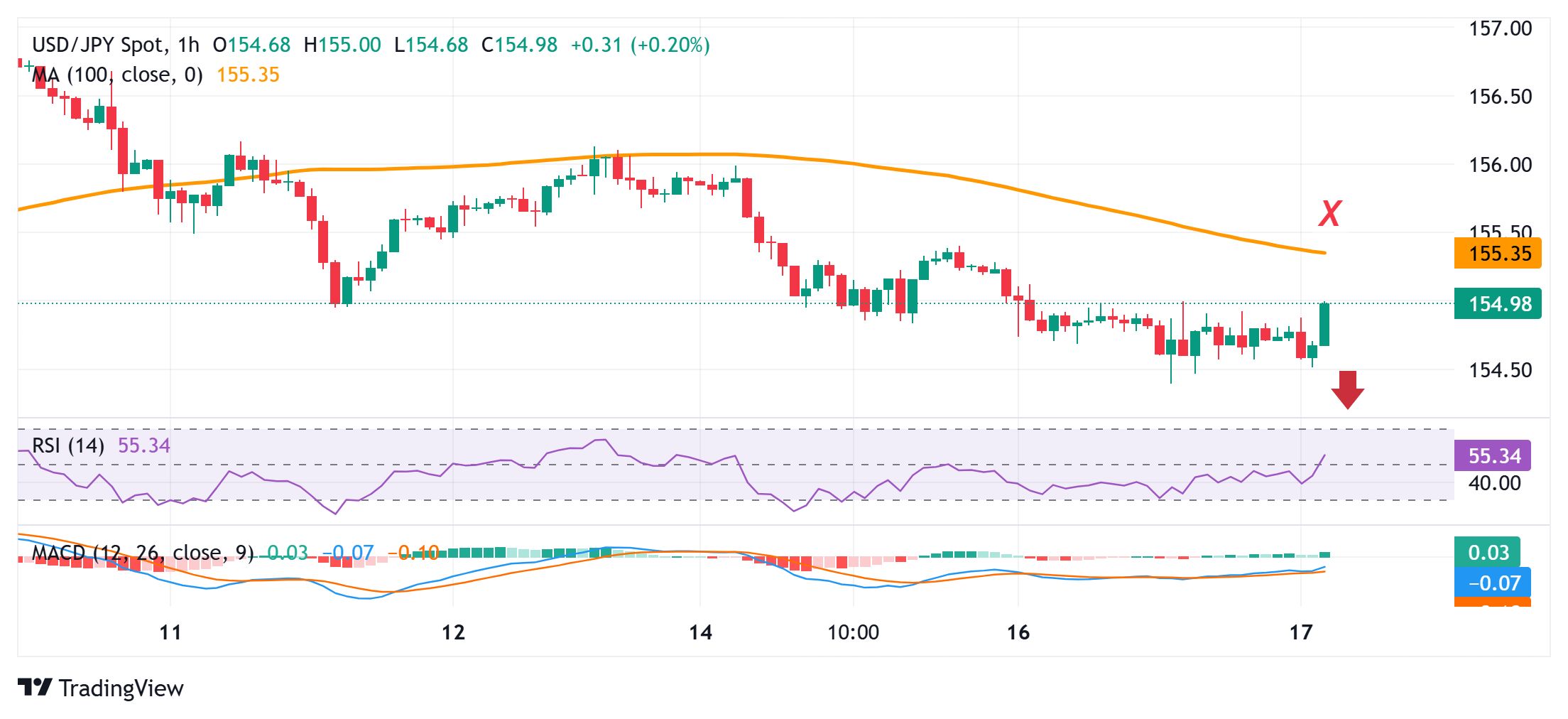
Against the backdrop of the USD/JPY pair's recent decline witnessed over the past week or so, the range-bound price action might still be categorized as a bearish consolidation phase. Moreover, oscillators on the daily chart have just started gaining negative traction, validating the near-term negative outlook for spot prices. Hence, weakness back towards retesting the monthly low, around the 154.35-154.30 region, en route to the 154.00 mark, looks like a distinct possibility. A convincing break below the latter will mark a fresh breakdown and pave the way for deeper losses.
On the flip side, the overnight swing high, around the 155.20-155.25 region, nearing the 100-hour Simple Moving Average (SMA), now seems to act as an immediate hurdle. A sustained strength beyond could trigger a bout of a short-covering rally and allow the USD/JPY pair to reclaim the 156.00 mark. The momentum could extend further towards the monthly swing high, around the 157.00 neighborhood, touched last week.
Japanese Yen FAQs
The Japanese Yen (JPY) is one of the world’s most traded currencies. Its value is broadly determined by the performance of the Japanese economy, but more specifically by the Bank of Japan’s policy, the differential between Japanese and US bond yields, or risk sentiment among traders, among other factors.
One of the Bank of Japan’s mandates is currency control, so its moves are key for the Yen. The BoJ has directly intervened in currency markets sometimes, generally to lower the value of the Yen, although it refrains from doing it often due to political concerns of its main trading partners. The BoJ ultra-loose monetary policy between 2013 and 2024 caused the Yen to depreciate against its main currency peers due to an increasing policy divergence between the Bank of Japan and other main central banks. More recently, the gradually unwinding of this ultra-loose policy has given some support to the Yen.
Over the last decade, the BoJ’s stance of sticking to ultra-loose monetary policy has led to a widening policy divergence with other central banks, particularly with the US Federal Reserve. This supported a widening of the differential between the 10-year US and Japanese bonds, which favored the US Dollar against the Japanese Yen. The BoJ decision in 2024 to gradually abandon the ultra-loose policy, coupled with interest-rate cuts in other major central banks, is narrowing this differential.
The Japanese Yen is often seen as a safe-haven investment. This means that in times of market stress, investors are more likely to put their money in the Japanese currency due to its supposed reliability and stability. Turbulent times are likely to strengthen the Yen’s value against other currencies seen as more risky to invest in.
Recommended Articles


