

When are the German/ Eurozone flash HCOB PMIs and how could they affect EUR/USD?
German/ Eurozone flash PMIs Overview
The preliminary German and Eurozone flash HCOB Purchasing Managers’ Index (PMI) data for December is due for release today at 08:30 and 09:00 GMT, respectively.
Amongst the Euro area economies, the German and the composite Eurozone PMI reports hold more relevance, in terms of their impact on the European currency and the related markets as well.
The flash Composite PMI for Germany is expected to come in slightly weaker due to a slowdown in the service sector activity. However, the overall business output is anticipated to hold above the 50.0 threshold, a level that separates expansion from contraction.
Preliminary Services PMI is seen at 52.8, lower than 53.1 in the final reading from November. The Manufacturing PMI is expected to have contracted again, but at a slower pace, to 48.5 from the prior reading of 48.2.
The forecast for the Eurozone flash Composite PMI shows that the overall private sector output increased at a faster pace in December due to an improvement in both manufacturing and the services sector activity. The Services PMI is seen at 53.9, up from 53.6 in November. Like the German Manufacturing PMI, the manufacturing activity in the old continent has contracted too, but at a moderate pace to 49.9 from the previous release of 49.6.
How could German/ Eurozone flash PMIs affect EUR/USD?
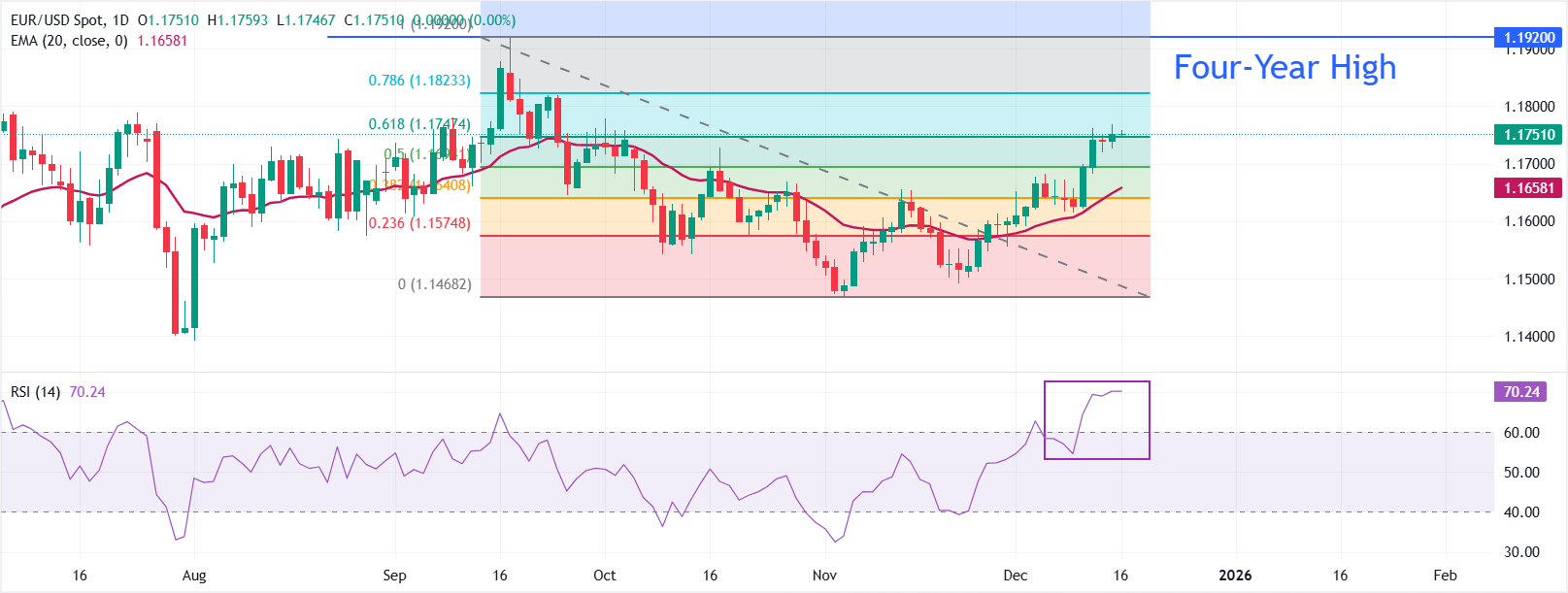
EUR/USD trades flat around 1.1750 as of writing ahead of the German/Eurozone PMI data. The 20-day Exponential Moving Average (EMA) at 1.1658 slopes higher and stays below the spot, keeping the short-term bias upward and offering initial support. A sustained hold above the 20-day EMA would preserve bullish momentum.
The 14-day Relative Strength Index (RSI) at 70.22 is near overbought levels, flagging stretched upside.
Measured from the 1.1920 high to the 1.1468 low, the stop wobbles around the 61.8% retracement at 1.1747. Going forward, a break above the same would unlock the 78.6% retracement at 1.1823. On setbacks, the rising 20-day EMA is expected to support the move. However, a close beneath it would soften the tone that might make it vulnerable towards the round-level figure of 1.1600.
(The technical analysis of this story was written with the help of an AI tool)
German economy FAQs
The German economy has a significant impact on the Euro due to its status as the largest economy within the Eurozone. Germany's economic performance, its GDP, employment, and inflation, can greatly influence the overall stability and confidence in the Euro. As Germany's economy strengthens, it can bolster the Euro's value, while the opposite is true if it weakens. Overall, the German economy plays a crucial role in shaping the Euro's strength and perception in global markets.
Germany is the largest economy in the Eurozone and therefore an influential actor in the region. During the Eurozone sovereign debt crisis in 2009-12, Germany was pivotal in setting up various stability funds to bail out debtor countries. It took a leadership role in the implementation of the 'Fiscal Compact' following the crisis – a set of more stringent rules to manage member states’ finances and punish ‘debt sinners’. Germany spearheaded a culture of ‘Financial Stability’ and the German economic model has been widely used as a blueprint for economic growth by fellow Eurozone members.
Bunds are bonds issued by the German government. Like all bonds they pay holders a regular interest payment, or coupon, followed by the full value of the loan, or principal, at maturity. Because Germany has the largest economy in the Eurozone, Bunds are used as a benchmark for other European government bonds. Long-term Bunds are viewed as a solid, risk-free investment as they are backed by the full faith and credit of the German nation. For this reason they are treated as a safe-haven by investors – gaining in value in times of crisis, whilst falling during periods of prosperity.
German Bund Yields measure the annual return an investor can expect from holding German government bonds, or Bunds. Like other bonds, Bunds pay holders interest at regular intervals, called the ‘coupon’, followed by the full value of the bond at maturity. Whilst the coupon is fixed, the Yield varies as it takes into account changes in the bond's price, and it is therefore considered a more accurate reflection of return. A decline in the bund's price raises the coupon as a percentage of the loan, resulting in a higher Yield and vice versa for a rise. This explains why Bund Yields move inversely to prices.
The Bundesbank is the central bank of Germany. It plays a key role in implementing monetary policy within Germany, and central banks in the region more broadly. Its goal is price stability, or keeping inflation low and predictable. It is responsible for ensuring the smooth operation of payment systems in Germany and participates in the oversight of financial institutions. The Bundesbank has a reputation for being conservative, prioritizing the fight against inflation over economic growth. It has been influential in the setup and policy of the European Central Bank (ECB).
Recommended Articles


