

USD/INR ticks up despite strong India’s Q3 GDP data
- The Indian Rupee edges down against the US Dollar due to the continuous foreign outflow from the Indian equity market.
- India’s GDP growth surprisingly remained stronger at 8.2% in the third quarter.
- Investors await the US ISM Manufacturing PMI data for November.
The Indian Rupee (INR) ticks lower against the US Dollar (USD) after a flat opening at the start of the week. The USD/INR pair edges up to near 89.65 as the Indian Rupee struggles to attract bids, with consistent foreign outflows offsetting the impact of robust India’s Q3 Gross Domestic Product (GDP) growth.
Foreign Institutional Investors (FIIs) have turned out to be net sellers in the last five months starting July, dumping stakes in the Indian stock market worth Rs. 1,49,718.16 crore.
Currencies from developing economies are significantly impacted by diminishing confidence of overseas investors into their economy.
On Friday, India’s Ministry of Statistics reported that the economy expanded at a robust pace of 8.2% on an annualized basis in the third quarter of the year, faster than expectations of 7.3% and the prior reading of 7.8%. This was the fastest growth seen in over six quarters.
Market experts have credited government’s announcements of lower direct and indirect taxes that led to robust consumer spending in the third quarter, and have become mixed over whether the Reserve Bank of India (RBI) will cut its Repo Rate in its upcoming monetary policy announcement on Friday.
Economists at Citi expect the RBI to leave rates unchanged this week, diverging from the consensus call for a 25-basis point rate cut.
Daily digest market movers: Investors await US ISM Manufacturing PMI data for November
- The Indian Rupee remains under pressure against the US Dollar, even as the latter trades cautiously amid firm expectations that the Federal Reserve (Fed) will cut interest rates in its monetary policy announcement on December 10.
- At press time, the US Dollar Index (DXY), which tracks the Greenback’s value against six major currencies, trades close to near the two-week low around 99.40.
- According to the CME FedWatch tool, the probability of the Fed to cut interest rates by 25 basis points (bps) to 3.50%-3.75% in December is 87.4%.
- Fed’s dovish speculation intensified last week after New York Fed Bank President John Williams supported the need for another interest rate cut in December, citing labour market risks. “I view monetary policy as being modestly restrictive, although somewhat less so than before our recent actions, adding that there is room for a further adjustment in the near term,” Williams said, CNBC reported.
- Meanwhile, rising expectations among investors that White House economic adviser Kevin Hassett could be chosen to replace Chair Jerome Powell have dampened the outlook of the US Dollar and bond yields. Over the weekend, Hassett stated in an interview on Fox News that he would be happy to be chosen as the next Fed chairman.
- The selection of White House economic adviser Hassett would be unfavourable for the US Dollar, assuming that his decisions will be influenced by US President Donald Trump’s economic agenda. "Hassett will be viewed as less independent, which creates some risk to the dollar as well as risks to a steeper Treasury yield curve,” analysts at Facet said.
- In Monday’s session, investors will focus on the US ISM Manufacturing Purchasing Managers’ Index (PMI) data for November, which will be published at 15:00 GMT. The agency is expected to report that the Manufacturing PMI contracted at a faster pace to 48.6 from 48.7 in October.
Technical Analysis: USD/INR holds key 20-day EMA
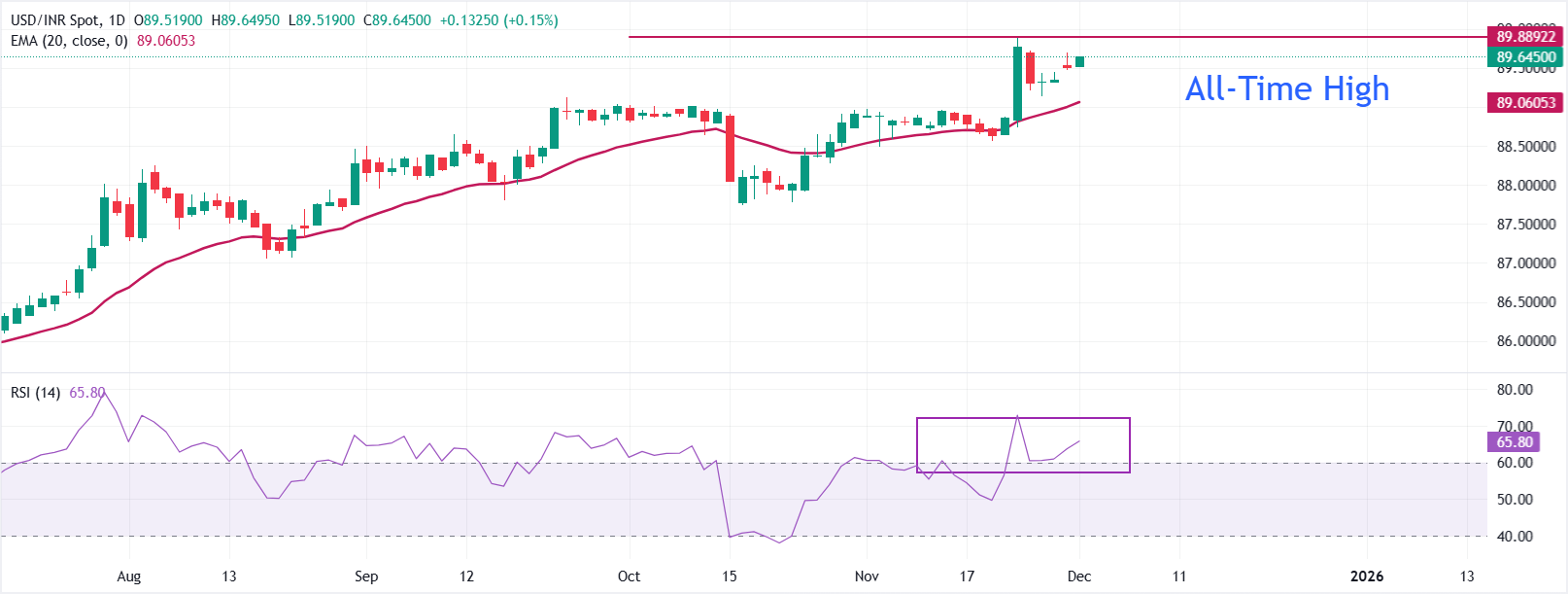
In the daily chart, USD/INR trades at 89.6450. The 20-day EMA climbs and remains below price, reinforcing a bullish bias and keeping the uptrend intact while above the average. RSI at 65.80 (bullish) has risen in recent sessions, confirming improving momentum. Initial support sits at the 20-day EMA at 89.0605.
Momentum stays firm as buyers defend higher ground, though a push into overbought territory could prompt short-lived consolidation. Pullbacks could be contained by support at 89.0605–88.9450. A sustained close above the rising average would keep gains unfolding, whereas a break beneath that zone would shift risk toward a deeper retracement.
(The technical analysis of this story was written with the help of an AI tool)
Indian Rupee FAQs
The Indian Rupee (INR) is one of the most sensitive currencies to external factors. The price of Crude Oil (the country is highly dependent on imported Oil), the value of the US Dollar – most trade is conducted in USD – and the level of foreign investment, are all influential. Direct intervention by the Reserve Bank of India (RBI) in FX markets to keep the exchange rate stable, as well as the level of interest rates set by the RBI, are further major influencing factors on the Rupee.
The Reserve Bank of India (RBI) actively intervenes in forex markets to maintain a stable exchange rate, to help facilitate trade. In addition, the RBI tries to maintain the inflation rate at its 4% target by adjusting interest rates. Higher interest rates usually strengthen the Rupee. This is due to the role of the ‘carry trade’ in which investors borrow in countries with lower interest rates so as to place their money in countries’ offering relatively higher interest rates and profit from the difference.
Macroeconomic factors that influence the value of the Rupee include inflation, interest rates, the economic growth rate (GDP), the balance of trade, and inflows from foreign investment. A higher growth rate can lead to more overseas investment, pushing up demand for the Rupee. A less negative balance of trade will eventually lead to a stronger Rupee. Higher interest rates, especially real rates (interest rates less inflation) are also positive for the Rupee. A risk-on environment can lead to greater inflows of Foreign Direct and Indirect Investment (FDI and FII), which also benefit the Rupee.
Higher inflation, particularly, if it is comparatively higher than India’s peers, is generally negative for the currency as it reflects devaluation through oversupply. Inflation also increases the cost of exports, leading to more Rupees being sold to purchase foreign imports, which is Rupee-negative. At the same time, higher inflation usually leads to the Reserve Bank of India (RBI) raising interest rates and this can be positive for the Rupee, due to increased demand from international investors. The opposite effect is true of lower inflation.
Recommended Articles


