


Hot Take: President Donald Trump Is Going to Miss Former Fed Chair Jerome Powell More Than He Thinks
Key Points
The new Fed chair will face the difficult task of appeasing the president and dealing with a divided Federal Open Market Committee.
It will not be easy for Warsh to cut rates right away.
While hard to know right now, it's possible Warsh's policies will not be so great for the stock market.
- These 10 stocks could mint the next wave of millionaires ›
Kevin Warsh is officially the new chair of the Federal Reserve's Board of Governors. He takes over for Jerome Powell, who was appointed by President Donald Trump during his first term as president and plans to remain on the board.
Trump and Powell's relationship quickly soured during Trump's second term because the Fed didn't cut interest rates as fast as Trump desired.
Will AI create the world's first trillionaire? Our team just released a report on the one little-known company, called an "Indispensable Monopoly" providing the critical technology Nvidia and Intel both need. Continue »
The U.S. Justice Department eventually subpoenaed Powell over comments he made about the Fed's new construction of its Washington, D.C., headquarters, sparking a very public feud between the two that ultimately led Powell to decide to stay on the board.
While no love will be lost between the two, I do think Trump may miss Powell as chair more than he thinks.
Warsh will have a difficult time cutting interest rates right away
It's really difficult right now to know exactly what Warsh will do now that he's been confirmed as chair.
Warsh is a Wall Street veteran with a storied career, having spent many years in investment banking, a prior stint at the Fed, and as a consultant and partner to Stanley Druckenmiller's family office. But he also wants to reform the Fed.
During the nomination and confirmation process, Warsh did make a case for cutting interest rates. His argument was essentially that artificial intelligence-driven productivity gains would be deflationary, keeping prices in check and paving the way for the Fed to cut.
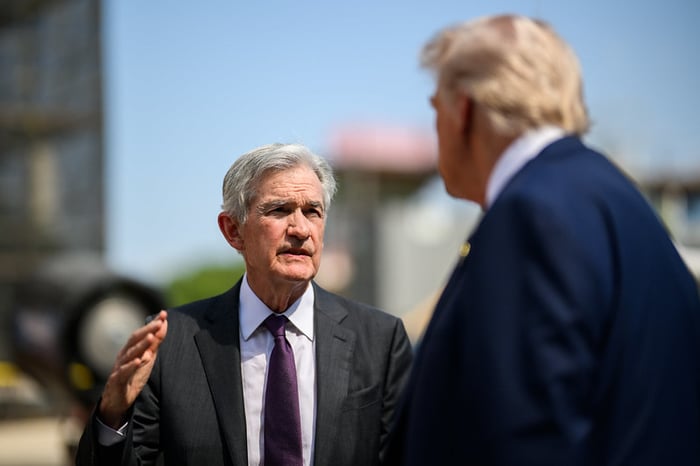
Official White House photo by Daniel Torok.
But during his Congressional testimony on April 22, his opinion on rates was harder to read. Warsh said the Fed's benchmark overnight lending rate could be lower, but he also said, "The trajectory on inflation is improving, but there's more work to do."
That was before the recent release of April inflation data that came in hotter than expected. Given this data, it is likely harder for Warsh to cut rates at the Fed's June meeting unless there is a big shift in the May inflation data, which will be released in June.
Additionally, based on the rate-setting Federal Open Market Committee's (FOMC) April meeting minutes, the 12 voting members do not seem close to cutting interest rates anytime soon. The only member who wanted to cut rates at the April meeting, Stephen Miran, just had to resign from the Fed board to make room for Warsh.
Three other members dissented because they believed the FOMC's policy statement was too dovish.
So, if the composition of the FOMC voting members remains the same, it will be very difficult for Warsh to advocate for a rate cut at the FOMC's June meeting, because the chair's job is to build consensus on the FOMC.
In fact, according to the Federal Reserve Bank of St. Louis, only one chair of the Federal Reserve Board of Governors has ever dissented at a Fed meeting. It was Fed Chair Marriner Eccles, who served from 1934 to 1948 and dissented three times in the late 1930s.
Trump has told the media he would be disappointed if Warsh doesn't cut rates right away.
There's also no proof that Warsh will be more dovish than Powell. Powell not only waited too long to raise rates after the pandemic in 2022, but the FOMC cut rates several times last year. Powell has also not moved to further increase rates, despite inflation remaining above the Fed's preferred 2% target for some time.
Warsh wants the Fed to be less impactful on the stock market
Warsh has also strongly disapproved of the Fed and U.S. government's money printing, mostly through quantitative easing (QE), in which the Fed purchases government bonds and mortgage-backed securities (MBSes) to expand its balance sheet, essentially injecting the economy with liquidity.
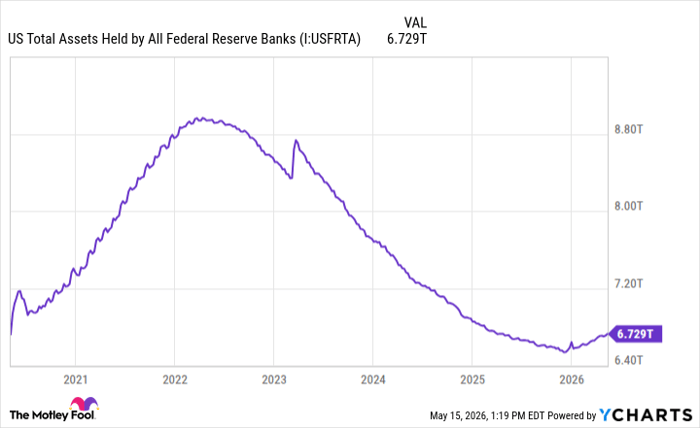
This was done significantly during the Great Recession and the COVID-19 pandemic. At one point, the Fed's balance sheet had swelled to $9 trillion.
Warsh is not a fan of this because he believes this type of monetary policy disproportionately helps people who own significant assets. Lower interest rates are more beneficial to everyone, he has said.
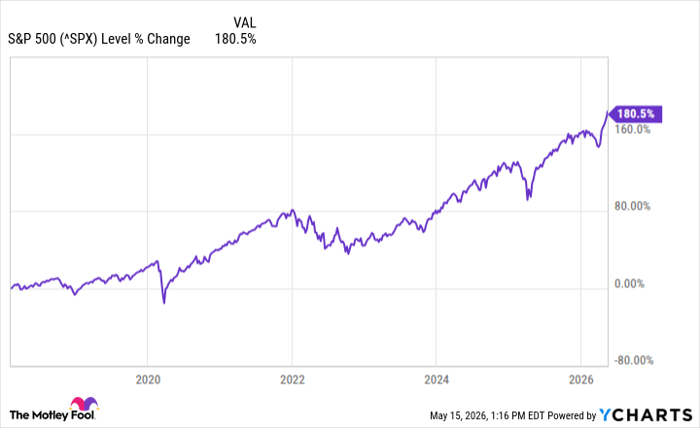
However, QE can be quite addicting for the economy, and many attribute the stock market's strong returns since the Great Recession in part to QE. In fact, many investors are big fans of Powell, and rushed to his defense after he got subpoenaed.
Look how well the market has performed since Powell became chair in 2018.
^SPX data by YCharts
Now, there's clearly more to the market's ascent than just QE, and Powell has certainly been more hawkish at times.
Powell tried to shrink the balance sheet in 2018 and 2019, but too many reserves were drained, forcing the Fed to step in and inject liquidity. The Fed has also shrunk the balance sheet by close to $2 trillion during the past several years.
US Total Assets Held by All Federal Reserve Banks data by YCharts
Warsh seems much more committed not only to running down the asset side of the balance sheet, but also to limiting the central bank's forward guidance regarding how the Fed is thinking about interest rates and the balance sheet.
Under Powell, the Fed has been pretty transparent and has not tried to surprise the market.
Ultimately, I think Warsh makes some interesting points worth exploring, and that most members of the Fed are economists at heart, interested only in looking at the data and doing what's best for the economy. But unless the data changes abruptly, it's likely going to be difficult for Warsh to cut rates immediately.
Furthermore, Warsh seems very committed to reversing QE, which may not be so conducive to bull markets. Only time will tell what happens between Trump and Warsh, but I do think Trump could end up missing Powell more than he thinks.
Where to invest $1,000 right now
When our analyst team has a stock tip, it can pay to listen. After all, Stock Advisor’s total average return is 993%* — a market-crushing outperformance compared to 207% for the S&P 500.
They just revealed what they believe are the 10 best stocks for investors to buy right now, available when you join Stock Advisor.
See the stocks »
*Stock Advisor returns as of May 19, 2026.
The Motley Fool has a disclosure policy.
Recommended Articles


