


Standard Chartered Hits New High, Will Banking Jobs Face Replacement Crisis Under AI Impact?
TradingKey - During the Asian trading session on May 19, Standard Chartered PLC (02888.HK) rose more than 4% intraday to HK$201.80, with its year-to-date cumulative gain exceeding 5%.

[Standard Chartered outlines sustainable growth plan, Source: Standard Chartered PLC]
Meanwhile, the bank announced a plan to cut more than 15% of its back-office positions by 2030, involving approximately 7,800 jobs and affecting functional departments such as HR, risk, and compliance across three global hubs: Bangalore, Shenzhen, and Warsaw. Previously, Citigroup planned to cut about 20,000 roles by the end of 2026, which would reduce its global workforce by approximately 8%.
In the first quarter of 2026, the six largest Wall Street banks collectively cut 15,000 jobs. This data indicates that AI is gradually impacting the rational allocation of resources across various industries.
Why Are Investors Cheering for Layoffs?
The rise in Standard Chartered's share price following the layoff announcement indicates that investors are cheering as banks aggressively cut their workforce.
CEO Bill Winters stated at a briefing in Hong Kong that the layoffs are 'not simply about cost reduction, but in some cases, replacing low-value human capital with the financial and investment capital we have deployed.'
This is not the first time banks have identified AI as a core path for performance growth. While the six largest Wall Street banks collectively cut jobs in the first quarter, they recorded a combined profit of $47 billion—an 18% year-on-year increase—as CEOs no longer hide AI's direct contribution to headcount reduction.
Bank of America's AI assistant, Erica, saves labor equivalent to 11,000 full-time positions annually, and nearly 90% of its 213,000 employees are using internal versions of AI tools. Wells Fargo CEO Charlie Scharf stated bluntly that anyone claiming AI will not shrink staff levels is 'either ill-informed or dishonest.'
Behind the sustained growth in bank profits, AI is systematically eliminating 'repetitive, routine, and labor-intensive' roles.
A Bloomberg survey predicts that the global banking industry will cut as many as 200,000 jobs over the next three to five years, requiring more than half of all bank workers to reassess their human value proposition.
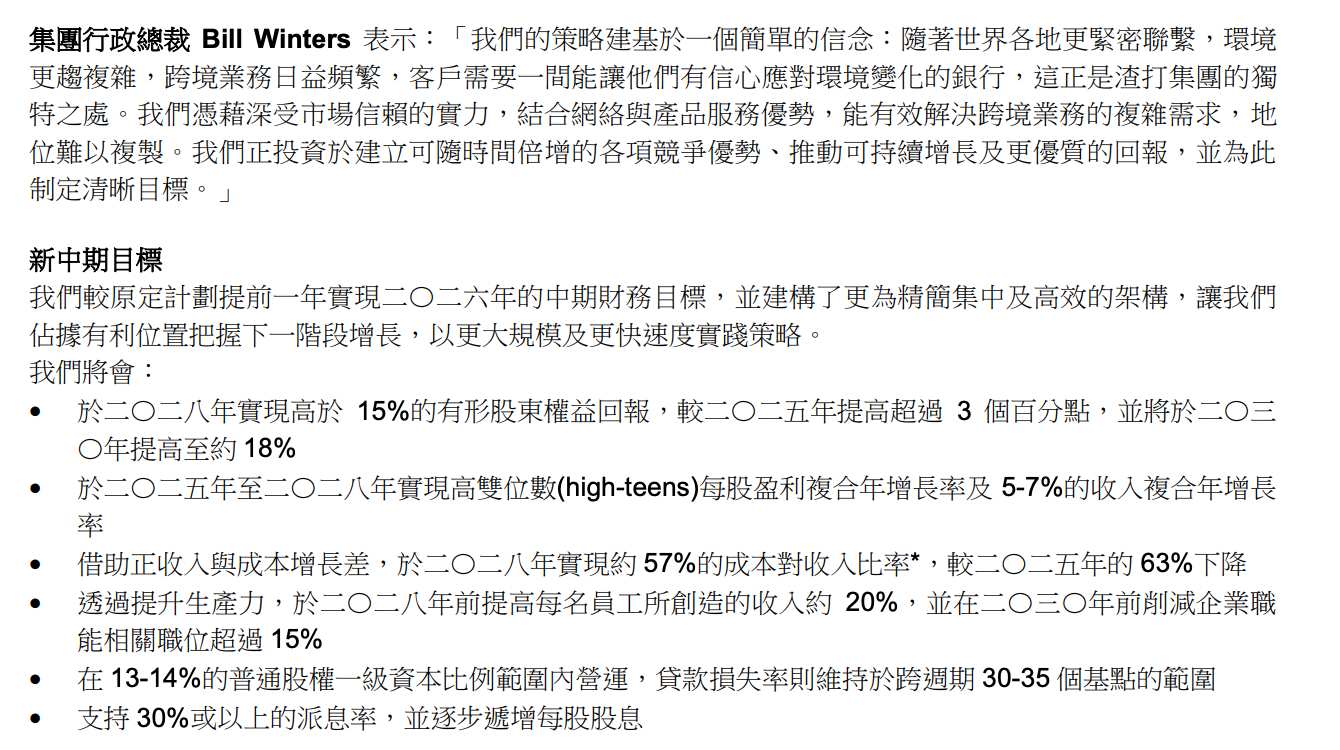
[Standard Chartered Outlines Sustainable Growth Plan; Source: Standard Chartered Group]
Furthermore, Standard Chartered announced in its statement that it has achieved its 2026 medium-term financial targets one year ahead of schedule and has raised its Return on Tangible Equity (RoTE) target from below 12% in 2025 to above 15% by 2028, with a further increase to approximately 18% by 2030.
Which traditional roles will AI replace?
The first functional area targeted by AI’s precision strikes is back-office support systems centered on process execution.
Standard Chartered’s layoff plans directly target back-office support functions such as human resources, risk, and compliance—roles that were previously considered a "stable" middle-to-back office employment pool.
Over the next five years, the groups most affected will include operational support, data processing, and basic customer service roles. The common characteristic of these positions is the completion of repetitive tasks following standardized instructions, rather than providing personalized decision-making or customer interaction.
The U.S. Bureau of Labor Statistics predicts that bank teller employment will shrink by approximately 13% over the next decade, while middle-to-back end positions such as loan servicing representatives and quality assurance administrators are being replaced en masse.
In contrast to the contraction in back-office roles, customer relationship-facing positions are on the rise. Data from JPMorgan Chase shows that productivity in AI-adopting departments has increased by approximately 6%, with operational roles cut by 4%, while customer interaction and revenue-generating roles have grown by 4%. JPMorgan Chase ( JPM) CEO Jamie Dimon calls this process a "large-scale redeployment," where humans no longer simply execute operations but instead serve as the faces customers trust.
Why Capital Markets Embrace Layoffs?
In the words of CEO Bill Winters, "substituting financial capital for human capital" means reinvesting saved labor costs into AI infrastructure and automated systems. JPMorgan Chase's technology spending alone is set to reach $19.8 billion in 2026, a $2 billion increase from the previous year.
Short-term investments have increased expenses, but the market believes the long-term logic of "capital for labor" is sound: smarter systems, fewer employees, faster response times, and higher profit margins.
Wall Street has also noted that major banks at the forefront of large-scale AI labor replacement have outperformed their peers in profit growth. First-quarter profits for the six largest Wall Street banks rose 18% year-over-year, while regional banks that did not significantly implement AI-related layoffs generally saw much lower growth rates.
Bank of America CEO Brian Moynihan listed "headcount alignment" as a top operating lever, while Citi stated in January that layoffs reflected "efficiency gains driven by technology." The banking AI race has shifted toward "who can transform their organization with AI faster" to enhance overall operational performance.
Recommended Articles


