


Seagate Shares Tumble Nearly 7% Monday, Dragging Down Memory Chip Sector; Is the Memory Chip Sector Set for a Major Correction?
TradingKey - Amid the AI-driven demand for storage chips, Seagate Technology ( STX) saw its stock sold off due to management's cautious remarks regarding the pace of capacity expansion.
The latest reports indicate that Seagate CEO Dave Mosley stated at a JPMorgan conference that building new factories is too time-consuming, and investing in expansion now could even lead to overcapacity after demand peaks.
Following the news, Seagate's stock price fell more than 8% intraday on Monday and closed down 6.87%, marking its largest decline in nearly two months; other stocks in the storage chip sector weakened in tandem, with Micron ( MU) falling 5.95%, SanDisk ( SNDK) falling 5.35%, and Western Digital ( WDC) falling 4.84%.
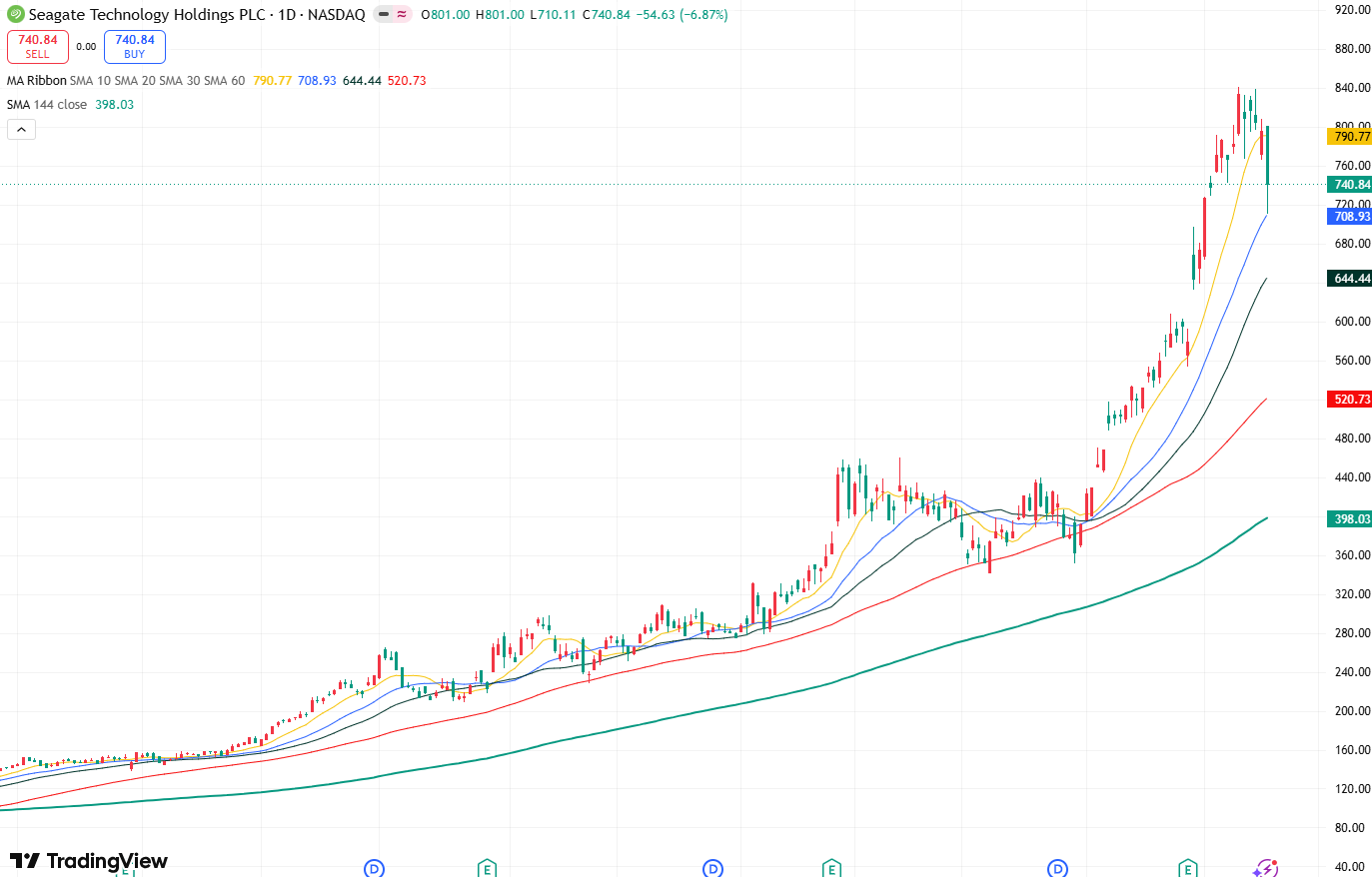
Seagate Technology daily stock price chart, Source: TradingView
The reason these remarks triggered a rapid correction is that the market had previously viewed Seagate as a direct beneficiary of AI storage demand. On April 28, Seagate released optimistic guidance, causing its stock to surge about 16% after hours and leading a broad rally in the storage chip sector.
Management at both Seagate and Western Digital have stated that capacity through 2026 has been largely allocated and sold out, as AI infrastructure build-outs continue to drive data storage demand. Morgan Stanley also named Seagate as a top pick in IT hardware, suggesting that the supply-demand tightness in the HDD and storage industry could persist until at least 2028.
However, Dave Mosley's cautious stance this time sparked concerns that the company would not use capacity expansion to further amplify earnings elasticity in the short term, prompting profit-taking by short-term holders and leading to the stock price decline.
From the perspective of the storage chip sector's overall performance, this adjustment does not signify a weakening of industry fundamentals. Since the beginning of the year, the storage chip sector has performed exceptionally well, with Seagate's year-to-date gain reaching 169% at one point, Western Digital up about 166%, Micron up about 138%, and SanDisk surging over 500%. These companies have all been favored by investors due to the sustained demand for high-bandwidth storage, hard drives, and flash memory from AI data centers. Monday's decline appears more like normal profit-taking rather than a debunking of the demand narrative.
Looking ahead, the storage chip sector remains strong in terms of AI demand, but slow supply expansion both supports prices and limits the market's room for imagination. Consequently, any statements regarding capacity cadence, capital expenditures, and factory construction cycles are viewed as pricing signals by investors. In the short term, Seagate's pullback has weighed on sentiment across the entire storage sector; in the medium term, as long as AI infrastructure investment continues, the storage industry remains in a cycle of tight supply and demand.
Recommended Articles


