


This 7.2% Yield Is Safe and On Stronger Ground Than It Seems
Key Points
Conagra has a huge 9.9% dividend yield, while General Mills' yield is 7.2%.
Dividend investors should tread with caution with one of these food makers, but the other could be a long-term opportunity.
Investors need to consider payout ratios, financial strength, and business fundamentals before buying.
- 10 stocks we like better than Conagra Brands ›
Consumer buying habits are shifting in a healthier direction. Inflation has been rising, in part due to high energy prices. And consumers are increasingly tightening their budgets. Food makers like Conagra (NYSE: CAG) and General Mills (NYSE: GIS) are facing a challenging business backdrop.
That helps explain why the price of both stocks is down materially. And why their dividend yields are shockingly high, sitting at 9.9% for Conagra and 7.2% for General Mills. Of the two, General Mills is probably the better choice for dividend lovers. But a comparison of the two companies will help explain why.
Will AI create the world's first trillionaire? Our team just released a report on the one little-known company, called an "Indispensable Monopoly" providing the critical technology Nvidia and Intel both need. Continue »
What does that big dividend cost?
Conagra has taken material one-time charges over the past three quarters, pushing its earnings through the first nine months of fiscal 2026 deep into negative territory. As a result, the payout ratio is negative, meaning the food maker's earnings don't cover the dividend.

Image source: Getty Images.
However, if you look at the fiscal third quarter's $0.42 adjusted earnings, which exclude one-time charges, Conagra is covering its $0.35 per share dividend. Moreover, for the full fiscal year, the company expects adjusted earnings of $1.70 per share, which will easily cover the full-year dividend of $1.40 per share. That equates to a payout ratio of around 80%.
General Mills' trailing 12-month payout ratio is roughly 60%. That said, the company's fiscal third-quarter 2026 adjusted earnings came in at $0.64, while the quarterly dividend was $0.61 per share. That's a bit tighter than Conagra's adjusted earnings dividend coverage.
That said, dividends are paid out of cash flows, not earnings. Both companies have cash dividend payout ratios, a metric that compares dividends to cash flow, of around 80%. So each of these consumer staples companies is covering its dividend payment, but it is eating up a lot of cash.
General Mills has a stronger business
Given the difficult backdrop, neither Conagra nor General Mills is exactly a low-risk dividend investment right now. However, General Mills has been a much more reliable dividend payer, having paid uninterrupted dividends for 127 years. Over the past 30 years, the dividend has trended generally higher, even though it hasn't been increased annually. Conagra cut its dividend in 2006, notably before the Great Recession, so the deep business downturn doesn't provide any cover.
Conagra's debt-to-equity ratio is roughly 0.9x, which is much lower than General Mills' 1.5x. However, General Mills has long operated with more leverage. It covered its trailing 12-month interest expenses 5.1x, compared with Conagra's 3.5x, hinting that General Mills is actually in a stronger financial position. That view is backed by General Mills' historically higher profit margins.
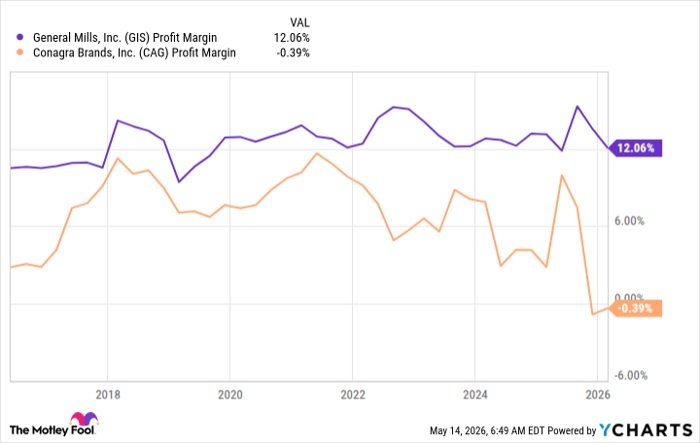
GIS Profit Margin data by YCharts
This brings the comparison to each company's business focus. General Mills has a long history of managing its brand portfolio effectively, continually adjusting it to include industry-leading products. Conagra, by comparison, tends to own more secondary brands. That's not bad, per se, but Conagra doesn't really have the same portfolio strength as General Mills. When dealing with companies facing headwinds, it is usually best to stick with those with the strongest businesses.
The risk/reward trade-off is better with General Mills
Conagra and General Mills both face business challenges right now. That's pushed their stocks lower and their yields higher. General Mills, however, has a stronger financial foundation, a stronger business focus, a more impressive dividend history, and equally strong, if not better, dividend safety. For dividend investors willing to buy while others are selling, General Mills and its 7.2% yield will probably be the better option. Simply put, its lofty yield looks safe, and the dividend is likely on stronger ground than it seems.
Should you buy stock in Conagra Brands right now?
Before you buy stock in Conagra Brands, consider this:
The Motley Fool Stock Advisor analyst team just identified what they believe are the 10 best stocks for investors to buy now… and Conagra Brands wasn’t one of them. The 10 stocks that made the cut could produce monster returns in the coming years.
Consider when Netflix made this list on December 17, 2004... if you invested $1,000 at the time of our recommendation, you’d have $469,293!* Or when Nvidia made this list on April 15, 2005... if you invested $1,000 at the time of our recommendation, you’d have $1,381,332!*
Now, it’s worth noting Stock Advisor’s total average return is 993% — a market-crushing outperformance compared to 207% for the S&P 500. Don't miss the latest top 10 list, available with Stock Advisor, and join an investing community built by individual investors for individual investors.
See the 10 stocks »
*Stock Advisor returns as of May 17, 2026.
Reuben Gregg Brewer has positions in General Mills. The Motley Fool has no position in any of the stocks mentioned. The Motley Fool has a disclosure policy.
Recommended Articles


